
The biggest mistake UK homeowners make isn’t choosing the wrong renovation, but funding projects that push their property’s value beyond what the local market will ever pay.
- Loft conversions and kitchen-diner extensions offer the highest ROI, often adding up to 15-20% to your home’s value.
- Hyper-personal or dated decor (like coloured bathroom suites) can actively deter buyers and reduce offers by signalling expensive work is needed.
Recommendation: Before spending a penny, calculate your street’s ‘value ceiling’ to define your maximum budget and ensure a profitable sale.
As a homeowner preparing to sell, your primary objective is clear: maximise your property’s sale price to secure the highest possible return on your investment. The conversation inevitably turns to pre-sale renovations. Common wisdom suggests a fresh coat of paint or a modernised kitchen will always add value. But this simplistic view often leads to costly missteps and, in the worst cases, financial loss. Many homeowners invest thousands in improvements that, while beautiful, offer a negligible or even negative return upon sale.
The problem lies in treating renovation as a matter of taste rather than a calculated financial strategy. But what if the key to a profitable renovation wasn’t about adding the most expensive features, but about understanding the absolute financial limits of your specific location? What if the most crucial calculation you could make happens before you even pick up a tool? This is the core of smart property investment: shifting focus from “what can I add?” to “what will the market actually pay for?”.
This guide moves beyond generic advice. We will dissect the most common renovation projects through the uncompromising lens of return on investment (ROI). We’ll establish the non-negotiable first step of identifying your property’s ‘value ceiling’, compare the real-world value of kitchens versus extra bedrooms, and pinpoint the specific decor mistakes that can kill a deal instantly. Finally, we’ll lay out a strategic timeline and explore how to transform your home from a place you live into a high-performing financial asset.
This article provides a detailed roadmap for making strategic renovation decisions. Below is a summary of the key areas we will cover to help you navigate your project with a focus on maximum financial return.
Summary: Maximising Your Property’s Asset Value Through Renovation
- Why You Should Never Renovate Beyond Your Street’s Value Ceiling?
- How to Estimate if a Loft Conversion Will Pay for Itself?
- New Kitchen vs Extra Bedroom: Which Adds More Value?
- The Decor Mistake That Makes Buyers Walk Away Instantly
- When to Start Renovations to Hit the Spring Selling Season?
- Why Keeping Cash in a Savings Account Is Costing You Real Wealth Daily?
- Why Your Power Shower Is Costing You More Than Your Bath?
- How to Choose a Real Estate Asset That Beats Inflation Over 10 Years?
Why You Should Never Renovate Beyond Your Street’s Value Ceiling?
The single most critical rule in property investment is this: a house is only worth what someone is willing to pay for it within its specific location. Every street has an unwritten but very real price limit, known as the ‘street value ceiling’. Exceeding this ceiling is the fastest way to experience ‘capital erosion’—where your renovation spending directly reduces your net profit because you will never recoup the cost. No matter how luxurious your new kitchen or extensive your extension, buyers and their mortgage valuers will not approve a price that is drastically out of line with neighbouring properties.
Pouring £50,000 into a home on a street where the top-selling house went for £300,000 does not automatically make your property worth £350,000. It’s more likely to be valued at £310,000, leaving you with a £40,000 loss. The key is to renovate *up to* the ceiling, not through it. This requires a cold, objective analysis of local sold prices, not optimistic online valuations. It’s crucial to remember that online tools can be misleading; real-world data shows that valuations can vary by up to 50% between different platforms, making your own research indispensable.
Before you commit to any budget, your first task is to become an expert on your immediate micro-market. This data-driven approach removes emotion and ensures every pound you spend is strategically targeted towards a profitable return. The following plan outlines exactly how to determine this crucial figure.
Your Action Plan: Calculate Your Property’s Ceiling Value
- Visit Rightmove’s sold prices section and enter your postcode to view recent sales within your street.
- Filter results by property type matching yours (terraced, semi-detached, detached) for accurate comparison.
- Note the highest sale price in the last 12-18 months – this is a strong indicator of your current ceiling.
- Cross-reference with Zoopla’s sold prices database for additional verification and a broader data set.
- For the most definitive data, check HM Land Registry records for official confirmation of sale prices.
How to Estimate if a Loft Conversion Will Pay for Itself?
Adding square footage is one of the most reliable ways to increase a property’s value, and a loft conversion is often the most cost-effective way to do it. By transforming unused attic space into a functional bedroom, home office, or master suite, you are fundamentally changing your property’s category—for example, from a three-bed to a four-bed. This is a powerful move that directly appeals to a wider market of buyers needing more space. The financial upside can be significant, with a 15% average property value increase being a realistic expectation for a well-executed project.
However, the ROI is entirely dependent on the balance between cost and added value. The average cost of a full loft conversion in the UK can be around £22,000, but this can escalate quickly depending on the complexity (e.g., dormer vs. Velux). A key strategic consideration is planning permission. Under ‘permitted development’ rights, you can often convert up to 50 cubic metres of loft space without a full planning application, which can significantly reduce both costs and timelines. Your calculation must weigh the total project cost against the potential value uplift, always keeping your street’s value ceiling in mind.
A successful loft conversion doesn’t just add space; it adds a ‘wow’ factor that can make your property stand out. Visualising the end result helps buyers connect emotionally with the space.

As this image demonstrates, a loft can become a highly desirable master suite with an en-suite bathroom, a feature that commands a premium in the family home market. This is the kind of aspirational space that justifies a higher asking price, provided the initial investment was managed prudently.
New Kitchen vs Extra Bedroom: Which Adds More Value?
This is a classic renovation dilemma. Do you invest in the ‘heart of the home’ with a new kitchen, or do you add a bedroom to appeal to larger families? From a pure ROI perspective, the answer depends heavily on your property’s current configuration and target buyer. A high-end, luxury kitchen in a small two-bedroom starter home is a form of over-capitalisation. Conversely, a five-bedroom house with a tiny, dated kitchen is equally unbalanced. The key is to address your property’s biggest weakness.
Generally, adding a bedroom (via an extension or loft conversion) offers a slightly higher potential ROI because it fundamentally changes the property’s classification and broadens its market appeal. However, the initial outlay is often higher. A kitchen renovation, while typically cheaper, is more about meeting buyer expectations and preventing your property from being immediately discounted. A modern, clean, and functional kitchen is now considered a baseline requirement by most buyers, not a luxury.
The ultimate sweet spot for many family homes is the kitchen-diner extension. This project achieves both goals: it improves the primary living space and adds valuable square footage, often delivering the best of both worlds in terms of lifestyle appeal and financial return. The following data provides a clear breakdown of the investment potential for each option.
This comparative data, based on a recent analysis of renovation ROI, highlights the clear winner for family homes.
| Improvement Type | Average Cost | Value Added | ROI Percentage | Best For |
|---|---|---|---|---|
| Kitchen Renovation | £15,000 | 10% property value | 60-70% | All property types |
| High-End Kitchen | £40,000 | 10-12% property value | 30-40% | Luxury homes only |
| Extra Bedroom (Extension) | £20,000-30,000 | 10-15% property value | 50-75% | 2-3 bed homes |
| Kitchen-Diner Extension | £25,000-35,000 | 15-20% property value | 60-80% | Family homes |
The Decor Mistake That Makes Buyers Walk Away Instantly
While major structural changes offer the biggest potential uplift, it’s often the small, cosmetic details that determine a buyer’s first impression and emotional response. The single biggest decor mistake is not necessarily bad taste, but hyper-specific taste. Buyers need to be able to envision themselves living in the space. Bold colours, themed rooms, or highly personal design choices create a psychological barrier, making it harder for them to project their own lives onto your property. Worse, they mentally calculate the cost and effort of “undoing” your choices, which can directly lead to lower offers or a complete lack of interest.
Your goal is to create a clean, bright, and neutral ‘blank canvas’. This doesn’t mean boring; it means sophisticated and depersonalised. Think of your home as a high-end hotel suite: inviting, stylish, but anonymous. This applies to the exterior as much as the interior. Poor ‘kerb appeal’—a neglected front garden, peeling paint, or a grubby front door—can deter a buyer before they even step inside. It signals a lack of care that they will assume extends to the rest of the property.
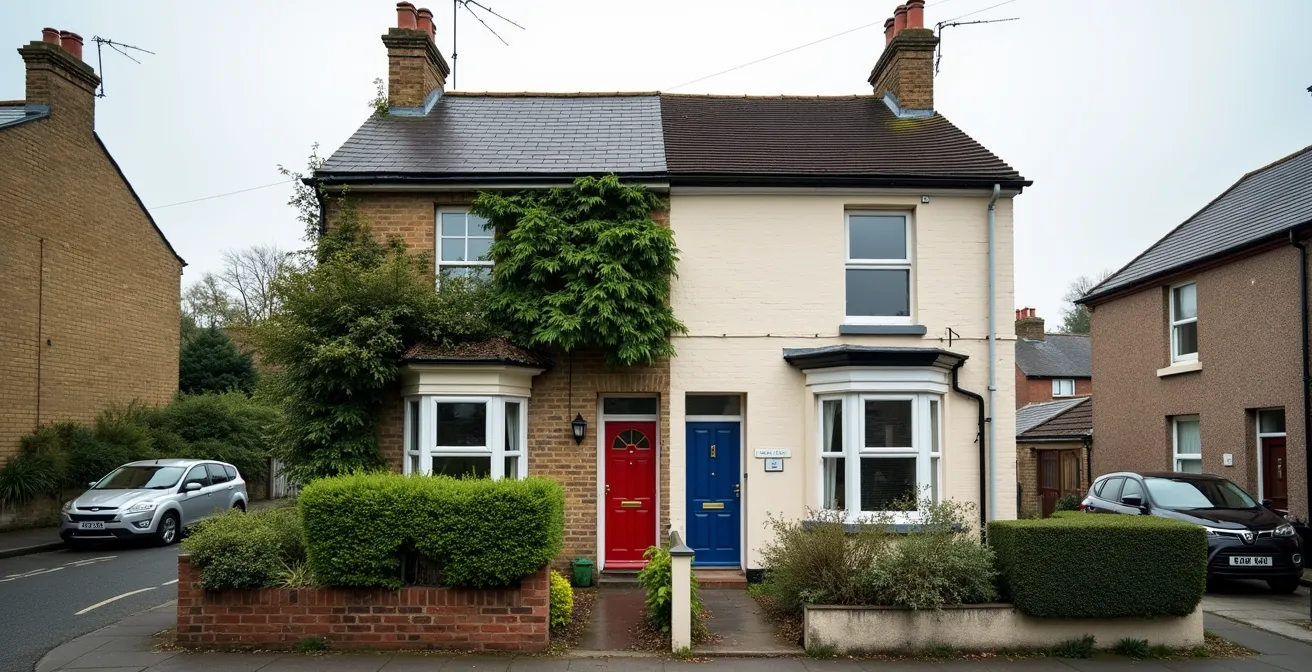
As illustrated, the difference between a well-maintained exterior and a neglected one is stark. The house on the left invites you in; the one on the right screams “work and expense”. Equally damaging are dated interior features that anchor your home in a bygone era. Things like woodchip wallpaper, avocado bathroom suites, and old storage heaters are major red flags that will have savvy buyers running for the door. An expert in a PAD Magazine property analysis puts it perfectly:
The error isn’t just bad decor, it’s decor that’s too hyper-specific. Buyers need a ‘blank-ish’ canvas to project their own aspirations onto.
– UK Property Expert, PAD Magazine Property Analysis
When to Start Renovations to Hit the Spring Selling Season?
In the UK property market, timing is everything. The ‘spring selling season’, typically running from March to June, is when buyer activity is at its peak. Listing a newly renovated property during this window can create a sense of urgency and competition, driving up the final sale price. However, to hit this deadline, your planning must start much earlier than you think. Underestimating lead times for planning permission, contractors, and materials is a common and costly error.
Major works, especially extensions that require planning permission, need a lead time of at least 6 to 9 months. A typical planning application can take 8-12 weeks for approval, and good contractors are often booked up for months in advance. Attempting to rush the process in January for a March launch will likely result in compromises on quality, higher costs for last-minute labour, and the risk of listing an unfinished property—a major deterrent for buyers.
A strategic timeline involves securing planning and finances in the autumn, booking tradespeople before the Christmas rush, and scheduling the bulk of the interior work for the quieter winter months. This ensures your property is market-ready, with all work completed and professionally cleaned, right as the first wave of spring buyers emerges. This level of foresight demonstrates to buyers that the property has been cared for and improved to a high standard, justifying a premium price.
Your Action Plan: UK Renovation Timeline for a Spring Market Launch
- July-August (Previous Year): Define project scope and submit planning permission applications for any extensions.
- September-October: Receive planning approval and secure detailed quotes from vetted contractors.
- November: Book and confirm your chosen contractors for a January start. Good builders have long lead times.
- December: Finalise your funding, whether through a mortgage advance, remortgage, or savings.
- January-March: Execute all major interior and exterior renovations during the winter months.
Why Keeping Cash in a Savings Account Is Costing You Real Wealth Daily?
In the world of property investment, the concept of ‘lazy capital’ is a critical one. This refers to money sitting idle in a low-interest savings account, where its value is actively being eroded by inflation. While it feels safe, holding a large cash sum for a future property sale is a strategy that guarantees a loss of real-world purchasing power over time. When inflation outpaces the interest rate on your savings, your money is effectively worth less each day.
This is where strategic, ROI-focused renovation comes in. By reallocating that ‘lazy capital’ into a carefully chosen home improvement project—one that is proven to add more value than it costs—you are not spending money, you are putting it to work. You are transforming a depreciating asset (cash) into an appreciating one (increased property equity). A £25,000 investment in a kitchen-diner extension that adds £40,000 of value to your home has generated a £15,000 profit. That same £25,000 in a savings account over the same period would have likely lost value in real terms.
The key, of course, is ‘strategic’. Pouring money into the wrong projects is just as bad as letting it sit idle. But by following the principles of understanding your value ceiling, choosing high-ROI projects, and executing them on a smart timeline, you are engaging in an active investment strategy. You are not just preparing a house for sale; you are managing your capital to deliver the best possible financial outcome, effectively making your property work for you to beat inflation.
Why Your Power Shower Is Costing You More Than Your Bath?
In today’s market, buyers are more financially and environmentally conscious than ever before. Rising energy bills have made a property’s running costs a major factor in the decision-making process. A feature that was once seen as a luxury, like a power shower, can now be perceived as a financial liability. While they provide strong water pressure, power showers are notoriously inefficient, using a vast amount of heated water and, consequently, a lot of energy.
A typical power shower can use more water in five minutes than a modern, well-insulated bath. For a family, the cumulative running costs can be substantial. When a savvy buyer inspects a bathroom and sees a power shower, they don’t just see a nice feature; they see higher future utility bills. This can subtly detract from the property’s overall appeal, especially when compared to a home with more economical and eco-friendly fittings. This is a perfect example of a ‘hidden cost’ that can negatively impact a buyer’s perception of value.
Replacing an old power shower with a modern, efficient mixer shower or, even better, a quality electric shower with an ‘eco’ setting and a low-flow head, is a small, low-cost upgrade with a surprisingly high impact. It signals to buyers that the home has been thoughtfully updated with running costs in mind. The following table breaks down the true cost of different shower types, both in installation and long-term use.
| Shower Type | Installation Cost | Annual Running Cost | Water Usage (15 min) | Appeal to Buyers |
|---|---|---|---|---|
| Power Shower | £500-800 | £400-500 | 150 litres | Low (high bills) |
| Electric Shower | £200-400 | £250-350 | 90 litres | Medium (economical) |
| Mixer Shower | £300-600 | £300-400 | 120 litres | High (balanced) |
| Eco Shower Head | £50-150 | £200-300 | 60 litres | Very High (eco-friendly) |
Key Takeaways
- ROI Over Aesthetics: Always prioritise market-driven value and broad buyer appeal over personal taste when renovating for a sale.
- Know Your Ceiling: Never spend more on renovations than your street’s maximum sale price will allow. This is the golden rule to prevent financial loss.
- Timing Is Capital: A successful and profitable renovation project requires meticulous planning, starting at least 6-9 months before your target selling season.
How to Choose a Real Estate Asset That Beats Inflation Over 10 Years?
Ultimately, transforming your house into a high-performing financial asset that beats inflation is the end goal. This isn’t achieved by chance or by simply following design trends. It is the result of a series of deliberate, data-driven decisions. The property itself—its location, size, and type—is the foundation. But its ability to outperform the market over the long term is unlocked through strategic capital investment, which is precisely what smart renovation is.
An asset that beats inflation consistently is one that remains desirable, functional, and efficient. A renovation strategy focused on long-term value will prioritise fundamentals over fads. This means ensuring the property has the right amount of space for its target demographic (e.g., a kitchen-diner for a family home), is energy-efficient (double-glazing, modern heating), and presents a neutral, well-maintained canvas that won’t date quickly. These are the qualities that will continue to attract buyers and command premium prices year after year, protecting your capital from being eroded by inflation.
By applying the principles discussed—calculating your value ceiling, focusing on high-ROI projects like loft conversions, avoiding personal decor, and planning meticulously—you are no longer just a homeowner. You are an active property investor. You are leveraging your capital and your asset to generate a return that far exceeds what you could achieve by simply letting your money sit in the bank. This is how real wealth is built in the property market: not through speculation, but through intelligent, calculated enhancement of the asset itself.
To turn these insights into actionable profit, the next logical step is to secure a professional, data-backed valuation to accurately define your property’s current value, its potential ceiling, and the most profitable renovation strategy for your specific market.