
Contrary to popular belief, the highest-converting touchpoints for UK service brands are rarely the ones closest to the sale; they are the moments of ‘intent capture’ that build trust early in the journey.
- The UK’s cost-of-living crisis has made users more research-intensive, prioritising informational touchpoints over transactional ones.
- Attribution models that only credit the final click ignore the crucial role of channels like LinkedIn and content in building the trust necessary for a conversion.
Recommendation: Shift budget allocation from purely ‘bottom-of-funnel’ activities to optimising ‘I want to know’ moments and systematically measuring their contribution to the final conversion.
For any digital marketer in the UK service sector, the core challenge remains the same: where do you allocate your budget to get the best return? The common approach is to map out a customer journey, identify touchpoints like social media, email, and the website, and then try to attribute sales to each one. This often leads to over-investing in the “buy now” button and under-valuing the moments that truly influence a customer’s decision.
The reality of the modern user journey is far less linear. It’s a complex web of interactions, especially for service brands where trust is the primary currency. The real question isn’t just “which touchpoint led to the sale?” but “which sequence of touchpoints built enough trust for the user to even consider the sale?”. As a conversion rate optimisation (CRO) expert, the data shows that focusing on the final click is a flawed strategy. We’re looking for a chain of “micro-yes” moments—small, low-friction agreements from the user that move them forward.
What if the most valuable touchpoint isn’t the final ad they clicked, but the blog post they read three weeks prior that established your authority? This guide reframes the analysis of digital touchpoints. We will move away from a simple inventory of channels and instead focus on the strategic purpose of each interaction. We will dissect how to design and measure touchpoints that capture intent, build trust, and create a compelling narrative that leads organically to conversion, all within the specific context of the UK market.
This article provides an analytical framework for identifying and optimising the moments that truly matter in your customer’s journey. Explore the sections below to understand how to shift from chasing clicks to engineering a high-trust conversion path.
Summary: A Strategic Map to High-Conversion Digital Touchpoints
- Why the “I want to know” Moment Is More Important Than the “Buy” Button?
- How to Redesign Your Contact Page to Generate 20% More Leads?
- LinkedIn vs Instagram: Which Touchpoint Builds Trust Faster for B2B?
- The Navigation Error That Traps Users on Your 404 Page
- In What Order Should You Send Welcome Emails to Maximize Engagement?
- First-Click vs Multi-Touch Attribution: Which Tells the Real Story?
- How to Set Up a Landing Page That Captures Intent Before You Build?
- How to Humanize Digital Customer Relationships to Reduce Churn by 15%?
Why the “I want to know” Moment Is More Important Than the “Buy” Button?
In the traditional marketing funnel, the “buy” button is the hero. It’s the final, measurable action. However, this view ignores the entire psychological journey that precedes it. For UK service brands, the most critical touchpoint is often the “I want to know” moment. This is the point where a potential client isn’t ready to commit but is actively seeking information to solve a problem or satisfy a curiosity. In the UK, social media and video portals are the top two digital advertising touchpoints, platforms designed for discovery and learning, not immediate purchase.
This informational-first approach is amplified by the current economic climate. A May 2024 analysis highlighted that over half of Britons are affected by the cost-of-living crisis, making them more risk-averse and research-intensive. They spend more time in the “I want to know” phase, comparing options and looking for signs of authority and trust. A hard sell at this stage is premature and can be perceived as tone-deaf. The goal here is not to get a sale, but to earn the first “micro-yes”: the user’s silent agreement that “this brand understands my problem and has valuable information.”
Therefore, your content strategy should be built around serving this intent. High-quality blog posts, in-depth guides, “how-to” videos, and insightful social media content are not cost centres; they are your most valuable conversion assets. They are the touchpoints that establish your authority, build initial trust, and ensure that when the user eventually transitions to the “I want to buy” phase, your brand is already their preferred choice. Ignoring this phase is like trying to harvest fruit without ever watering the tree.
How to Redesign Your Contact Page to Generate 20% More Leads?
Your ‘Contact Us’ page is not a simple utility; it is a critical, final-stage touchpoint where trust is either solidified or shattered. Many businesses treat it as an afterthought, offering a simple form and a generic email address. For a UK service brand, this is a massive missed opportunity. A redesigned contact page should function as a “digital reception,” proactively reassuring the user and making it frictionless to take the next step. The goal is to earn the “this is a legitimate and trustworthy company” micro-yes.
This is achieved by embedding tangible, UK-specific trust signals directly on the page. Beyond a clean design, this means displaying your Companies House registration number, VAT number, and any relevant industry accreditations (e.g., Gas Safe Register, FCA authorisation). These elements are not just legal formalities; they are powerful psychological cues that you are a serious, accountable entity. Offering multiple, modern contact methods like WhatsApp Business links and ‘tel:’ links for mobile users also demonstrates a commitment to customer convenience.
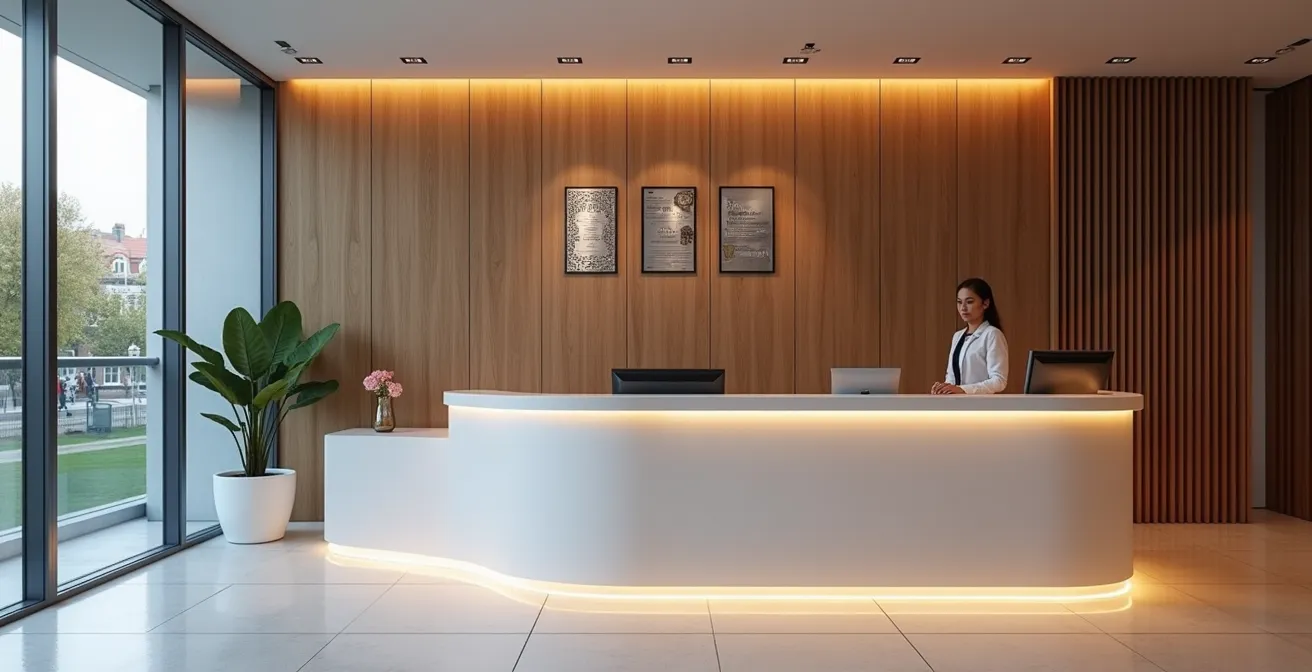
As the image suggests, this page should feel like a professional and welcoming front door. It’s the digital equivalent of a clean, well-staffed reception area with awards on the wall. Embedding your Google Maps profile with recent, positive reviews further reinforces this trust. By transforming your contact page from a passive form into an active hub of credibility, you are not just providing information; you are removing the final barrier of doubt that often prevents a user from making an enquiry. This focus on trust-building is how you can realistically aim for significant increases in lead generation from this single page.
LinkedIn vs Instagram: Which Touchpoint Builds Trust Faster for B2B?
The generic advice to “be where your customers are” is unhelpful without context. For UK B2B service brands, the choice between platforms like LinkedIn and Instagram is not about reach, but about “trust velocity”—how quickly a platform can build meaningful credibility. While both are visual, their ability to generate the “this expert is credible” micro-yes differs dramatically. As the Userpilot team notes, the key is choosing platforms where you can genuinely engage potential customers and share content that builds authority.
LinkedIn is purpose-built for professional trust. It is a touchpoint where in-depth articles, commentary on industry trends, and the personal brands of your key team members can flourish. A well-argued post from a director on LinkedIn has an inherently higher trust velocity than a visually pleasing but context-light image on Instagram. It allows for the demonstration of expertise, which is the cornerstone of B2B service relationships. It’s a platform for showing, not just telling, your competence.
Instagram, on the other hand, can build trust through different means—humanisation and culture. Showing the team, celebrating milestones, and sharing behind-the-scenes content can make a faceless corporation feel more approachable. However, for a direct B2B service sale, it’s often a lower-velocity touchpoint, better suited for brand awareness and employer branding. A powerful strategy is to use both, but with a clear understanding of their roles. Instagram builds brand affinity, while LinkedIn builds professional credibility. The most effective brands understand this and create content tailored to the unique trust-building capabilities of each platform, ensuring that every touchpoint serves a specific strategic purpose in the customer’s journey.
The Navigation Error That Traps Users on Your 404 Page
A 404 ‘Page Not Found’ error is more than a broken link; it’s a moment of digital frustration and a direct “no” from your website. It breaks the user’s journey and erodes trust. The most common error is leaving the user at this dead end with a generic, unhelpful message. This is a critical failure, especially when data shows the problem is widespread; a 2024 Pew Research Center study found that 23% of news webpages contain at least one broken link, indicating how frequently users can hit these walls.
The strategic approach is to transform your 404 page from a dead end into a “digital concierge.” Its job is to acknowledge the error, apologise, and immediately guide the user back to a productive path. Instead of just saying “Not Found,” use proactive language like, “Sorry, we couldn’t find that page. Let’s get you to the right place.” This simple shift in tone changes the experience from one of failure to one of assistance.

This is your chance to recover the user’s journey and turn a negative moment into a positive “micro-yes” of “this brand is helpful even when things go wrong.” By providing a prominent search bar, links to your most popular services or articles, and direct contact methods, you give the user immediate, useful options. Injecting a bit of on-brand, UK-specific humour, like “Oops! Looks like this page has gone for a cuppa,” can further diffuse frustration and humanise your brand, making a memorable positive impression out of a potential negative one.
Action Plan: Transform Your 404 Page into a Digital Concierge
- Acknowledge and Apologise: Ensure a clear 404 error message is displayed using proactive language like “Sorry, we couldn’t find that page.”
- Provide a Search Tool: Include a prominent, auto-focused search bar to empower users to find what they were looking for themselves.
- Offer Guided Pathways: Add direct links to your homepage, contact page, and the 3 most popular services or articles on your site.
- Inject Brand Personality: Use on-brand copy and imagery. For a UK audience, light-hearted, self-deprecating humour (e.g., “It seems this page is lost in the fog”) can be effective.
- Offer a Lifeline: Provide a direct email link or a chatbot widget for users who need immediate, personal assistance.
In What Order Should You Send Welcome Emails to Maximize Engagement?
A user signing up for your newsletter or making an initial enquiry is giving you a significant “micro-yes.” They’ve invited you into their inbox. A welcome email sequence is your opportunity to nurture this nascent trust, but the order and content are critical. Sending a single, generic “thanks for subscribing” email is a wasted opportunity. A strategic sequence should be designed to secure a series of progressive micro-yeses, guiding the user from initial interest to genuine engagement.
The ideal sequence for a UK service brand consists of 3-5 emails sent systematically over 7-14 days. The order should follow a logical path of reassurance, value, and connection:
- Email 1: Immediate Reassurance. Sent instantly. This email confirms the signup or query, thanks the user, and, most importantly, sets clear expectations (e.g., “Our team will respond to your query within 24 hours,” or “You’ll hear from us weekly with industry insights.”). This builds immediate trust through professionalism.
- Email 2: Value and Proof. Sent 1-2 days later. This is not a sales pitch. Provide a high-value piece of content—a link to a powerful case study, a free guide, or a relevant tool. This demonstrates your expertise and generosity, earning the “this was useful” micro-yes.
- Email 3: Human Connection. Sent 3-5 days later. Introduce the specific person or team the user might interact with. Including a photo and a brief, genuine message from an account manager or founder humanises the brand and makes the relationship feel personal, not automated.
A UK-based example from Southbank Centre shows the power of giving users control. Their welcome email’s highest clicked section, with 44% of total clicks, was the link to update content preferences. This is a perfect example of intent capture; they are getting a clear “micro-yes” on what the audience wants to hear about next, allowing for powerful segmentation and personalisation. The goal is to make the user feel seen, valued, and understood from the very first interaction.
First-Click vs Multi-Touch Attribution: Which Tells the Real Story?
The debate between attribution models like first-click and multi-touch often misses the point. The question isn’t which model is “correct,” but which model tells the most useful story about how your touchpoints work together. As a CRO analyst, I can tell you that relying solely on one model, especially last-click, gives you a dangerously incomplete picture. It’s like crediting only the final striker for a goal while ignoring the defenders and midfielders who moved the ball up the field.
For UK service brands with long and complex sales cycles, a multi-touch model is essential for understanding the whole journey. However, even within multi-touch, different models tell different stories. Your choice of model should be a conscious, strategic decision based on your business goals.
| Model | What It Credits | Best For | UK Service Brand Application |
|---|---|---|---|
| First-Click | Initial touchpoint | Understanding awareness channels | Identifying which channels introduce new UK clients |
| Last-Click | Final touchpoint | Conversion optimization | Understanding what closes UK service deals |
| Multi-Touch | All touchpoints in journey | Full journey understanding | Mapping complex B2B service journeys |
| U-Shaped | First & last heavily weighted | Discovery + Decision focus | UK financial advisors’ customer journey |
The real insight comes from creating an “attribution narrative.” This means using the data from these models not as a final answer, but as the basis for a hypothesis about a channel’s role. As the team at KRM Digital Marketing explains, a channel’s value might be purely informational:
Let’s say you look at the data and see that Organic Social is driving a massive number of assisted conversions but very few actual last-click conversions. Does that mean Social is failing? Absolutely not. It demonstrates that the channel’s role is informational. It’s where people go to learn, explore, and get comfortable with your brand. You wouldn’t waste time posting ‘Buy Now’ hard-sell posts on LinkedIn. Instead, you would double down on educational content
– KRM Digital Marketing, Assisted Conversions in GA4
This is the essence of a strategic approach. You use attribution data to understand if a touchpoint’s job is to generate the first “micro-yes” (awareness), the middle ones (consideration, trust), or the final one (decision). You then fund and measure that channel based on its specific role in the story, not against a single, universal KPI.
How to Set Up a Landing Page That Captures Intent Before You Build?
One of the costliest mistakes a service brand can make is investing heavily in developing and marketing a new service that nobody wants. A “smoke test” landing page is a powerful CRO technique to mitigate this risk. It’s a touchpoint designed for one purpose: intent capture. The strategy is to create a simple landing page for a service you are *considering* offering and drive hyper-targeted traffic to it. The goal is not to sell anything but to measure a crucial “micro-yes”: “I am interested enough to give you my email address for this.”
This is a low-cost, data-driven way to validate a business idea. You can use targeted Facebook or LinkedIn ads to reach specific UK demographics that you hypothesise would be the ideal customer for the new service. The landing page itself must be convincing, using strong copy, testimonials (if available from related services), and trust seals to persuade the user that the potential offer is valuable. The call-to-action is simple: “Be the first to know when we launch” or “Register for early access.”
The number of email sign-ups becomes your primary success metric. If you get a strong response, you have evidence of market demand. If the response is weak, you’ve saved significant time and resources. This approach is particularly relevant in the UK, where YouGov’s 2024 insights show that 46% of UK adults aged 25-39 report online shopping as their primary mode for purchasing, indicating a high level of digital fluency and a willingness to engage with new online offers. You can also use this method to A/B test different positioning or names for an existing service, letting the data tell you which message resonates most strongly before you commit to a full-scale rebrand.
Key takeaways
- The user journey is not linear; it’s a series of “micro-yes” moments that build trust and momentum.
- The most valuable touchpoints are often informational (“I want to know”), not transactional (“Buy Now”), especially in the research-intensive UK market.
- Attribution should tell a narrative about how channels work together, rather than just crediting the last click.
How to Humanize Digital Customer Relationships to Reduce Churn by 15%?
In a digital-first service economy, customer relationships can easily become cold and transactional. Churn is often a symptom of this perceived indifference. The solution is to strategically inject human, and even analog, touchpoints into your digital customer journey. These moments are designed to surprise and delight, reinforcing the “I am a valued client” micro-yes long after the initial sale. This isn’t about grand gestures, but consistent, thoughtful interactions that show there are real people behind the screen.
A powerful technique is the use of personalised video messages from account managers. Using a simple tool like Loom, a manager can record a quick, unscripted video welcoming a new client or checking in after a milestone. This has a vastly higher impact than an automated email. Similarly, as Groove HQ’s onboarding strategy demonstrates, consistently delivering value first and pitching second sets the tone for a long-term relationship. Their five-email welcome series contains only one direct pitch at the very end, prioritising the relationship over the immediate sale.
The most impactful strategies often bridge the digital-analog divide. Imagine receiving a handwritten thank-you card after a significant project milestone or an unexpected piece of branded merchandise. In a world of overflowing inboxes, these “unexpected” analog touchpoints have an outsized emotional impact. It’s about monitoring for opportunities to be human: genuinely engaging with a client’s content on LinkedIn, setting up alerts for drops in user activity to reach out proactively, and actively monitoring feedback to show you’re listening. By weaving these human moments into your digital processes, you build a relationship that is far more resilient to churn.
The key to improving conversions is to stop thinking in terms of isolated touchpoints and start architecting a journey of trust-building micro-yes moments. By applying this analytical, test-driven mindset to every interaction, from your 404 page to your welcome emails, you can build a more resilient and profitable customer relationship. Start today by auditing your own customer journey through this lens.