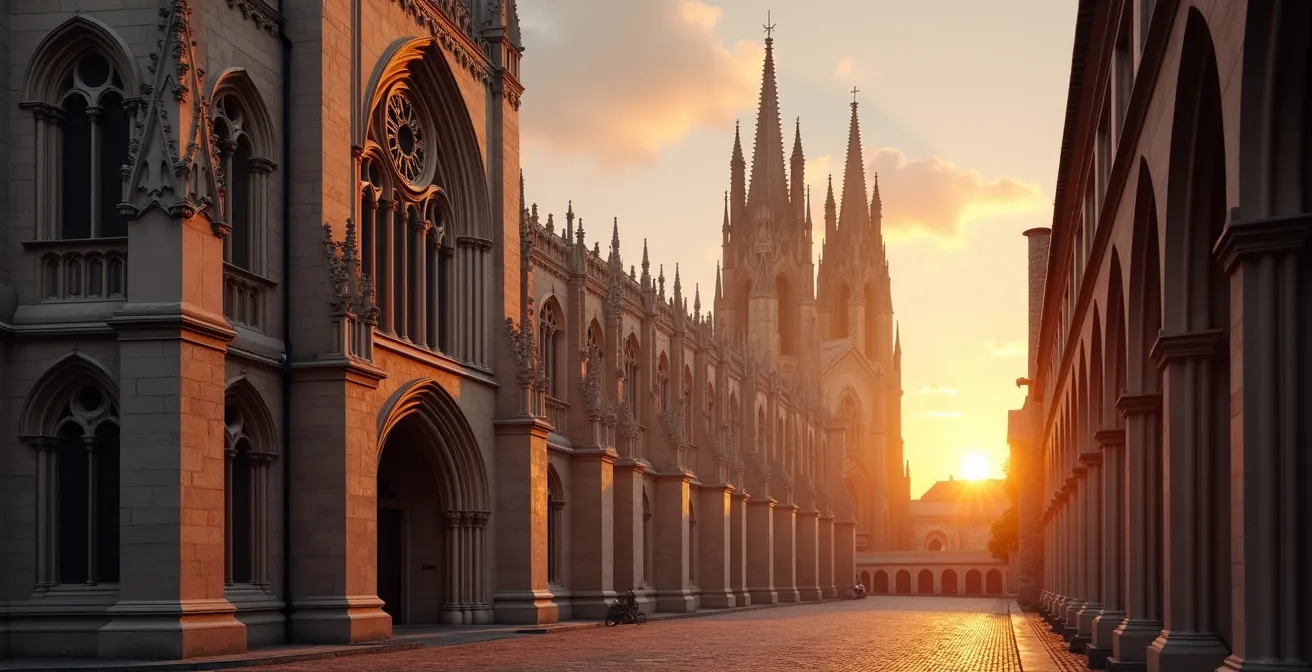
The true charm of European architecture is not found in a checklist of cities, but in learning to read its intricate visual language.
- Understand foundational styles like Gothic and Baroque not as historical facts, but as competing philosophies expressed in stone.
- Engage with buildings actively through skilled observation, like perspective-correcting photography and narrative-driven walking routes.
- Connect the built environment to its context, from the integrity of a city’s skyline to the natural architecture of the landscape.
Recommendation: On your next trip, treat every historic street not as a path between sights, but as a text rich with stories, waiting to be deciphered.
For the architecture enthusiast, a weekend in Europe presents a daunting, exhilarating prospect. The continent is a living museum, a dense tapestry of stone, glass, and ambition woven over millennia. The common approach—a frantic dash through a capital city, ticking off major monuments—often leaves one with a gallery of photos but a shallow sense of understanding. It’s a journey that catalogues sights but fails to grasp the story they tell. We’ve been conditioned to ‘see’ the Colosseum or the Charles Bridge, but are we truly appreciating them?
The solution is not to find a more obscure city, but to adopt a more profound way of seeing. The real secret to unlocking Europe’s charm lies in shifting perspective: from a tourist collecting landmarks to a historian reading a language. This guide proposes that true architectural appreciation is an active skill. It’s the ability to understand why Gothic architecture still inspires awe, to recognize the political arguments embedded in Baroque facades, and to see the ‘visual grammar’ in something as humble as a piece of cornicing. This is about learning to read the narrative thread that connects a cathedral’s soaring vault to the delicate ecosystem of a rewilded estate, and ultimately, to the design choices within our own homes.
This article will guide you through the process of developing this architectural literacy. We will explore the emotional power of historic styles, provide practical methods for capturing and navigating them, and delve into the principles of conservation and design that give these places their soul. Prepare to transform your next weekend break from a simple visit into a deep, aesthetic conversation with the past.
Summary: Unlocking Europe’s Architectural Secrets
- Why Gothic Architecture Still Evokes Awe in the 21st Century?
- How to Photograph Cathedrals Without Distorting the Perspective?
- Prague vs Vienna: Which City Offers the Best Baroque Experience?
- The Planning Mistake That Ruins the Skyline of Historic Cities
- How to Plan a Walking Route That Hits Every Key Landmark in 4 Hours?
- Why Removing Original Cornicing Devalues Your Period Home?
- Why Visiting a Rewilding Estate Helps Restore British Biodiversity?
- How to Choose a Curated Design Style That Matches Your Victorian Period Property?
Why Gothic Architecture Still Evokes Awe in the 21st Century?
To stand within a great Gothic cathedral is to experience a masterclass in architectural psychology. The style, which dominated European construction from the 12th to the 16th century, was engineered not just for structural stability but for emotional and spiritual effect. Its defining features—pointed arches, ribbed vaults, and flying buttresses—were technological innovations that allowed for unprecedented height and light. Walls dissolved into vast expanses of stained glass, transforming cathedrals into ‘caskets of jewels’ that were both awe-inspiring and deeply symbolic.
This was a deliberate philosophy. As the 12th-century Abbot Suger, a key pioneer of the Gothic style, articulated, the goal was to use light as a medium for spiritual elevation. In his view, the ethereal glow filtering through stained glass was a manifestation of the divine, designed to lift the human spirit from the earthly to the celestial. It is this masterful manipulation of light and vertical space that creates the sensation of being small yet uplifted, a feeling that transcends centuries and belief systems.
For Suger, and other like-minded medieval theologians, light itself was divine and could be used to elevate human consciousness from an earthly realm to a heavenly one.
– Abbot Suger, World History Encyclopedia on Gothic Architecture
The power of this aesthetic is so profound that it continues to resonate in contemporary culture. The verticality, dramatic lighting, and atmospheric grandeur of Gothic cathedrals have directly influenced the design of worlds in fantasy video games like *Dark Souls* and *Bloodborne*. These modern creations tap into the same psychological responses, using Gothic principles to evoke wonder, mystery, and a sense of confronting something ancient and powerful. This enduring influence demonstrates that Gothic architecture is not a relic; it is a living language of awe.
How to Photograph Cathedrals Without Distorting the Perspective?
Capturing the scale and soul of a cathedral in a photograph is a challenge that frustrates many. The immense verticality and extreme contrast between shadowy interiors and brilliant stained-glass windows often result in images that feel distorted or fail to convey the building’s true atmosphere. However, by adopting a few professional techniques, you can move beyond simple snapshots to create images that do justice to these architectural wonders. The key is to control perspective and light deliberately.
Instead of fighting the inevitable distortion of a wide-angle lens, one can embrace it artistically. By positioning yourself in the exact center of the nave and shooting directly upwards, you can create a powerful, symmetrical composition that emphasizes the soaring height. Alternatively, to avoid distortion altogether, switch to a longer lens, such as a 100mm. This allows you to isolate and compress details—a gargoyle sneering from a parapet, the intricate carving on a capital—turning them into compelling abstract studies. This approach shifts the focus from capturing the whole building to capturing its essential character through its details.
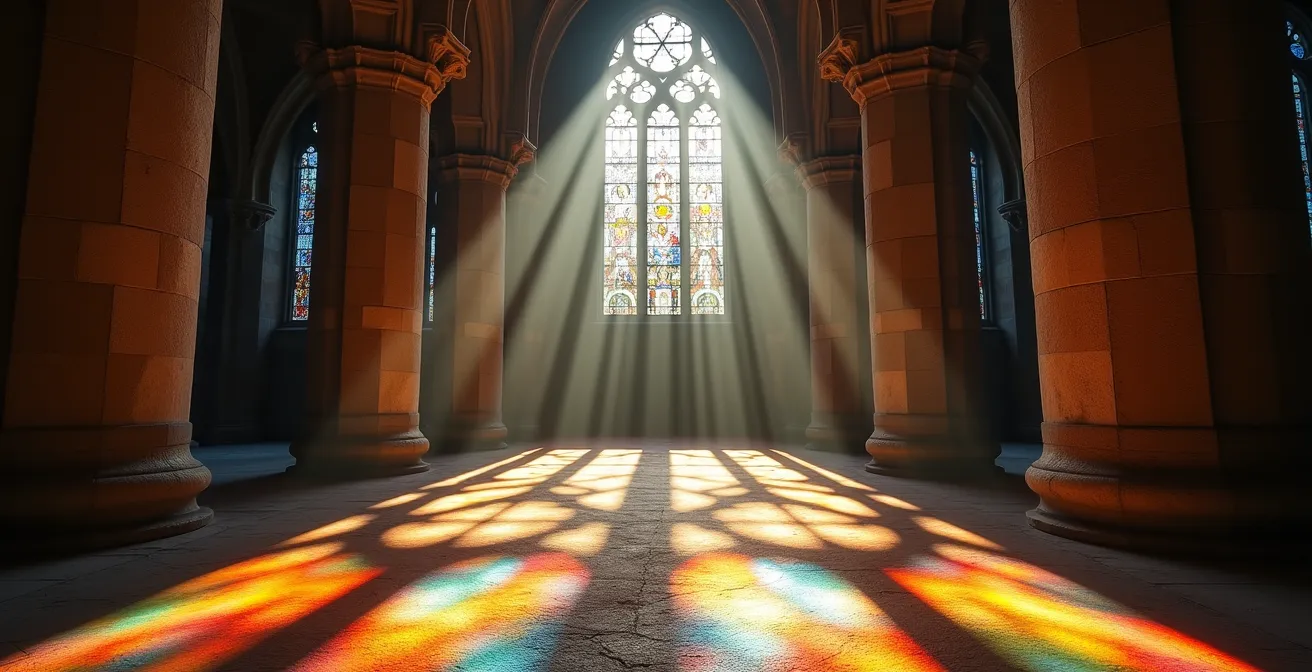
The extreme dynamic range is another major hurdle. Your camera cannot see the deep shadows and bright highlights simultaneously. The solution is exposure bracketing: take three or more shots of the same scene at different exposure levels and merge them later in software. This technique allows you to retain detail in both the darkest corners of the vault and the most luminous sections of the stained glass, creating a final image that more closely matches the experience of the human eye.
Your Action Plan: The Cathedral Photographer’s Checklist
- Positioning is everything: Stand at the exact center of the nave for symmetrical upward shots that embrace intentional distortion as an artistic choice.
- Isolate details: Use a longer lens (e.g., 100mm) to capture architectural features like gargoyles and capitals without the distortion common to wide-angle lenses.
- Master the light: Bracket your exposures by 2-3 stops to handle the extreme contrast between dark interiors and bright stained glass windows.
- Chase the ‘golden hour’: Time your visit for when angled morning or afternoon light streams dramatically through the windows.
- Provide a sense of scale: Strategically include human silhouettes in your composition to give a powerful context to the massive scale of the architecture.
Prague vs Vienna: Which City Offers the Best Baroque Experience?
While Gothic architecture aimed for celestial transcendence, Baroque was a style firmly rooted in the drama and power of the terrestrial world. Emerging in the 17th century, it was the architecture of the Counter-Reformation and absolute monarchy, using movement, emotion, and opulence to overwhelm the senses. Two of the finest cities to experience this style are Prague and Vienna, yet they offer remarkably different “dialects” of the Baroque language, each shaped by its unique history and cultural context.
Prague’s Baroque is a story of conflict and conversion. Imposed after the Thirty Years’ War, it served as a powerful tool of Catholic propaganda. Its character is therefore more muscular, emotional, and dramatic. The swirling statues on the Charles Bridge seem caught in moments of divine ecstasy or torment, and the undulating facades of churches by architects like Kilian Ignaz Dientzenhofer feel dynamic and theatrical. It is an art form designed to persuade and awe the populace.
Vienna’s Baroque, by contrast, speaks the language of a stable, confident empire. As the heart of the Habsburg dynasty, its architecture is more ceremonial, orderly, and imperial. The grand palaces and apartment entrances, often designed by figures like Johann Bernhard Fischer von Erlach, project power through scale, symmetry, and refined ornamentation rather than raw emotion. The experience is less about spiritual drama and more about appreciating the sophisticated grandeur of an established world power, a feeling that extends to the city’s grand café culture.
To truly understand their distinct architectural personalities, a side-by-side comparison is invaluable. The following table, drawing from an analysis of European architectural designs, breaks down the key differences.
| Aspect | Prague | Vienna |
|---|---|---|
| Baroque Philosophy | Dramatic, emotional Counter-Reformation art | Imperial, ceremonial stable empire expression |
| Key Architect | Kilian Ignaz Dientzenhofer | Johann Bernhard Fischer von Erlach |
| Signature Elements | Charles Bridge statues, Malá Strana doorways | Plague columns, grand apartment entrances |
| Living Heritage | Vivaldi concerts in churches | Coffee culture in grand cafés |
| Atmosphere | Muscular, propagandistic art | Confident, orderly imperial style |
The Planning Mistake That Ruins the Skyline of Historic Cities
The skyline of a historic European city is, or was, a carefully composed work of art—a “fifth facade” where the spires of churches and the towers of town halls punctuated a harmonious sea of tiled roofs. This visual hierarchy was not an accident; it was an expression of a community’s values, with sacred and civic buildings literally rising above the everyday. For centuries, this skyline was the city’s signature. Indeed, historical records show Lincoln Cathedral held the title of the world’s tallest building for 238 years, defining its region’s identity from miles away.
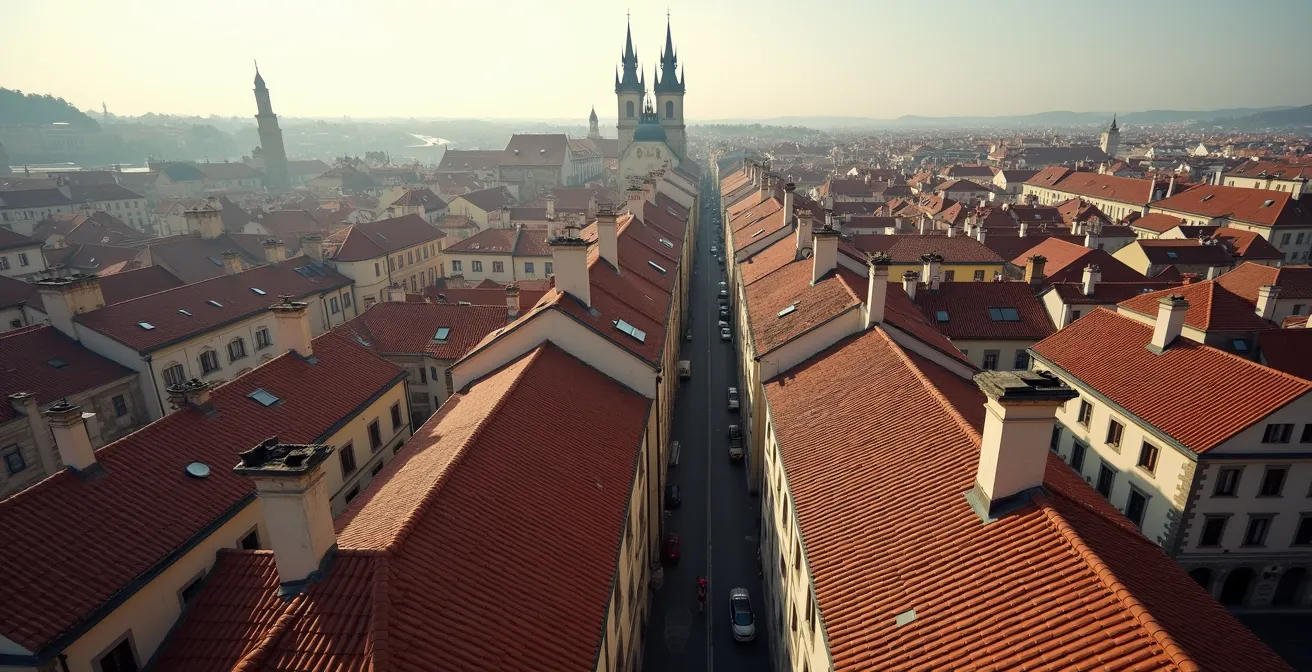
The single greatest planning mistake that ruins this delicate composition is the loss of skyline discipline. This occurs when modern, oversized, or stylistically incongruous buildings are allowed to intrude upon and dominate the historic silhouette. A glass office tower that looms over a Baroque dome, or a blocky apartment building that eclipses a Gothic spire, does more than just add a new structure; it fundamentally scrambles the architectural language of the city. It flattens the historical narrative, creating visual noise that makes it difficult to read the city’s original story.
A particularly insidious form of this mistake is the practice of “facadism” or, more critically, “facade-omy.” This is the process where developers preserve only the historic street-front facade of a building while gutting the interior and erecting a completely new, often much larger, structure behind it. While this is often touted as a preservation compromise, it creates a form of zombie architecture. The city maintains a veneer of historical continuity for the casual passerby, but the authentic spatial quality, structural integrity, and soul of the original building are lost forever. The facade becomes a decorative mask, hiding the erasure of true architectural heritage.
How to Plan a Walking Route That Hits Every Key Landmark in 4 Hours?
The challenge for the architecture enthusiast with limited time is not just seeing the key landmarks, but connecting them in a meaningful way. A frantic dash from one monument to the next creates a disjointed experience, like reading only the chapter headings of a great novel. The art of a successful architectural walk lies in crafting a narrative thread that turns the spaces *between* the landmarks into part of the story. A well-planned four-hour route should feel like a curated journey, not a checklist.
First, abandon the idea of “efficiency” in favour of “narrative.” Instead of the fastest path, choose a thematic one. Your theme could be chronological (“From Roman Foundations to Gothic Heights”), stylistic (“A Hunt for Art Nouveau Details”), or functional (“Following Medieval Trade Routes”). This theme becomes your guiding principle, informing which alleys you explore and which squares you cross. The goal is to make the journey as instructive as the destinations. A truly great route is composed of roughly 40% landmarks and 60% atmospheric connective tissue—the winding alleys, hidden courtyards, and local markets that give a city its unique texture.
Next, plan for pauses. Identify three or four “pause points” with perfect viewing angles—a specific bench in a quiet square, a viewpoint from a bridge, or a café terrace. These are not just for resting; they are for absorption. Build in 15-minute breaks at each major site for contemplation, sketching, or simply watching the light change on the stone. Add sensory waypoints to your map: a street known for its bakeries to catch the morning aromas, or a bell tower square to experience the noon chimes. This multisensory approach transforms a walk from a visual exercise into a full-body experience of place.
Everything was beautifully judged – the pacing, the choice of sites, the amount of detail, the provision of breaks. It was a treat from beginning to end. The key is not rushing between monuments but savoring the journey between them.
– Architectural tour experience, Martin Randall Travel
Why Removing Original Cornicing Devalues Your Period Home?
In the world of period properties, original features are the keystones of both aesthetic integrity and financial value. While elements like fireplaces and sash windows are often celebrated, the humble cornice is frequently overlooked, or worse, removed during modernization. This is a critical error, as removing original cornicing does more than just simplify a room—it fundamentally devalues the property by erasing a key piece of its architectural DNA. In fact, real estate market analysis demonstrates that properties with intact original features can command a price premium of 15-25%.
The value of cornicing extends far beyond its decorative function. As one historic preservation expert noted, it serves a crucial role in defining the character of a room. It is the architectural punctuation that manages the transition between wall and ceiling, establishing the room’s proportions and guiding the eye. In Victorian and Georgian homes, the size and complexity of the cornicing were often linked to the status of the room; a grand, ornate cornice signalled a public space like a reception room, while a simpler design denoted a private or service area. To remove it is to erase this subtle social and architectural history.
Cornicing isn’t just decoration; it’s the ‘punctuation’ of a room. It defines the transition between wall and ceiling, establishes proportion, and guides the eye.
– Historic Preservation Expert, Architectural Heritage Documentation
Furthermore, original plaster cornicing is a mark of craftsmanship. It was often run in-situ by skilled artisans, and its crisp lines and unique profile are impossible to replicate with modern, mass-produced substitutes. Removing it severs a direct link to the building’s past and the hands that built it. Preserving and restoring it, on the other hand, maintains the visual grammar of the space, ensuring that the room “reads” as it was originally intended. It is a sign of a thoughtful and respectful renovation that savvy buyers and fellow enthusiasts will always recognize and value.
Why Visiting a Rewilding Estate Helps Restore British Biodiversity?
At first glance, a discussion of rewilding estates may seem disconnected from European architectural history. Yet, for the enthusiast learning to read the language of structure and environment, they offer a profound lesson. Visiting an estate like Knepp in the UK provides a unique opportunity to witness “ecosystem architecture” in its purest form, revealing the deep structural parallels between natural processes and human design. It helps us understand the foundational principles upon which our own architectural ambitions are built.
Rewilding is the process of allowing nature to reclaim and manage landscapes, restoring dynamic, self-sustaining ecosystems. On these estates, one can observe how keystone species function as natural engineers. Beavers, for example, are ecosystem architects. Through the construction of dams and lodges, they create complex wetlands, slow water flow, and build intricate living structures. These dams, built of woven branches and mud, are not random; they are sophisticated engineering feats that create a framework enabling an entire system of biodiversity to flourish around them.
The structural logic of a beaver’s dam is uncannily similar to that of a Gothic buttress. Both are external support systems designed to manage immense pressure—water for the beaver, the stone vault’s lateral thrust for the medieval mason. Both create a stable framework that allows for the creation of a larger, more complex, and more vibrant interior space, whether it’s a thriving wetland or a light-filled cathedral nave. By observing this natural architecture, we gain a deeper appreciation for the structural honesty and problem-solving ingenuity that underpins the greatest human achievements in building.
A visit to a rewilding estate recalibrates the eye, training it to see the structural and ecological logic in the landscape. It’s a reminder that before humans built, nature was already engineering. This perspective enriches our understanding of man-made architecture, grounding it in a context that is millions of years old and reminding us that the most successful designs are often those that work in harmony with fundamental natural principles.
Key Takeaways
- True architectural appreciation is an active skill of ‘reading’ a building’s visual language, not a passive consumption of sights.
- From Gothic cathedrals to Victorian cornicing, every architectural element follows a ‘visual grammar’ that communicates history, status, and philosophy.
- The most successful designs, both natural and man-made, are those that create a stable framework for a complex and vibrant system to flourish.
How to Choose a Curated Design Style That Matches Your Victorian Period Property?
Bringing the lessons of architectural history into one’s own home is the ultimate act of appreciation. For the owner of a Victorian period property, the challenge is to create a living space that feels both contemporary and authentic, avoiding the pitfalls of either a cold, minimalist intervention or a stuffy, museum-like recreation. The most successful approach is not about slavishly copying the past, but about entering into a thoughtful and curated dialogue with it. This is the “Eclectic Inheritance” method—designing as if the home has been thoughtfully added to by successive, tasteful generations.
The first step is to “read the bones” of your house. Before choosing a single paint colour or piece of furniture, study the architectural language already present. Examine the style of the fireplaces, the profile of the skirting boards, and the type of sash windows. These details will tell you which part of the long Victorian era your home belongs to—early, mid, or late—and what its original character was. This understanding forms the foundational grammar for your design choices.
With this foundation, you can begin to layer. The “conversation principle” is key: when mixing periods, do so thoughtfully. A mid-century modern chair can look stunning against a Victorian bay window if its scale, colour, and form are chosen to complement, not fight, the original architecture. Think about how Victorians themselves used colour; they often chose dark, rich hues not just for fashion, but for the practical reason of hiding soot from coal fires. Applying that same practical, principle-based thinking to modern life leads to more authentic choices than simply picking a colour from a heritage chart.
The best approach is not a slavish historical recreation, but a dialogue between past and present. The goal is to respect the ‘voice’ of the house while adding your own chapter.
– Interior Design Historian, Victorian Property Design Guide
Ultimately, respect for proportion is paramount. Any modern additions, from kitchen extensions to light fixtures, must be scaled to the visual weight of the original home. A successful curated style is a testament to the owner’s ability to listen to the house’s history and add their own voice to the conversation, creating a space that is both a comfortable home and a living piece of architectural history.
The journey from tourist to architectural connoisseur is a rewarding one. It transforms travel from a passive activity into an active, intellectual pursuit. By learning to read the language of buildings, you equip yourself with a new sense that can find beauty and meaning not just in famous monuments, but in the texture of a city street, the curve of a roofline, or the detail of a door. Begin your next journey not as a tourist, but as a reader of cities, and discover the timeless stories written in stone.