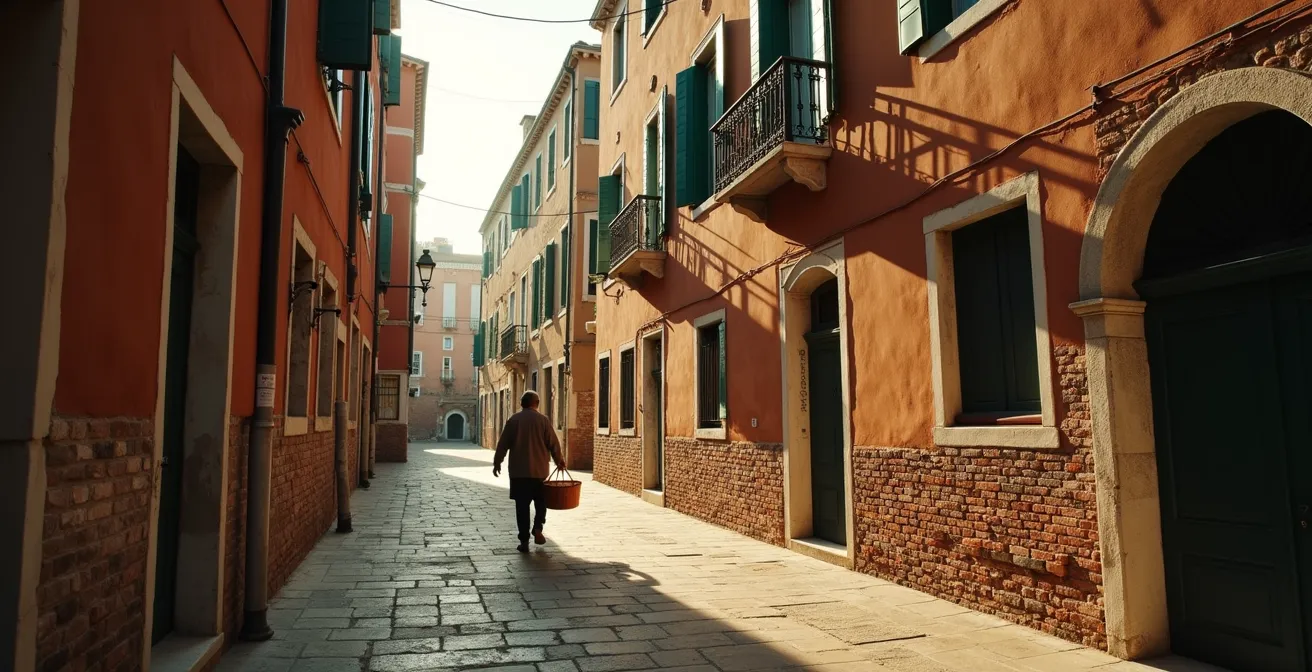
The secret to experiencing Venice in August isn’t avoiding the crowds, but outsmarting them by understanding the city’s invisible systems.
- Instead of just getting lost, follow a “Helios Itinerary” that uses the sun’s path to find shade and tranquility.
- Trade a generic gondola ride for a targeted walking tour to uncover the city’s true architectural and economic secrets.
Recommendation: Support the real Venice by patronizing certified local artisans and dining at authentic ‘bacari’ where Venetians eat, ensuring your visit contributes to the city’s survival.
The thought of Venice in August often conjures two conflicting images: one of sublime beauty, of sunlight glinting on green canals and Gothic palaces; the other, of shoulder-to-shoulder crowds shuffling through narrow calli, a human river flowing between St. Mark’s and the Rialto. For a culture-loving couple, the dilemma is acute. How do you immerse yourselves in the profound history of La Serenissima when its very stage is overwhelmed by the spectacle of mass tourism?
The common advice is predictable: wake up at dawn, book tickets online, wander off the beaten path. While not wrong, this advice only scratches the surface. It treats the city as a museum to be ticked off rather than a living, breathing organism with its own rhythms and logic. These strategies help you dodge the crowds, but they don’t necessarily help you connect with the city’s soul. To truly access the heritage you seek, you must look deeper.
But what if the key wasn’t simply avoiding people, but understanding the very systems that allow Venice to function? This guide proposes a different approach. We will not just list quiet spots; we will decode the city’s invisible operating systems—its relationship with water, its unique methods of transport, its economic DNA, and its daily dance with the sun. By thinking like a Venetian historian, you can unlock an authentic experience, even in the heart of August.
This journey will take us from the monumental engineering that holds back the sea to the subtle clues on a restaurant menu that betray a tourist trap. We will learn to navigate not just the canals, but the flow of time and money, revealing the layers of history hidden in plain sight.
Contents: A Strategic Path Through Venice’s Secrets
- Why MOSE Barriers Are Essential to Save Venice From Aqua Alta?
- How to Use the Vaporetto System to Visit Islands Most Tourists Miss?
- Gondola Ride vs Private Walking Tour: Which Offers Better Historical Insight?
- The Menu Red Flag That Signals a Tourist Trap in Venice
- In Which Order Should You Visit the Sestieri to Follow the Sun?
- Why Gothic Architecture Still Evokes Awe in the 21st Century?
- How to Ensure Your Tourism Money Actually Reaches the Local Community?
- Where to Find Timeless Architectural Charm in Europe for a Weekend Break?
Why MOSE Barriers Are Essential to Save Venice From Aqua Alta?
To understand Venice, you must first understand its vulnerability and its resilience. The city is a miracle built on water, but that same water is its greatest threat. The phenomenon of “acqua alta,” or high water, has for centuries flooded its squares and ground floors. For a long time, the city simply lived with it, but climate change has intensified the threat. The first “invisible system” to comprehend is the one keeping the city dry: the MOSE project.
MOSE (Modulo Sperimentale Elettromeccanico) is a network of 78 mobile floodgates at the three inlets to the Venetian Lagoon. When a dangerously high tide is forecast, these barriers rise from the seabed, temporarily sealing the lagoon from the Adriatic Sea. It is a monumental feat of engineering, a testament to the modern will to preserve this fragile heritage. Since its implementation, its impact has been profound; a report from Venice’s Tide Forecasting Center shows the system has been activated 97 times since October 2020, preventing widespread flooding and economic damage that in 2024 alone was estimated between 200 and 400 million euros.
While you won’t see MOSE on a typical tour, its existence is what guarantees you can walk through a dry St. Mark’s Square during a potential flood. Understanding this constant, silent battle against the sea provides a deeper appreciation for every stone and brick. It reframes the city not as a passive relic, but as a place of active, ongoing preservation. As a leading engineer from the project noted, this is a critical, but not final, step. According to Giovanni Cecconi of Ca Foscari University, Venice is now facing an accelerated rise in water levels due to climate change, forcing the city to already plan for what comes after MOSE.
How to Use the Vaporetto System to Visit Islands Most Tourists Miss?
The second invisible system is the city’s circulatory network: the vaporetto. Most tourists see the water buses as a simple A-to-B transport, often crowding onto Line 1 for a slow, packed tour of the Grand Canal. A historian, however, sees the vaporetto as a key to unlocking the lagoon’s hidden geography. To escape the August crowds, you must master this navigational intelligence.
Forget the mad dash for Murano and Burano. Instead, use the vaporetto to explore the islands that sustain Venice’s soul. Take the route to Sant’Erasmo, known as “Venice’s vegetable garden.” Here, you’ll find authentic farming landscapes and a quiet that feels a world away from San Marco. Or visit the cemetery island of San Michele during off-peak hours for a moment of profound peace and contemplation amidst the tombs of figures like Ezra Pound and Igor Stravinsky.
This paragraph introduces the concept of using the vaporetto system strategically. To better understand this, the image below evokes the feeling of arriving at a quieter, more authentic part of the lagoon, away from the main tourist arteries.

As you can see, the journey itself becomes part of the discovery. For an even more local experience, try traveling during the Italian lunch break (roughly 1-3 PM), when the boats fill with residents returning home, their conversations a temporary antidote to the tourist babble. Consider using the circular lines (4.1/4.2 or 5.1/5.2) which act as local “commuter” routes, offering unique perspectives of the city’s outer edges. For a true escape, the long ride to Pellestrina offers cycling paths and authentic fishing villages where the rhythm of life has remained unchanged for generations.
Gondola Ride vs Private Walking Tour: Which Offers Better Historical Insight?
The quintessential image of Venice is a couple in a gondola. It’s romantic, iconic, and often, historically shallow. While a gondola offers a unique water-level perspective of the architecture, the commentary is typically limited. For a culture-loving couple, the system of information—how you access the city’s stories—is paramount. The choice between a gondola and a private walking tour is a choice between romance and revelation.
A good walking tour, led by a licensed local guide, transforms the city from a beautiful backdrop into a narrative. A guide can lead you through deserted calli, point out a hidden medieval relief sculpture, and explain its significance. They can unlock the stories behind the stones. A particularly powerful experience is visiting one of the last remaining gondola boatyards, like the Squero di San Trovaso in Dorsoduro. Here, from across the canal, you can witness craftsmen repairing the iconic boats by hand, using techniques passed down through centuries. This is a level of historical insight a standard gondola ride simply cannot provide.
However, the choice isn’t always binary. There’s a third, hyper-local option: the traghetto. These are larger, unadorned gondolas used by Venetians to cross the Grand Canal at points where there are no bridges. A crossing costs only a couple of euros and offers a two-minute, authentic slice of Venetian life. The following table breaks down the options to help you decide based on your priorities.
| Priority | Gondola Ride | Walking Tour | Traghetto Option |
|---|---|---|---|
| Best for Photography | Water-level architecture views | Street-level details | Quick canal crossing shots |
| Historical Depth | Limited commentary | In-depth storytelling | Authentic local experience |
| Cost | €80-100 (30 mins) | €25-50 per person | €2 per crossing |
| Crowd Level | Tourist-heavy routes | Can access quiet areas | Used mainly by locals |
| Duration | 30-40 minutes | 2-3 hours | 2 minutes |
The Menu Red Flag That Signals a Tourist Trap in Venice
Nothing breaks the historical spell faster than a bad, overpriced meal. The fourth invisible system is the city’s culinary economy, and learning to read it is crucial for an authentic experience. This is an exercise in “economic archaeology”: digging past the tourist-facing facade to find the real thing. In Venice, the most obvious red flag is the menu itself.
Be wary of restaurants with servers standing outside, aggressively waving laminated menus with glossy photos. If the menu is translated into five or more languages, you are in a tourist trap. Another dead giveaway is the presence of non-Venetian “Italian” classics like Spaghetti Bolognese or Fettuccine Alfredo. A truly Venetian osteria serves dishes of the lagoon. Also, look for the ‘coperto’ (cover charge); authentic places almost always have it, while tourist traps may advertise “no cover charge” to lure you in.
The true heart of Venetian casual dining is the bacaro, a small, standing-room-only wine bar where locals gather for an ‘ombra’ (a small glass of wine) and ‘cicchetti’ (small snacks). As one local guide puts it, the authentic experience is clear:
Authentic bacari feature zinc counters displaying fresh cicchetti prepared daily from market ingredients, with no printed menus and prices that reflect local rather than tourist economics.
– Venice Food Guide, Machupicchu.org Venice Tourism Guide
Here, you’ll find sarde in saor (sweet and sour sardines), baccalà mantecato (creamed cod), and other local delicacies. The price is another clue: according to traditional bacari pricing ranges from €1.50-4.00 per cicchetto piece. If you are paying significantly more, you are likely in the wrong place. To eat like a Venetian is to seek out these bustling, unpretentious havens.
In Which Order Should You Visit the Sestieri to Follow the Sun?
The fifth and most poetic invisible system is the chronobiology of Venice—the city’s relationship with light and time. In the sweltering heat of August, simply wandering can lead to exhaustion. A strategic visitor, however, moves with the sun, using its path to find both comfort and beauty. This “Helios Itinerary” is a secret to managing the heat while seeing each sestiere (district) in its best light.
Start your day before 9 AM in the easternmost sestiere, Castello. Here you can catch the glorious sunrise light on the historic Arsenale, the former shipyard of the Venetian Republic, and explore its quiet streets before the city fully wakes. As the morning progresses and tour groups begin to clog the arteries, move west to San Marco. You’ll still find crowds, but you’ll be ahead of the peak midday rush.
This paragraph introduces the idea of following the sun. The image below captures the unique quality of light during the “golden hour,” a key moment in the Helios Itinerary, reflecting on the textures of Venetian architecture.
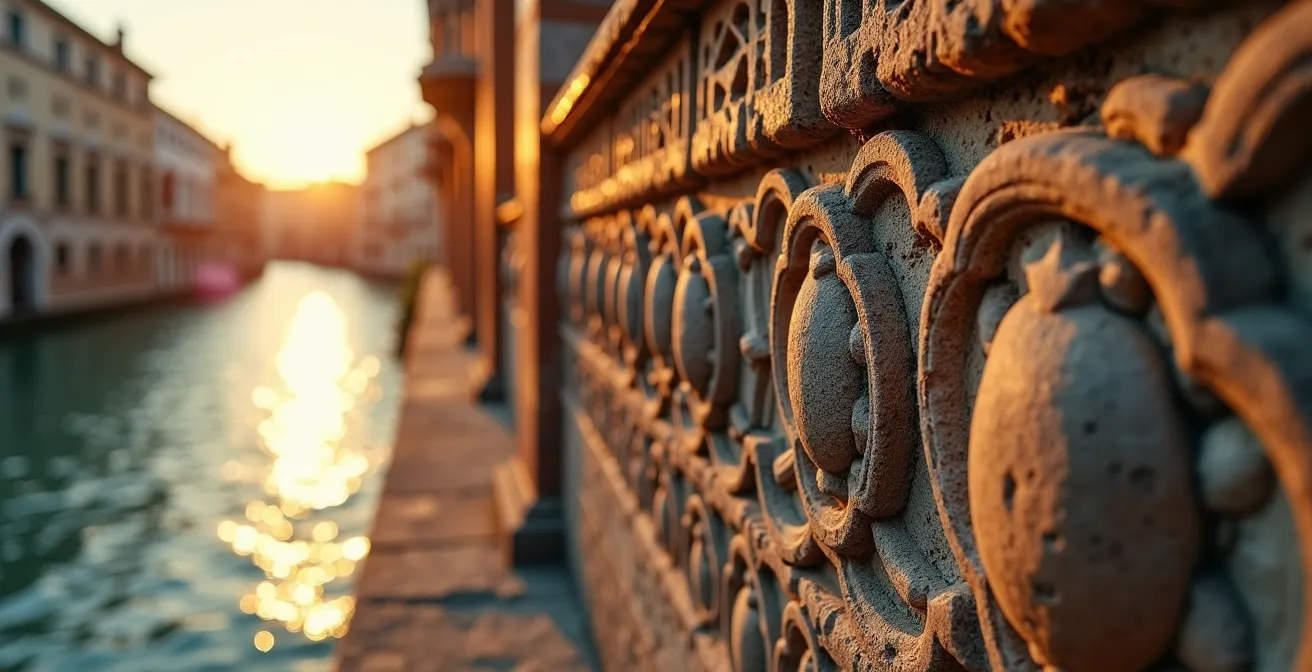
When the sun is at its highest and most punishing (roughly 1-4 PM), do as the Venetians do: seek refuge. This is the time to explore the labyrinthine, narrow calli of San Polo, where the tall buildings provide constant shade, or to retreat into the cool, cavernous interiors of the city’s many churches. In the late afternoon, move to Dorsoduro, enjoying its tree-lined promenades and world-class, air-conditioned museums like the Gallerie dell’Accademia. For the golden hour, head to the northern sestiere of Cannaregio. Find a canal-side bacaro for an aperitivo and watch the sunset paint the water gold. Finally, after 8 PM, when the day-trippers have departed, you can return to a calmer, more magical San Marco for an evening stroll.
Why Gothic Architecture Still Evokes Awe in the 21st Century?
Venice’s buildings are not just beautiful; they are a direct response to the city’s unique environment. The sixth invisible system is this structural logic, most powerfully expressed in Venetian Gothic architecture. Understanding why it looks the way it does is to read the story of the city’s history, ambition, and physical constraints. It’s a style that blends the vertical aspirations of Northern European Gothic with the decorative richness of the Byzantine East and the structural lightness required by unstable, marshy ground.
Unlike the heavy, buttressed cathedrals of France or England, Venetian Gothic is characterized by its airiness and intricate ornamentation. Key elements to look for are the pointed Islamic-inspired arches, the delicate quatrefoil windows (four-lobed openings), and the ornate balconies. A prime example is the Ca’ d’Oro, or “Golden House,” on the Grand Canal. Its name comes from the original gilt decorations that covered its facade. Its open loggias and large windows were a brilliant adaptation designed to capture and reflect light from the water below, illuminating the grand interiors and creating an effect of shimmering elegance that stood in for heavy, solid walls.
This unique blend was a symbol of Venice’s status as a maritime power, a crossroads between East and West. The decorative paterae—small, circular reliefs often depicting animals or geometric patterns—are a direct nod to Byzantine art. To appreciate these details away from the crowds of the Doge’s Palace, explore the smaller palazzi in the quieter canals of Cannaregio or Castello. There, you can study the intricate stonework and delicate tracery up close, feeling the living history of the stone.
How to Ensure Your Tourism Money Actually Reaches the Local Community?
The most critical invisible system for the city’s future is its local economy. Venice is in a precarious situation; a report highlights that Venice’s historic center now has fewer than 50,000 full-time residents, while facing up to 30 million visitors annually. This imbalance threatens to turn the city into a hollow theme park. As a conscious traveler, directing your money to authentic, local businesses is not just a nice gesture; it’s an act of preservation.
This requires another form of “economic archaeology.” You must actively seek out businesses run by and for Venetians. Instead of buying a cheap, imported carnival mask, find a certified artisan workshop like Ca’ Macana, where you can see masks being made by hand using traditional methods. When buying Murano glass, look for the official “Vetro Artistico® Murano” trademark to ensure you are not buying a foreign-made imitation. Better yet, engage directly with local culture by booking a workshop—a mask-making class, a Venetian rowing lesson, or a local cooking course.
Choosing where you stay is also vital. Opt for locally-owned accommodations in more residential areas like Cannaregio or the eastern parts of Castello. Even your daily shopping can make a difference. Buy from neighborhood bakeries, hardware stores, or unique spots like the Acqua Alta bookstore. Platforms like ‘Venezia Autentica’ exist to help visitors find and support verified local businesses. Making these conscious choices ensures your visit is a regenerative force, not an extractive one.
Action Plan: Your Checklist for Supporting the Real Venice
- Verify Artisans: Before purchasing, identify authentic workshops. Look for the ‘Vetro Artistico® Murano’ trademark for glass or visit renowned mask makers like Ca’ Macana.
- Book Local Experiences: Instead of passive consumption, invest in interactive workshops. A Venetian rowing lesson or a local cooking course puts money directly into the hands of residents.
- Consult Local-First Platforms: Use resources like the ‘Venezia Autentica’ website to discover a curated list of verified, locally-owned shops, restaurants, and services.
- Shop Where Locals Shop: For daily needs or unique souvenirs, step into a neighborhood bakery, a family-run hardware store, or an independent bookstore like Acqua Alta.
- Choose Your Accommodation Wisely: Stay in locally-owned hotels, B&Bs, or apartments in residential sestieri like Cannaregio, Dorsoduro, or Castello to support the resident community.
Key Takeaways
- True Venetian immersion comes from understanding the city’s “invisible systems”—its water, transport, food, time, architecture, and economy.
- Avoid crowds and heat by following a “Helios Itinerary,” moving through the sestieri in harmony with the sun’s daily path.
- Support the city’s fragile ecosystem by directing your money to verified local artisans, authentic bacari, and locally-owned accommodations.
Where to Find Timeless Architectural Charm in Europe for a Weekend Break?
After immersing yourself in Venice’s unique architectural DNA—that magical blend of Gothic verticality, Byzantine opulence, and maritime pragmatism—you begin to see its echoes elsewhere. Venice is not an isolated miracle; it is the most famous expression of a certain kind of urban charm. Understanding its essence allows you to recognize its spirit in other European cities, providing a wonderful blueprint for future weekend breaks, especially when you crave that Venetian feeling without Venetian crowds.
On peak summer days, Venice can receive over 80,000+ visitors, a number that drastically outstrips its resident population. Knowing this, seeking out “cousin cities” becomes a sustainable travel strategy. For that specific charm of canals and tall merchant houses, the Belgian cities of Bruges and Ghent are obvious heirs, especially beautiful during a midweek visit in late autumn when misty canals are free of crowds. If it’s the medieval citadel atmosphere you love, the walled old towns of Tallinn, Estonia, or Český Krumlov in the Czech Republic offer a similar sense of stepping back in time.
For those enchanted by the Renaissance splendor that punctuates Venice, the smaller Italian “jewel box” cities of Mantua and Ferrara offer breathtaking beauty with a fraction of the tourists found in Florence or Rome. The key is to identify the “charm profile” you are chasing and find its less-famous-but-equally-enchanting relative. The following table provides a starting point for your next European adventure, inspired by the spirit of La Serenissima.
This comparative table, drawn from an analysis of European destinations, helps categorize cities by the type of charm they share with Venice, offering strategic advice for avoiding crowds.
| Charm Profile | Cities | Anti-Crowd Strategy |
|---|---|---|
| Canal & Merchant Houses | Bruges (Belgium), Ghent (Belgium) | Visit midweek in late autumn for misty canal views without crowds |
| Medieval Citadel Charm | Český Krumlov (Czech Republic), Tallinn (Estonia) | Explore early morning before tour buses arrive from capital cities |
| Renaissance Jewel Box | Mantua (Italy), Ferrara (Italy) | These smaller Italian cities offer Renaissance beauty with 80% fewer tourists than Florence |
| Maritime Heritage | Dubrovnik (Croatia), Porto (Portugal) | Book accommodations outside old town walls for authentic neighborhood life |
Your journey through Venice has equipped you not just with memories, but with a method. By applying this way of seeing—of looking for the invisible systems beneath the surface—you can transform any trip from a passive tour into an active, meaningful discovery. Start planning your next cultural immersion with this new perspective.