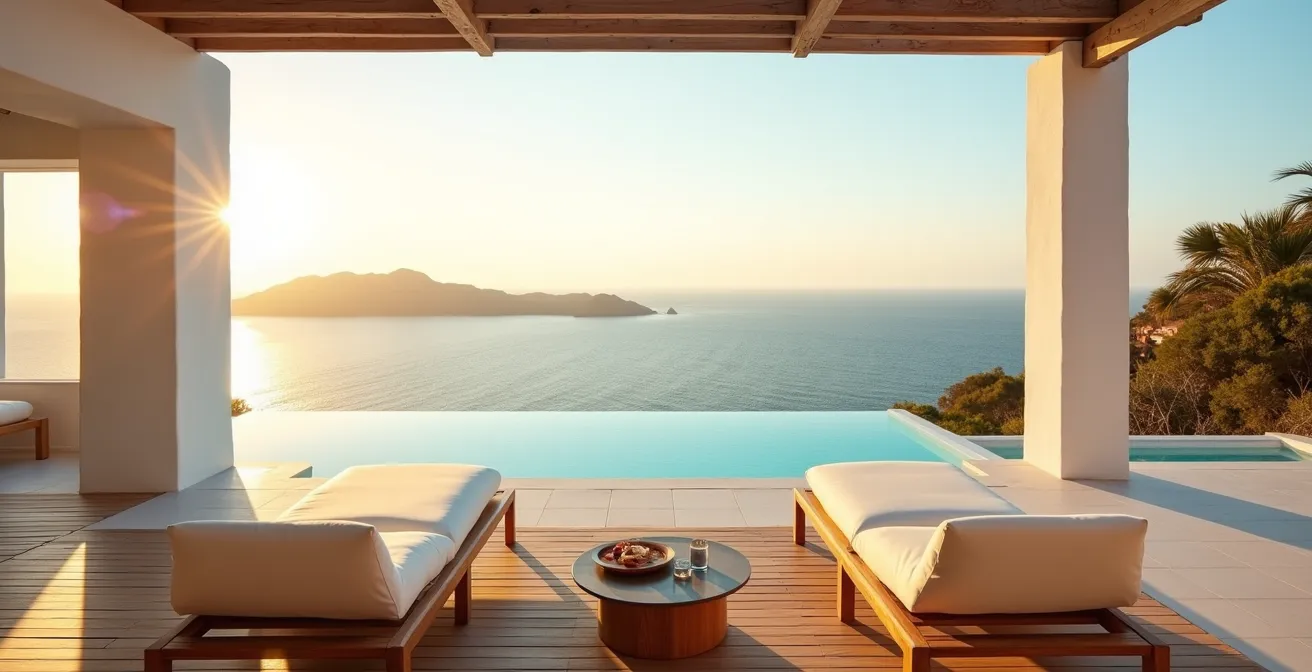
The common belief that true luxury privacy is a feature of a specific destination is a myth; it is, in fact, an engineered system you can learn to identify and choose.
- Privacy is not just about location but about verifiable metrics like staff-to-guest ratios and the design of service protocols.
- True seclusion extends beyond your accommodation to encompass the entire journey, including seamless, private transit through airports.
Recommendation: Shift your focus from asking “where to go” to asking “how is privacy delivered,” using the frameworks in this guide to vet any potential destination.
For discerning couples, the search for a truly private escape has become the ultimate luxury. Yet, the typical advice—lists of over-photographed destinations or a simple recommendation to “book a villa”—often leads to disappointment. You arrive at a celebrated resort in the Maldives or Santorini only to find your serene view is shared with a dozen other balconies, and your “private” beach is a short walk from a bustling public path. The promise of seclusion evaporates under the glare of mass luxury tourism, leaving you with a five-star price tag for a three-star experience in privacy.
The problem lies in a fundamental misunderstanding. We have been taught to see privacy as a geographical attribute, a pin on a map. We look for remote islands or secluded coastlines, believing distance equals discretion. But what if this approach is flawed? What if the key to genuine, uninterrupted intimacy isn’t about finding an undiscovered location, but about understanding the operational systems that create a bubble of personal space around you, regardless of the destination?
This guide offers a paradigm shift. We will move beyond destination-focused thinking to reveal the art and science of “engineered privacy.” This is the framework used by elite travel concierges to ensure a client’s experience is truly their own. It’s about learning to spot the difference between marketing language and genuine service discretion, evaluating the critical ratio of space to guests, and understanding how a journey can be made seamless from your front door back to your front door. Throughout this guide, we will deconstruct the components of true privacy, giving you the tools to make informed decisions for your next romantic journey.
This article provides a comprehensive framework for evaluating and securing genuine privacy. The following sections break down each critical component of a truly secluded luxury experience.
Summary: The Art of Privacy: A Guide to Choosing Secluded Luxury Travel for Two
- Why “5-Star” Does Not Always Mean Great Service in Europe
- How to Charter a Private Yacht for a Day Without Being a Billionaire
- Boutique Hotel vs Private Villa: Which Is Better for a Romantic Week?
- The “Exclusive” Resort That Is Actually Overcrowded and Noisy
- How to Use VIP Airport Services to Bypass Queues Completely
- Why Your Cortisol Levels Drop Faster in Ubud Than in Cornwall
- Why Trust Is the Most Valuable Currency for UK Consumers Today
- How a Bali Wellness Retreat Cures Executive Burnout in 10 Days
Why “5-Star” Does Not Always Mean Great Service in Europe
The star rating system, particularly in Europe, is often a measure of facilities—the presence of a swimming pool, a 24-hour reception, the size of the rooms—rather than the intangible quality of service. A hotel can tick all the five-star boxes and still offer an experience that feels intrusive or impersonal. For couples seeking privacy, the critical differentiator is not the number of stars, but the culture of service discretion. This is the art of being flawlessly attentive without ever being obtrusive, a philosophy that is engineered, not accidental.
True luxury service anticipates your needs before you voice them, creating a seamless environment where every detail is handled quietly in the background. This proactive approach is a hallmark of elite establishments that prioritize the guest experience over mere amenities. The demand for this level of privacy is growing; a recent Internova Index report shows that 25% of luxury travelers now prioritize ultra-private travel. This signifies a shift where the quality of personal space and discretion outweighs traditional markers of luxury.
Look for hotels that define themselves as “service-led” specialists, as these are the properties that command premium rates precisely because they understand that privacy and quality are intertwined. They invest heavily in staff training, focusing on emotional intelligence and situational awareness. Their goal is for you to feel like the only guests in the hotel, even when it’s fully booked. This is the true measure of five-star service in the modern era of luxury travel.
How to Charter a Private Yacht for a Day Without Being a Billionaire
The image of a private yacht often conjures thoughts of oligarchs and week-long charters costing hundreds of thousands of dollars. However, the market has evolved, creating a new tier of accessibility for couples wanting the ultimate day of private coastal exploration. The secret is to shift focus from weekly charters of superyachts to daily or half-day charters of smaller, yet still luxurious, motor or sailing yachts. This approach provides the full private experience—a dedicated crew, a bespoke itinerary, and access to secluded coves unreachable by land—for a fraction of the cost.

As you can see, the true value of a yacht is the unparalleled access it grants to pristine, private environments. Many charter companies in the Mediterranean, particularly in destinations like Croatia which can be more affordable than the South of France, now specialize in these shorter excursions. For a romantic day, a 46-60ft motor yacht is perfectly sized, offering ample space for sunbathing, a private lunch prepared by the crew, and the agility to navigate into breathtakingly quiet anchorages. The key is to book well in advance, especially during high season, and to work with a reputable broker who understands your desire for privacy and can match you with the right vessel and crew.
The cost-effectiveness of this approach is often surprising. As the data below illustrates, while weekly rates can be formidable, the emergence of daily options has made this pinnacle of private travel a viable indulgence for a special occasion.
| Yacht Type | Weekly Rate (Low Season) | Weekly Rate (High Season) | Daily Options |
|---|---|---|---|
| Small Sailing Yacht (35ft) | €1,500 (bareboat) | €2,000+ | Not typically available |
| Skippered Yacht (40ft) | €2,500 | €3,500+ | Limited availability |
| Motor Yacht (46-60ft) | €10,500 | €37,500-39,000 | €1,500-3,900/day |
| Luxury Crewed Yacht | €8,000 | €15,000+ | 4-6 hour charters emerging |
| Croatia vs St. Tropez | 30-50% less expensive | 30-50% less expensive | More flexible options |
These figures, highlighted in a recent analysis of Mediterranean charter costs, confirm that a day of unparalleled privacy on the water is more accessible than ever.
Boutique Hotel vs Private Villa: Which Is Better for a Romantic Week?
The classic dilemma for a romantic getaway often boils down to a choice between the curated service of a boutique hotel and the absolute seclusion of a private villa. There is no single correct answer; instead, the ideal choice depends on where you fall on the “Seclusion Spectrum.” This spectrum ranges from wanting impeccable service at your fingertips to desiring complete autonomy and isolation. Understanding your personal preference is the first step to crafting the perfect private escape.
A high-end boutique hotel offers a powerful combination of privacy and service. With fewer rooms than a large resort, the environment is inherently more intimate. The staff can learn your preferences, creating a highly personalized experience. It offers what can be termed “serviced seclusion”—you are shielded from the outside world, yet every need is catered to by an expert team. A recent survey highlights this divide, showing that while 37.5% of luxury travelers prefer private villas, a nearly equal 36.4% opt for boutique hotels, proving both models have strong appeal.
On the other end of the spectrum, a private villa offers unrivaled spatial privacy. You have your own pool, your own schedule, and no other guests to consider. This is ideal for couples who value autonomy above all else. However, it’s crucial to vet the level of service. Does the villa come with a dedicated concierge, daily housekeeping, and a private chef, or are you left entirely to your own devices? The surge in demand for luxury villas, which grew by 40% recently, means the quality and service levels can vary dramatically. The best private villa experiences now mirror the service of a top hotel, but within your own exclusive domain.
The “Exclusive” Resort That Is Actually Overcrowded and Noisy
The word “exclusive” is one of the most overused and misleading terms in the luxury travel industry. Many resorts market themselves as exclusive while operating with a high density of rooms, shared facilities, and a constant flow of guests. This is where the illusion of exclusivity shatters. True exclusivity isn’t about a high price point or a remote location; it’s a verifiable, mathematical reality based on the rooms-to-acreage ratio. A resort with 20 villas spread over 50 acres will offer a profoundly different experience of privacy than one with 100 rooms on the same footprint.
The pandemic has only intensified this desire for genuine space and seclusion. As noted by industry analysts, the trend is clear. Travel And Tour World highlights this shift in their market analysis:
The COVID-19 pandemic has amplified the desire for privacy and exclusivity in travel. Guests are seeking private villas, secluded resorts, and exclusive experiences away from crowds.
– Travel And Tour World, Luxury Hotels Market Analysis 2025
This insight underscores the need for a more discerning evaluation process. Beyond marketing materials, you must become a detective, looking for tangible evidence of privacy. This includes examining resort maps, counting the number of pools versus the number of rooms, and looking for features like private entrances, secluded terraces, and dedicated staff for certain suites or villas. A high staff-to-guest ratio (ideally 2:1 or better) is another strong indicator that personal attention and discretion are priorities.
Action Plan: How to Identify Truly Private Luxury Resorts
- Calculate the rooms-to-acreage ratio (fewer rooms per acre = more privacy).
- Look for properties with less than 20 rooms for ultimate exclusivity.
- Check staff-to-room ratios (ultra-luxury resorts average well above 3:1).
- Verify privacy offerings include private plunge pools, separate villa entrances, and dedicated staff.
- Research location remoteness—private islands and isolated atolls offer maximum seclusion.
How to Use VIP Airport Services to Bypass Queues Completely
The experience of privacy should not begin when you arrive at your hotel; it should start the moment you leave home. Airports are often the most significant friction point in a journey, filled with queues, noise, and a complete lack of personal space. However, a parallel, unseen system exists to eliminate this stress entirely. VIP airport services, often referred to as “meet and greet” or “airport concierge,” offer a seamless transit through the terminal, ensuring your journey is as private and effortless as your destination.

This service is not merely about skipping lines. Upon arrival at the airport, a dedicated agent meets you at the kerbside. They handle your luggage while escorting you through private security and immigration channels, often in a separate, quiet lounge. While you relax with a drink, they take care of all formalities. When it’s time to board, you are driven directly to the aircraft in a private vehicle, often being the last to board. The experience is reversed upon arrival at your destination. This is the essence of seamless transit, and its value is increasingly recognized. In fact, more than 60 percent of discerning clients now request skip-the-line experiences, demonstrating that the journey is as important as the destination.
These services are available at most major international airports and can be booked independently or through a travel advisor. While once the preserve of diplomats and celebrities, they are now an accessible luxury for anyone who places a high premium on their time and peace of mind. It transforms the airport from a place of stress into a calm, controlled, and utterly private part of your vacation.
Why Your Cortisol Levels Drop Faster in Ubud Than in Cornwall
While any beautiful location can be relaxing, certain environments are scientifically more effective at reducing stress. The difference between a pleasant trip to Cornwall and a transformative retreat in Ubud, Bali, lies in the concept of immersive sensory engineering. It’s the deliberate curation of an environment that minimizes harsh stimuli and maximizes restorative sensory input, directly impacting your body’s chemistry by lowering cortisol, the primary stress hormone.
Ubud, a world-renowned wellness hub, is a masterclass in this principle. Its best retreats are designed to be holistically calming. Consider the soundscape: instead of traffic or the sharp cry of gulls, you are enveloped in the gentle, non-rhythmic sounds of flowing water, wind through bamboo, and distant gamelan music—sounds proven to soothe the nervous system. The visual input is overwhelmingly green, a colour associated with tranquility. The air is filled with the natural aromatherapy of frangipani and incense. This is not accidental; it is a carefully constructed ecosystem designed for decompression.
In contrast, a beautiful destination like Cornwall offers stunning sea views and fresh air, which are certainly beneficial. However, the overall sensory environment is often less controlled. You may still encounter crowds on coastal paths, traffic in picturesque villages, and a less consistent soundscape. While deeply enjoyable, it does not create the same profound, physiological shift as an environment where every sensory detail is harmonized for relaxation. The takeaway for the discerning traveler is to look for destinations that don’t just offer beauty, but have a deeply ingrained culture of environmental wellness, where the setting itself is an active part of the restorative experience.
Why Trust Is the Most Valuable Currency for UK Consumers Today
In mature luxury markets like the United Kingdom, consumers have become increasingly sophisticated. They have experienced high-end service and can readily distinguish between transactional hospitality and a relationship built on trust. For these travelers, trust has surpassed price and even brand name as the most valuable currency. This trust is not built on grand gestures, but on the consistent, flawless execution of small, personalized details. It is the hotel that remembers you prefer a specific type of water, or the concierge who proactively books your favourite restaurant without being asked.
This deep level of personalization is the bedrock of modern luxury. It demonstrates that a service provider sees you as an individual, not just a room number. The data is unequivocal on this point: research shows that 66% of luxury travelers state it’s ‘very important’ that a hotel anticipates and accommodates their personal preferences. When a hotel gets this right, it creates a powerful bond of loyalty. The guest feels understood and, more importantly, safe in the knowledge that their needs will be met without them having to ask.
This dynamic is why a traveler might choose a lesser-known boutique hotel where they have a trusted relationship with the staff over a globally famous five-star brand where they are anonymous. For the UK consumer, and indeed for discerning clients worldwide, the question is no longer “what is your brand?” but “do I trust you to manage my experience perfectly?” This trust is earned through demonstrated consistency and a genuine investment in understanding the individual. It is the quietest, yet most powerful, element of a truly private and luxurious experience.
Key Takeaways
- True privacy is an engineered system, not a geographical feature. Evaluate properties on verifiable metrics like rooms-to-acreage and staff-to-guest ratios.
- The definition of luxury service is shifting from facilities to “service discretion”—the art of providing attentive, anticipatory service without being intrusive.
- Extend your privacy strategy to the entire journey by using VIP airport services to create a seamless, stress-free transit experience.
How a Bali Wellness Retreat Cures Executive Burnout in 10 Days
Executive burnout is a modern epidemic, characterized by chronic stress, exhaustion, and a sense of detachment. A standard vacation often fails to address this, as it doesn’t break the cycle of mental and physiological stress. A true wellness retreat, particularly the ultra-luxury variant found in places like Bali, is specifically engineered to do just that. It’s not a holiday; it’s a prescribed system for recovery, combining a controlled environment with personalized wellness protocols to achieve a measurable reduction in burnout in a short timeframe.
The efficacy of these retreats lies in their holistic, multi-pronged approach. First, they remove all sources of external stress. There are no decisions to make about meals, schedules, or activities; everything is curated for you by a dedicated team. Second, they immerse you in a restorative environment, as discussed previously, using sound, sight, and scent to lower cortisol. Finally, they provide a structured program of activities—such as yoga, meditation, spa therapies, and nutrition coaching—designed to restore the body’s equilibrium. This integrated approach creates a powerful synergistic effect that a simple beach holiday cannot replicate.
The key difference between a standard luxury hotel with a spa and an ultra-luxury wellness retreat is the level of integration and personalization. The latter offers a complete journey, not just à la carte services. This is reflected in their operational structure, which is designed for maximum privacy and impact.
This table, based on an industry report from Arthur D. Little, clearly shows the structural differences that define an ultra-luxury wellness experience.
| Resort Feature | Standard Luxury | Ultra-Luxury Wellness |
|---|---|---|
| Room Count | 50-200+ rooms | Less than 20 villas |
| Staff-to-Guest Ratio | 1:2 | 3:1 or higher |
| Privacy Features | Private balconies | Private pools, dedicated staff per villa |
| Wellness Programs | Spa treatments à la carte | Integrated wellness journeys, private instructors |
| Average Nightly Rate | $500-1,500 | $3,000+ per night |
In just 10 days, this highly controlled, hyper-personalized system can reboot an executive’s nervous system, providing the deep rest needed to truly recover from burnout.
To implement this discerning approach, the next logical step is to begin building a portfolio of vetted properties and service providers that meet these stringent criteria for privacy and trust.
Frequently Asked Questions on Private Luxury Travel
What do luxury travelers value most from hotels?
Nearly 74% of luxury travelers love when hotels surprise and delight guests with welcome amenities and upgrades without being asked. This demonstrates that anticipatory service which shows a guest is truly seen and valued is a key component in building trust and loyalty.
How important is exclusive access in building trust?
Over 50% of luxury travelers consider concierge services that provide access to exclusive or hard-to-get experiences as very important. When a hotel can open doors that a guest cannot open themselves, it establishes a high degree of authority and trust, proving its value beyond a simple room booking.
What role does personalization play in trust?
A significant two-thirds of travel advisors report their clients believe it is very important that hotels know and accommodate their individual preferences. Personalization is the core of modern luxury trust; it is the tangible proof that a provider is invested in the individual guest’s experience.