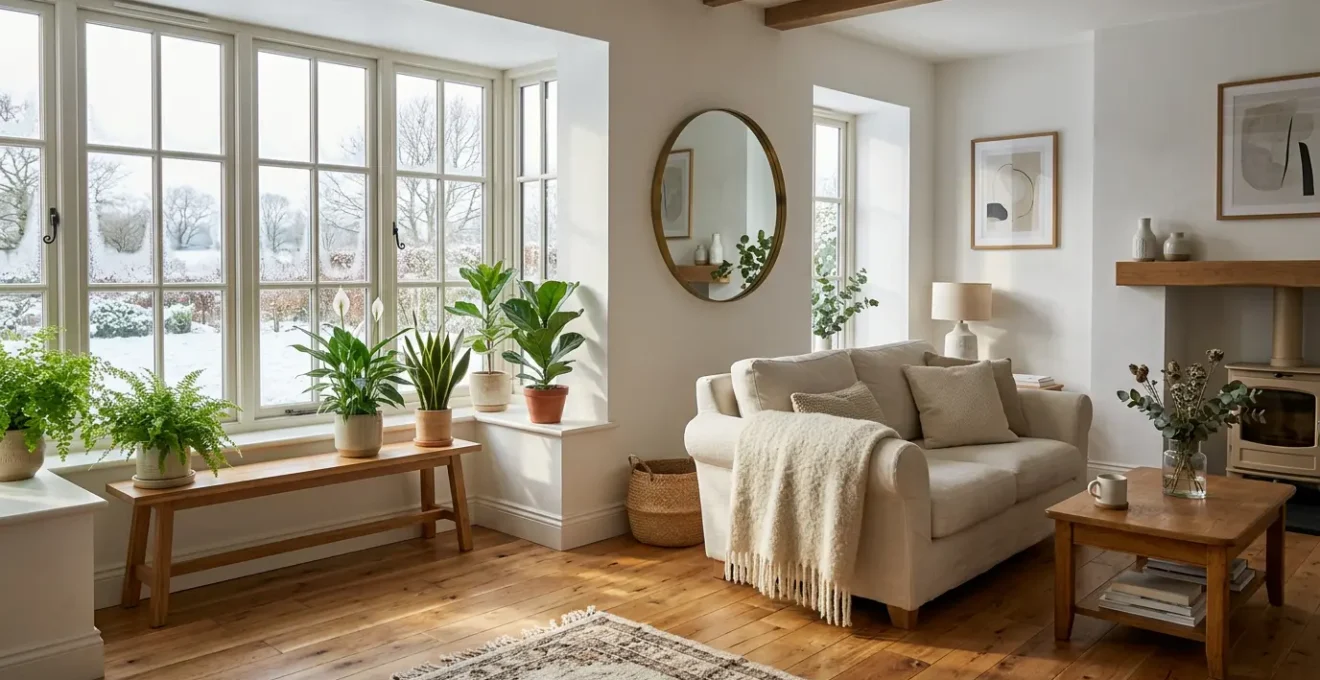
Beating the winter blues isn’t about simply adding more light; it’s about choreographing the *right light at the right time* to reset your internal body clock.
- Maximise high-intensity, blue-spectrum natural light before 10 a.m. to suppress sleep hormones and boost cortisol for daytime energy.
- Actively create “biological darkness” in the evening with warm, low-level lighting to allow for natural melatonin production and deep, restorative sleep.
Recommendation: Stop thinking like a decorator who just fills a space with light and start thinking like a circadian choreographer who sculpts it to enhance your biology.
As the days shorten and a familiar grey blanket settles over the UK, a heavy lethargy can creep into our homes and our spirits. For many, this is the onset of Seasonal Affective Disorder (SAD), a mood dip intrinsically linked to the lack of light. The common advice is often simplistic: open the curtains, paint the walls white, maybe buy a SAD lamp. While well-intentioned, these tips only scratch the surface. They treat light as a brute commodity to be maximised, rather than a powerful biological signal to be intelligently managed.
The truth is, your home is not just a shelter; it’s an environment that constantly communicates with your deepest biological rhythms. The problem isn’t merely the *quantity* of light during a British winter, but its *quality, timing, and direction*. What if the key to feeling vibrant and energised, even in the depths of January, wasn’t just about fighting the darkness, but about embracing a new kind of light science within your own walls? This is the core principle of biophilic design: creating habitats that realign our ancient biology with the modern world.
This guide moves beyond generic advice. We will explore how to become a “circadian choreographer” in your own space. We’ll uncover how to harvest and bounce precious daylight into the darkest corners, why your garden might be stealing your morning energy, and how to layer artificial light in the evening to orchestrate a perfect “indoor sunset.” It’s time to transform your home from a passive container into an active partner in your wellbeing.
This article provides a comprehensive roadmap to reclaiming your energy during the darker months. Below, the summary outlines the key strategies we will explore, from mastering your sleep cycle to optimising your home’s windows and workspace for maximum vitality.
Summary: A Biophilic Blueprint for a Brighter Winter
- Why Artificial Blue Light at Night Ruins Your Sleep Quality
- How to Position Mirrors to Bounce Light Into Dark Corners
- Voiles vs Blinds: Which Maximises Privacy Without Blocking Light?
- The Garden Mistake That Steals 30% of Natural Light From Your Living Room
- In Which Order Should You Layer Artificial Lights for Evening Ambiance?
- Why Your Cortisol Levels Drop Faster in Ubud Than in Cornwall
- Why the U-Value of Your Glass Matters More Than the Frame
- How to Create a Functional Ergonomic Interior for a 100% Remote Job
Why Artificial Blue Light at Night Ruins Your Sleep Quality
Our bodies are wired with an ancient internal clock, the circadian rhythm, which is primarily calibrated by light. Bright, blue-spectrum light—like that of the morning sun—tells our brain to be alert, suppressing the sleep hormone melatonin. Conversely, the warm, dim light of sunset signals that it’s time to wind down. For millennia, this was a perfect system. Today, our homes are filled with artificial lights and screens that emit high levels of blue light, effectively telling our brains it’s midday at 10 p.m. This creates a state of “circadian disruption,” which is a primary driver of poor sleep and low mood.
The biological impact is significant. The blue light from our devices and cool-white LED bulbs is a potent melatonin suppressant. In fact, Harvard research demonstrates that blue light can suppress melatonin for about three hours, twice as long as green light. This delay in melatonin release makes it harder to fall asleep, reduces the quality of that sleep, and leaves you feeling groggy the next morning, creating a vicious cycle of fatigue that is amplified during the winter.
The solution is to create “biological darkness” in your home a few hours before bed. This doesn’t mean sitting in total darkness, but rather shifting the colour and intensity of your light to mimic a natural sunset. By consciously curating an evening light environment, you send the correct signals to your brain, allowing it to begin the crucial processes of rest and repair. This is the first and most critical step in your circadian choreography.
Your Digital Sunset Ritual: A 5-Step Plan for Better Sleep
- Set a phone alarm for 2 hours before bedtime as your ‘digital sunset’ trigger. This is the cue to begin winding down.
- Switch from overhead cool LED lights to warm, low-level table lamps. Look for bulbs with a colour temperature of 2700K or below.
- Activate ‘night mode’ on all your digital devices or use blue-light blocking apps to shift the screen colour to a warmer amber tone.
- For the final hour before bed, transition to accent lighting only. This could be very dim amber lights, salt lamps, or even candlelight.
- Finally, place all devices in another room. Using an analogue alarm clock can remove the temptation to check your phone one last time.
How to Position Mirrors to Bounce Light Into Dark Corners
Once you’ve managed your light at night, the daytime mission begins: capturing every precious photon of natural light the UK winter offers. The desire for better light is a deeply felt need. A study revealed that when employees were asked what would most improve their mood at work, a third (33%) of respondents stated better lighting. The same principle applies tenfold to our homes during darker months. Mirrors are the most powerful tool in your “light harvesting” arsenal, but their effectiveness depends entirely on strategic placement, not just presence.
A mirror placed on a dark wall opposite another dark wall does little more than reflect the gloom. The key is to position mirrors so they can “catch” light from a source—typically a window—and “throw” it into a dark area. Think like a physicist playing with angles. A large mirror placed on a wall adjacent to a window, or directly opposite it, can effectively double the perceived amount of light in that area. It captures the incoming daylight and bounces it deep into the room, illuminating spaces the direct light cannot reach.
This technique transforms a mirror from a decorative object into a functional part of your home’s lighting system, as the diagram below illustrates.
As you can see, the angle of incidence is key. Don’t be afraid to experiment. Try placing a mirror at a 45-degree angle in a corner to see how it redirects light. Consider using multiple smaller mirrors or even a piece of furniture with a mirrored surface. The goal is to create a pathway for light to travel, turning dim corridors and shadowy corners into brighter, more inviting spaces. This isn’t just decoration; it’s active light management.
Voiles vs Blinds: Which Maximises Privacy Without Blocking Light?
Finding the balance between maintaining privacy and maximising natural light is a classic design dilemma, especially in urban or suburban UK homes. The wrong window treatment can be a major light thief. As colour psychologist Angela Wright notes, many interiors lean towards grey, a colour that can amplify our natural instinct to hibernate in winter. She states:
Grey is always a favourite colour for office design – yet, the human instinct in a grey world is to hibernate – so the winter months are already a constant battle to fight the instinct to sleep.
– Angela Wright, Colour psychologist
Heavy, opaque curtains or dark-coloured blinds can compound this effect, creating a cave-like environment that starves our brains of the light they crave. The choice of window dressing is therefore a crucial part of your home’s wellbeing strategy. You need a solution that diffuses light beautifully while obscuring the view from the outside.
This is where modern voiles and innovative blind designs come into play. Sheer voiles are excellent for light diffusion; they soften harsh glare and scatter light evenly throughout a room, but they offer limited privacy, especially at night. On the other hand, certain types of blinds are engineered specifically to solve this problem. “Top-down, bottom-up” blinds are a game-changer, allowing you to lower the blind from the top to let in light from the sky while keeping the bottom half of the window covered for privacy at street level. The following table compares some of the best options for light-conscious homeowners.
| Window Treatment | Light Transmission (%) | Privacy Level | Best For |
|---|---|---|---|
| Sheer Voiles | 60-80% | Low-Medium | Maximum light diffusion |
| Top-Down Bottom-Up Blinds | Variable 0-100% | High (bottom blocked) | Street-level privacy + ceiling light |
| Cellular Shades | 20-50% | High | Thermal insulation + diffusion |
| Translucent Rollers | 30-40% | Medium-High | Clean aesthetic + privacy |
The Garden Mistake That Steals 30% of Natural Light From Your Living Room
The “light harvesting” mission extends beyond your four walls and into your garden. Many homeowners unknowingly commit a major error that can rob their primary living spaces of up to a third of their potential winter daylight. The mistake? Planting large, dense, evergreen shrubs and trees too close to the house, particularly in front of south-facing windows. While lovely in the summer, these plants become solid walls that block the low-angled winter sun at precisely the time of day your body needs it most.
Our circadian rhythm is most powerfully reset by bright light exposure in the morning. This morning light signals the brain to shut down melatonin production and ramp up cortisol, providing the energy and alertness needed for the day. In fact, research consistently shows that morning light is biologically more potent than afternoon light. Therefore, any obstruction that blocks this crucial morning sun is actively working against your wellbeing.
The solution is strategic gardening and pruning. This doesn’t mean clear-cutting your garden. It means making intelligent choices about what grows where. Replace dense evergreen hedges near windows with deciduous plants that lose their leaves in winter, allowing light to pass through. For existing trees, consider “lifting the crown” (removing lower branches) or “thinning the canopy” to create “light windows” for the sun to penetrate. Even simple changes, like using light-coloured gravel instead of dark bark mulch, can help reflect light up and into your home.
Action Plan: A Winter Pruning Guide for Maximum Light
- Identify Blockers: Locate any evergreen hedges or large shrubs situated within 3 meters of your primary windows. These are your main targets as they block the low winter sun.
- Lift the Crown: During the dormant season (late autumn to early spring), prune the lower branches of trees close to the house, removing growth up to about one-third of the tree’s total height.
- Thin the Canopy: For dense trees, selectively remove 20-30% of the inner branches. This opens up the structure, allowing sunlight to filter through the canopy instead of being blocked entirely.
- Reflect Light Upwards: Replace dark mulch or soil around your foundations with light-coloured gravel, white stones, or pale paving to bounce more light towards your windows.
- Use Reflective Boundaries: If you have fences or walls near plants, consider painting them a bright, light-reflecting white. This turns them into a secondary light source.
In Which Order Should You Layer Artificial Lights for Evening Ambiance?
As daylight fades, your artificial lighting strategy takes over. This is where you create your “indoor sunset” to continue the day’s circadian choreography. The common mistake is to simply flip on a single, bright overhead light, which is the equivalent of a sudden, jarring blast of noon sun at 7 p.m. This sends confusing signals to your brain and disrupts the natural winding-down process. A far more effective and pleasant approach is to layer your lighting, using different sources in a specific sequence to create a gradual transition into the evening.
Lighting designers think in three main layers:
- Ambient Light: This is the general, overall illumination of the room, often from a central ceiling fixture or recessed downlights. As evening approaches, this should be your first layer to dim down.
- Task Light: This is focused light for specific activities, like a lamp for reading or under-cabinet lighting for cooking. It provides brightness where you need it without flooding the whole room.
- Accent Light: This is the “mood” lighting. It highlights architectural features, artwork, or plants and creates a warm, inviting glow. This is the final layer of light that should remain in the hour before bed.
The sequence is key: start the evening by dimming the ambient layer. Keep task lights on as needed, but try to use warmer bulbs (around 2700K). As you get closer to bedtime, turn off the task lights and rely solely on the warm, gentle glow of your accent lights. This progressive dimming and warming of light mimics the natural progression of sunset. Modern smart lighting systems make this easy to automate. A case study on workplace wellness found significant benefits from programmable bulbs that shifted from a morning ‘Focus’ setting at 4000K to an evening ‘Wind Down’ at 2200K, improving circadian rhythm regulation. The same principle, using a light therapy box output of 2,500 to 10,000 lux in the morning and warm dim light at night, is a cornerstone of managing winter fatigue.
Why Your Cortisol Levels Drop Faster in Ubud Than in Cornwall
The title poses a provocative question, but the answer lies in a simple, powerful concept: biophilia. This is our innate, genetically-coded need to connect with nature. An environment rich in natural elements, like the lush landscapes of Ubud, Bali, instinctively signals safety and calm to our nervous system. This helps lower stress hormones like cortisol much more effectively than an environment that is nature-deprived, even a beautiful but stark coastal landscape like in Cornwall during winter.
You don’t need to move to a tropical island to reap these benefits. You can bring the essence of Ubud into your UK home by consciously integrating biophilic design elements. This goes beyond just adding a pot plant. It’s about incorporating natural patterns, materials, and sensory experiences that reduce stress. Studies have found that even brief exposure to biophilic environments can help restore cognitive ability and reduce mental fatigue. The presence of indoor plants, views of nature, natural materials like wood and stone, and even the sound of water can all contribute to a restorative atmosphere.
The key is to create “micro-restorative” zones in your home. This could be a comfortable armchair next to a window with a clear view of a tree, a collection of indoor plants in your workspace, or a water feature on a balcony. As researcher Elton Lima highlights, the barrier to entry is low: “Even adding one or two medium-sized plants into frequently-used spaces helps.” These small pockets of nature act as anchors, providing moments of psychological relief throughout the day, helping to buffer the mental strain of a long, grey winter.
Why the U-Value of Your Glass Matters More Than the Frame
When considering how light and warmth enter our homes, we often focus on the window frames—their material, style, and colour. However, the glass itself, or “glazing,” typically makes up 80% or more of the window’s total area. It is the single largest surface through which light enters and heat escapes. Therefore, the technical performance of your glass is far more critical to your home’s comfort and energy efficiency than the frame that holds it. Understanding a few key metrics is essential for making an informed choice.
The three most important values for glazing are:
- U-Value: This measures how well the window prevents heat from escaping. The lower the U-Value, the better the insulation. In the UK climate, a low U-Value is crucial for staying warm in winter without huge heating bills.
- g-Value (or SHGC): The Solar Heat Gain Coefficient measures how much heat from the sun the window lets through. In winter, a higher g-Value is beneficial on south-facing windows to capture free solar warmth.
- Visible Transmittance (VT): This is the percentage of visible light that passes through the glass. A higher VT means a brighter room.
The challenge is balancing these three factors. For example, triple glazing has a fantastic U-Value but often a lower VT and g-Value than high-quality double glazing. For a UK home, a modern Low-E (low-emissivity) double-glazed unit often represents the best compromise, offering good insulation while still allowing for significant light and solar heat gain. The following table breaks down the performance of common glazing types.
| Glazing Type | U-Value (W/m²K) | g-Value (SHGC) | VT (%) | Best Application |
|---|---|---|---|---|
| Single Glazing | 5.8 | 0.85 | 88 | Historic buildings only |
| Double Glazing | 2.8 | 0.76 | 81 | Standard UK homes |
| Triple Glazing | 0.8 | 0.50 | 74 | Passive house standard |
| Low-E Double | 1.6 | 0.63 | 78 | South-facing winter gain |
Key Takeaways
- Morning Light Is Medicine: Prioritise capturing bright, natural light before 10 a.m. to set your body clock for a day of energy and focus.
- Sculpt and Diffuse, Don’t Just Expose: Use mirrors, light-coloured surfaces, and strategic pruning to actively guide light into your home’s darkest corners.
- Your Evenings Define Your Mornings: Create an “indoor sunset” with warm, dim, layered lighting to allow for natural melatonin production, leading to better sleep and a brighter mood the next day.
How to Create a Functional Ergonomic Interior for a 100% Remote Job
In the era of 100% remote work, our homes have become our offices. Creating a functional ergonomic interior is no longer a luxury but a necessity for productivity and long-term health. However, true ergonomics goes beyond an adjustable chair and a standing desk. It must encompass “light ergonomics“—the practice of designing your workspace to align with your biological need for dynamic, high-quality light throughout the day. This is especially critical during the UK winter when the lack of light can severely impact focus and motivation.
Research has shown that over half of British workers feel significantly less productive during winter. A biophilic and light-centric approach to workspace design can directly combat this. A UK tech company provides a powerful case study. They tackled winter fatigue by creating multiple work zones: bright “focus areas” with 10,000 lux task lighting for morning work, softer collaboration spaces for the afternoon, and screen-free biophilic break zones. The result was a remarkable 25% reduction in reported winter fatigue symptoms among staff. This demonstrates that varying the light environment is as important as the light itself.
To create your own functional and light-ergonomic workspace, position your desk to receive as much natural side-light as possible, avoiding glare on your screen. Use a powerful, full-spectrum task lamp (mimicking daylight) for focused work, especially in the morning. Then, create a separate, more softly lit area with a comfortable chair for calls, reading, or simply taking a screen break. Integrate plants and natural materials into your direct line of sight. By actively managing your light exposure and creating distinct zones for different types of work, you are not just organising your space; you are designing a powerful engine for wellbeing and productivity that can sustain you through even the greyest of days.
Start today by choosing one room and one strategy. Whether it’s creating a digital sunset ritual, repositioning a mirror, or pruning a single branch, every small act of light choreography is a step toward a brighter, more energised winter.