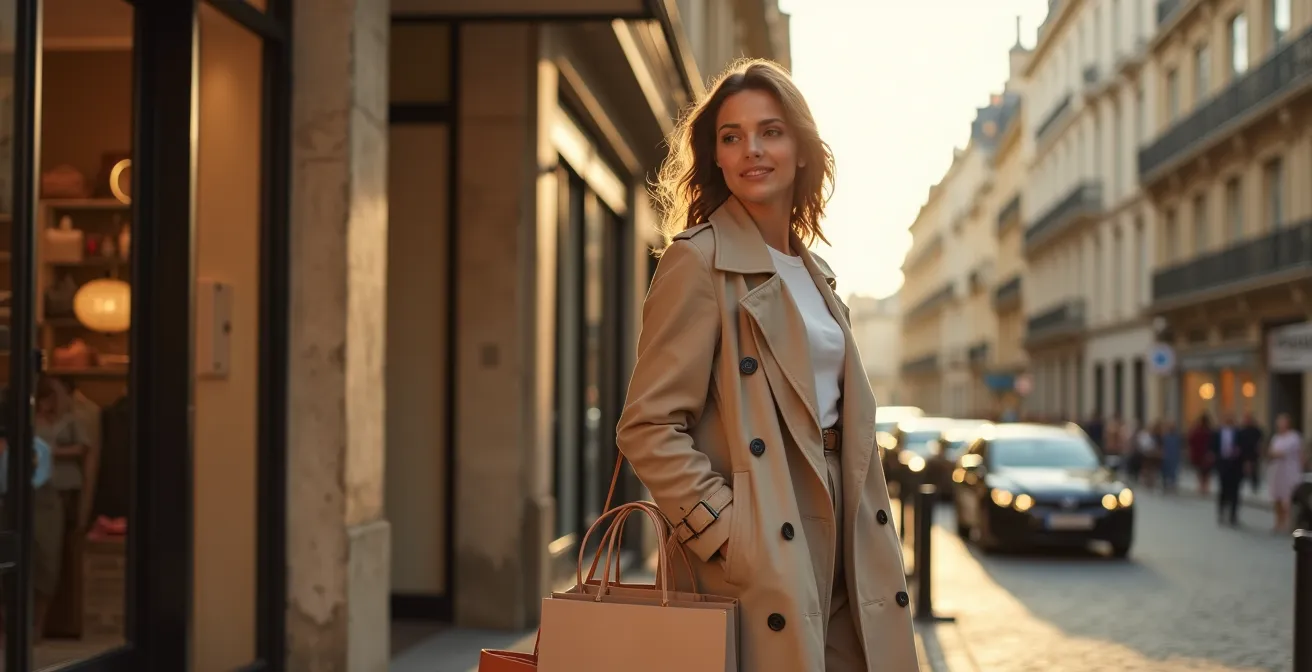
A chic Parisian shopping haul for under £2,000 isn’t about finding bargains; it’s about mastering the art of strategic spending, from insider appointments to crucial tax knowledge.
- Unlock an extra 12% in savings by correctly navigating the post-Brexit tax-free shopping process.
- Secure private appointments at top boutiques not through VIP status, but with a well-timed and polite email.
Recommendation: Allocate 10-15% of your item’s budget for professional alterations—a perfect fit is the ultimate luxury investment.
The allure of a Parisian shopping spree is undeniable: the whisper of tissue paper in a heritage boutique, the weight of a beautifully crafted handbag, the thrill of finding that perfect piece. For the fashion-conscious UK traveller, however, this dream often clashes with the perceived reality of a post-Brexit world and a strict budget. Many believe a truly luxurious experience is out of reach, settling for crowded department stores and generic advice.
The common wisdom is to hunt for sales or stick to high-street brands. But what if the secret to a sub-£2,000 luxury trip wasn’t about spending less, but about spending smarter? The key isn’t found in compromising on quality, but in mastering the fiscal finesse, insider access, and strategic philosophy that separate seasoned shoppers from tourists. It’s about transforming your budget from a limitation into a tool for precision-guided acquisition.
This guide isn’t a list of places to shop. It’s a personal shopper’s playbook. We will deconstruct the process, revealing how to leverage tax refunds to your advantage, secure the kind of personal service usually reserved for VIPs, and understand the critical customs rules that can make or break your budget. We’ll explore how to choose where to shop based on your style DNA and, most importantly, how to adopt a mindset that values timeless quality over fleeting trends, making every pound spent a true investment in your personal style.
This article will guide you through the essential strategies for a successful and stylish Parisian shopping experience. Discover the key steps to maximise your budget and enjoy luxury for less.
Summary: Your Chic Parisian Shopping Blueprint
- Why You Might Be Missing Out on 12% Savings via Tax-Free Shopping?
- How to Get a Private Appointment at Heritage Brands Without Being a VIP?
- Le Marais vs Avenue Montaigne: Which Fits Your Style Personality?
- The Customs Limit Error That Could Cost You Dearly at St Pancras
- When to Visit Paris to Catch the Best “Soldes” Discounts?
- Greenwashing vs True Sustainability: Which Certifications Can You Trust?
- Why a £500 Suit That Fits Perfectly Looks Better Than a £2000 Ill-Fitting One?
- How Sustainable Fashion Allows Self-Expression Without Harming the Planet?
Why You Might Be Missing Out on 12% Savings via Tax-Free Shopping?
Let’s begin with the most critical element of fiscal finesse: the VAT refund. Since Brexit, Paris has become a haven for savvy British shoppers, but many leave significant money on the table through confusion or simple oversight. The process isn’t just a travel chore; it’s a strategic tool. When handled correctly, it effectively gives you an immediate discount on your luxury purchases. According to recent data, UK tourists can claim back a substantial 12-13% on their spending, instantly making that dream item more attainable.
This isn’t a complex procedure reserved for high-rollers. It’s a simple, digital process. When you purchase goods over €100 in a single store, ask for the “bordereau de vente à l’exportation” (tax-free form). The key is the PABLO system at Gare du Nord. Before you go through passport control, you’ll find the self-service kiosks. The process is straightforward:
- Locate the PABLO self-service kiosks before passport control.
- Scan the barcode on your tax-free form (it will have a PABLO logo).
- Wait for the green confirmation light; this is your electronic customs stamp.
- Keep all your documents safely until the refund appears in your account.
- If you see a red light, don’t panic. Simply proceed to the nearby manual customs desk for assistance.
The impact is significant. As British consumers shift their luxury spending to the EU, with one report noting a surge from €169 million in 2021 to €854 million in 2024, the savings are clear. A Loewe Puzzle Bag priced at €3,600, for instance, could end up costing around €700 less once the VAT is reclaimed. This isn’t a discount; it’s your money. Mastering this simple process is the first step to making your £2k budget feel like £2,240.
How to Get a Private Appointment at Heritage Brands Without Being a VIP?
The ultimate luxury isn’t just the item you buy; it’s the experience of buying it. Fighting crowds at a busy counter is stressful and inefficient. The real secret to a sublime shopping day is securing a private appointment. This isn’t about having a celebrity’s contact book; it’s about preparation and politeness. A quiet, one-on-one session with a knowledgeable sales associate allows you to explore collections, try on pieces without pressure, and receive undivided attention. You transform from a mere customer into a valued guest.
This level of service is more accessible than you think. The key is a well-crafted email sent two to three weeks before your trip. Here’s how to compose it:
- Be specific: Mention the collections or even the exact pieces you’re interested in. This shows you’re a serious, informed client.
- Be strategic with timing: Request an appointment on a Tuesday or Wednesday morning. These are the quietest times in Parisian retail, making the boutique more likely to accommodate you.
- Be polite: Always start your email with “Bonjour,” even if the rest is in English. It’s a small gesture of respect that goes a long way.
- Be clear about your intent: Ask for a “personal shopping appointment” to view specific items, not just to browse. This frames your visit as a focused mission.
This proactive approach positions you as a discerning client who values their time and the brand’s expertise. It allows the boutique to prepare for your visit, perhaps setting aside the items you mentioned. It’s a simple strategy that unlocks a world of service, turning a potentially overwhelming experience into a serene and memorable highlight of your trip.
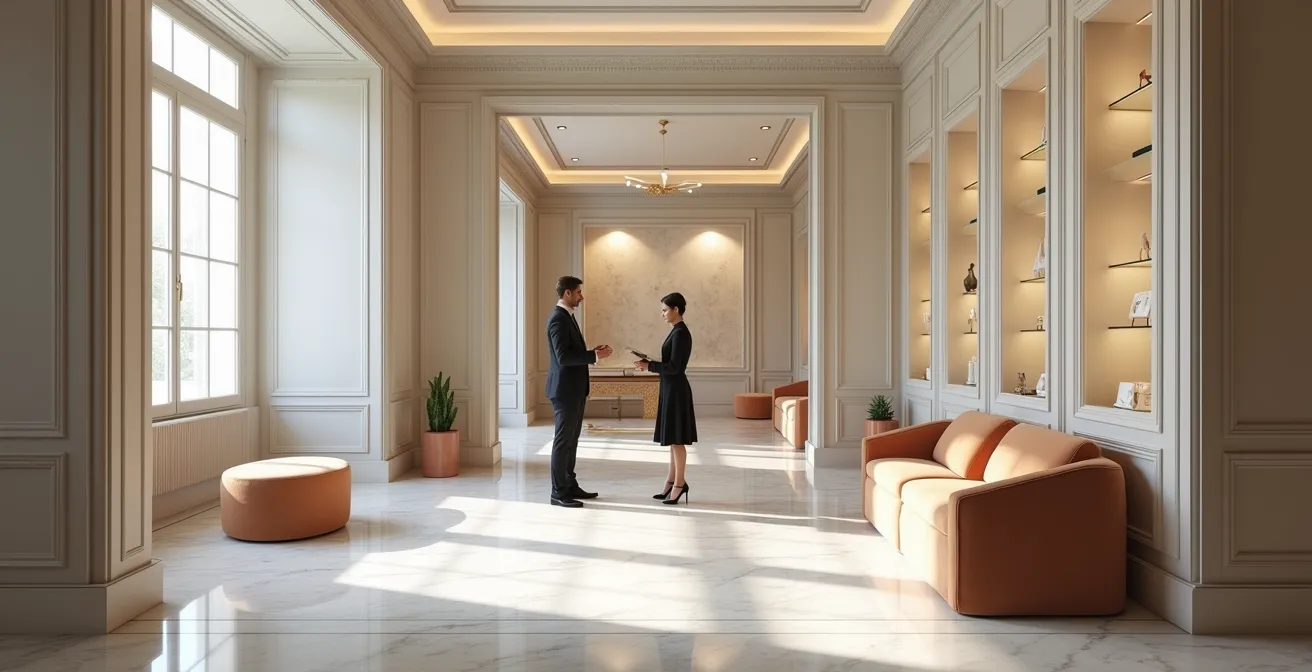
As you can see, the atmosphere of a private appointment is one of calm and curated elegance. This environment is not just more pleasant; it leads to better purchasing decisions. When you aren’t rushed or distracted, you can truly assess an item’s quality, fit, and place in your wardrobe—essential for making the most of a tight budget.
Le Marais vs Avenue Montaigne: Which Fits Your Style Personality?
Parisian shopping is not a monolith. The city’s retail landscape is a tapestry of distinct neighbourhoods, each with its own “style personality.” Choosing where to spend your time and money is the most personal strategic decision you’ll make. It’s not about which street has the most famous names, but which district resonates with your unique aesthetic. This is the essence of style geography: aligning your shopping environment with your personal brand.
The two most famous poles are Avenue Montaigne and Le Marais, representing the classic and the contemporary. Avenue Montaigne is the heart of traditional, investment-piece luxury. It’s a world of hushed reverence, where you are served champagne while considering a timeless handbag. It’s for the shopper seeking iconic, enduring style. In contrast, Le Marais is the epicentre of avant-garde and emerging design. Its cobbled lanes are filled with independent boutiques, art galleries, and a sense of discovery. It’s for the fashion-forward individual looking for unique, conversation-starting pieces.
But the map is richer than that. Saint-Germain-des-Prés offers a third way: intellectual chic. It’s less ostentatious than Avenue Montaigne but more refined than the trend-driven parts of Le Marais. Here, you’ll find understated luxury, artisanal quality, and boutiques that cater to a clientele that values subtlety and craftsmanship. It is also home to the world’s first ‘grand magasin,’ Le Bon Marché. Founded in the 1850s and now part of the LVMH family, it’s a curated mecca of Parisian luxury that combines fashion with gourmet food in a uniquely sophisticated atmosphere.
The following table breaks down what your £1,000 might get you in each district, helping you direct your budget with precision.
| District | £1000 Budget Gets You | Shopping Experience | Best For |
|---|---|---|---|
| Avenue Montaigne | One classic designer handbag or small leather good | Hushed reverence, champagne service, appointment-based | Investment pieces, timeless luxury |
| Le Marais | 3-5 unique pieces from emerging designers | Discovery, gallery-hopping, cobbled lanes | Avant-garde fashion, unique finds |
| Saint-Germain-des-Prés | 2-3 understated luxury items | Intellectual chic, boutique browsing | Refined, subtle luxury |
The Customs Limit Error That Could Cost You Dearly at St Pancras
You’ve successfully navigated Paris, secured your dream items, and even have your VAT refund validated. The final hurdle is returning to the UK, and it’s here that a simple mistake can erase all your savvy savings. The crucial detail every UK traveller must know is the personal customs allowance. Forgetting this can be a very expensive error upon arrival at St Pancras.
The rule is strict and unforgiving. The critical UK customs allowance for other goods is £390. Here’s the critical part: if the total value of your goods exceeds this amount by even £1, you must pay customs duty on the *entire* value of the goods, not just the amount over the limit. Furthermore, if you claimed a VAT refund in France, you have automatically declared your intention to export the goods, and therefore you are legally required to declare them upon entry to the UK, regardless of value.

This process, though seemingly daunting, can be handled smoothly and efficiently online, avoiding queues and stress at the station. HMRC’s online declaration service is your best friend. Here’s how to use it to ensure a seamless return:
Your Action Plan for a Smooth Customs Declaration
- Access HMRC’s online service up to 72 hours before your arrival in the UK.
- Calculate the total value of your goods. Remember, exceeding £390 means duty on the full amount.
- Declare all items for which you claimed a VAT refund in France. This is non-negotiable.
- Pay any tax and duty online in advance to avoid delays at St Pancras.
- Keep the confirmation receipt. With an online declaration, you can often use the green “nothing to declare” channel.
Ignoring this step is a gamble not worth taking. A surprise customs bill can quickly turn a triumphant shopping trip into a financial regret. By planning for this final step, you protect your investments and ensure your trip ends on a high note.
When to Visit Paris to Catch the Best “Soldes” Discounts?
For the ultimate bargain hunter, timing your Parisian trip to coincide with the official sales, or “Soldes,” is a classic strategy. These state-regulated sales periods happen twice a year and offer a structured way to access luxury goods at a discount. However, a truly strategic shopper knows that the best deals aren’t just about showing up during the right month; they’re about understanding the rhythm of the markdowns.
The two main periods are the Winter Soldes (typically late January to late February) and the Summer Soldes (late June to late July). The strategy you adopt depends on your priority: selection or discount. The first week offers the best selection of sizes and styles, but with modest discounts, usually around 20-30%. If you have a specific, popular item in mind, this is your moment. However, for the deepest price cuts, patience is key. During the final week of Parisian sales, discounts can reach up to 70%, but the selection will be extremely limited and often consists of more eccentric pieces.
But the savviest shoppers know about a third, more exclusive opportunity: the “Ventes Privées” or private sales. These are invitation-only events that boutiques hold for their best clients in the week *before* the official Soldes begin. How do you get on this list? Months in advance, sign up for the newsletters of your favourite brands. This simple step can grant you early access to the sales floor, giving you the best of both worlds: pristine selection at a discounted price.
If your travel dates don’t align with the Soldes, there is another excellent option. A trip to La Vallée Village, an outlet destination just outside Paris, can yield significant savings. My advice? Visit on a weekday outside of French school holidays to avoid the crowds and have a more relaxed and fruitful experience. Planning your visit isn’t just about booking a Eurostar ticket; it’s about aligning your calendar with the Parisian retail clock.
Greenwashing vs True Sustainability: Which Certifications Can You Trust?
In today’s world, luxury is increasingly intertwined with sustainability. However, the term “sustainable” is often used as a marketing buzzword, a practice known as greenwashing. To be a truly smart and conscious shopper, you must look beyond vague claims and understand what constitutes genuine, long-term value. This means shifting your mindset from the initial price tag to a more holistic metric: the Cost Per Wear (CPW).
The CPW philosophy reframes a purchase as an investment. A £2,000 coat worn 200 times over a decade has a CPW of £10, making it a far more sustainable and economically sound choice than a £100 fast-fashion item worn only five times (£20 CPW) before it falls apart. This calculation encourages you to prioritise quality, timeless design, and durability over fleeting trends. When you’re on a budget, every purchase must count, and focusing on a low CPW ensures your money is invested wisely in pieces that will serve you for years.
When in Paris, look for tangible proof of craftsmanship and ethical production. One of the most reliable indicators is the Entreprise du Patrimoine Vivant (EPV) label. This is a state-issued certification awarded to French firms for their exceptional traditional and industrial know-how. Brands holding this certification are recognised for their commitment to preserving heritage crafts and producing high-quality goods. Seeing this label is a strong sign that you’re investing in a piece built to last.
Your Checklist for Calculating True Wardrobe Sustainability
- Calculate Cost-Per-Wear: Divide the item’s price by the number of times you realistically expect to wear it. Aim for a low CPW.
- Consider Resale Value: Check platforms like Vestiaire Collective. A strong resale value is an indicator of an item’s enduring quality and desirability.
- Prioritise Repairable Materials: Favour natural materials like high-quality leather, wool, and cashmere, which can be repaired and maintained over a lifetime, unlike most synthetics.
- Look for Certifications: When in a French boutique, ask if the brand or its artisans hold the EPV (Living Heritage Company) certification.
- Assess Versatility: Before buying, mentally style the piece with at least three existing items in your wardrobe to ensure it will be a workhorse, not a show pony.
By adopting this analytical approach, you move beyond marketing claims and empower yourself to build a wardrobe that is not only stylish but also economically and environmentally sustainable. This is the modern definition of luxury.
Why a £500 Suit That Fits Perfectly Looks Better Than a £2000 Ill-Fitting One?
Here is one of the most fundamental truths of style, and a secret weapon for the budget-conscious luxury shopper: fit is everything. A perfectly tailored garment projects confidence, elegance, and quality, regardless of its price tag. Conversely, an ill-fitting, expensive piece will always look cheap. The drape of a shoulder, the break of a trouser, the length of a sleeve—these details communicate more about style than any logo.
This is why one of the smartest things you can do is to build an “alteration budget” into your shopping plan. Let me be clear: you should not expect off-the-rack perfection. Even the highest quality garments are made for a standard model, not your unique body. As a rule of thumb, fashion experts recommend allocating an additional 10-15% of your item’s cost for alterations. A good Parisian “retoucheur” (tailor) can transform a very good purchase into an absolutely perfect one. This small, additional investment yields an exponential return in terms of look, feel, and confidence.
When you’re in the boutique, you must train your eye to look beyond the brand and assess the garment’s intrinsic quality. A personal shopper doesn’t just look at the design; they perform a tactile, forensic analysis. You should too. Before you even consider the fit, run through this quick quality check:
- Stitch Density: Look closely at the seams. Higher quality garments have more stitches per inch, indicating durability.
- Pattern Matching: On a striped or patterned fabric, check if the pattern aligns perfectly at the seams. This is a hallmark of meticulous craftsmanship.
- Fabric Hand-Feel: Touch the fabric. Quality materials like wool, cashmere, or silk have a substantial, pleasant weight and texture that synthetics cannot replicate.
- Button Quality: Examine the buttons. Are they cheap plastic, or are they horn, mother-of-pearl, or metal? It’s a small but telling detail.
- Suit Canvas: For tailoring, gently pinch the front of the jacket. If you can feel a separate, floating layer inside, it’s a quality canvas construction, far superior to a fused (glued) one.
By prioritising impeccable fit and intrinsic quality over a designer label, you can make a £500 suit look like it’s worth £2000. This is the ultimate style hack: you’re not just buying clothes, you’re investing in silhouette and proportion.
Key takeaways
- A £2k budget is not a restriction but a call for strategic, intelligent shopping.
- Mastering the VAT refund and customs declaration process (fiscal finesse) is non-negotiable for maximising value.
- Prioritise fit and quality over brand names; an alteration budget is a smart investment.
How Sustainable Fashion Allows Self-Expression Without Harming the Planet?
We’ve covered the strategies for acquiring luxury pieces, but the ultimate goal is to build a wardrobe that is a true and lasting expression of your identity. The most sustainable garment is one you love and wear for years. This is where the principles of smart shopping and sustainability converge beautifully, allowing for profound self-expression without contributing to the cycle of waste.
The modern, chic approach is not about a massive haul, but a curated selection. It’s about building a Parisian capsule wardrobe: acquiring three to four foundational, high-quality pieces that work harmoniously with each other and your existing clothes. Before you even step on the Eurostar, create a visual wishlist. This focused approach prevents impulse purchases and ensures every item you bring home has a purpose. Prioritise timeless designs over fleeting trends; a perfect trench coat or a beautifully crafted leather bag will serve you far longer than the season’s “it” item.
This philosophy also opens the door to the exciting world of the circular economy. Paris is home to some of the world’s best high-end consignment stores, such as La Boutique de Cara or Lorette & Jasmin. These are not dusty thrift shops; they are curated archives of fashion history. Here, you can find vintage Chanel or Yves Saint Laurent pieces in immaculate condition. This is the pinnacle of sustainable self-expression: giving a beautiful, pre-owned garment a new life while acquiring a unique piece with a story that no one else will have. It’s a chic, responsible, and economically savvy way to shop.
Ultimately, a successful luxury shopping trip is not measured by the number of bags you carry home. It’s measured by the joy and confidence the pieces you’ve chosen bring you over time. By combining fiscal strategy with a philosophy of “fewer, but better,” you can use your £2,000 budget to acquire not just clothes, but cornerstones of a personal style that is both expressive and enduring.
To put these strategies into practice, the next logical step is to start building your own personalised Parisian shopping itinerary. Begin by defining your style goals and shortlisting the boutiques or districts that align with your vision.