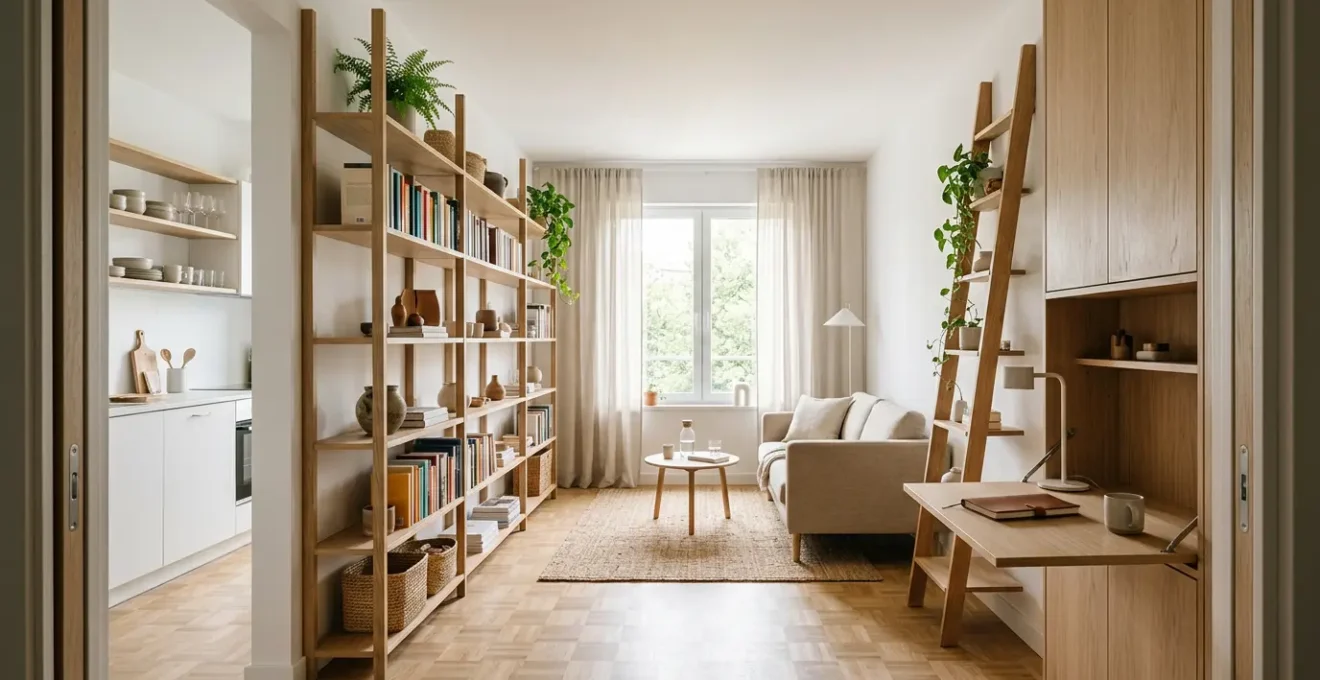
The common advice to simply “add more shelves” misses the point of living well in a small space. True spatial optimization is not about cramming in more storage; it’s about re-architecting your perception of space. This guide reveals how to treat your apartment’s height, sightlines, and flow as volumetric assets, transforming cramped quarters into a clever, functional, and expansive home by thinking like a small space architect.
For the renter in a city apartment, the four walls can feel less like a sanctuary and more like a container that’s perpetually full. The default solution is often a frustrating game of Tetris with bulky furniture, or a desperate trip to buy yet another shelving unit. We are told to think “vertically,” but this advice is often interpreted as simply stacking boxes higher. This approach leads to visual clutter and fails to address the core issue: we are not using our space; we are just filling it.
The real challenge isn’t a lack of square footage, but a lack of spatial imagination. What if the solution wasn’t just about finding a new place for your things, but about fundamentally changing the way you perceive and interact with your home’s volume? The key lies in shifting from a floor-plan mindset to a three-dimensional, architectural one. It’s about orchestrating a spatial choreography where every vertical inch has a purpose, every sightline is intentional, and every piece of furniture enhances, rather than obstructs, the natural flow of movement.
This article moves beyond the generic advice. We will deconstruct your one-bedroom flat and re-imagine it through an architect’s eyes. We will explore how to turn overlooked voids into functional features, select furniture that manipulates perception, and embrace a philosophy that creates not just physical space, but mental clarity. Prepare to see the air above your head not as emptiness, but as untapped potential.
To guide you through this spatial transformation, we will explore eight critical concepts. From the most overlooked storage opportunities to the psychological benefits of owning less, this structure is designed to build your skills as your own small space architect.
Summary: Architectural Secrets for Vertical Space Optimization
- Why the Space Above Your Door Is the Best Storage You Are Not Using?
- How to Choose a Sofa Bed That Is Actually Comfortable to Sleep On?
- Open Shelving vs Closed Cabinets: Which Makes a Room Look Bigger?
- The Furniture Layout Mistake That Blocks Flow in Small Rooms
- In Which Order Should You Tackle Rooms to Feel Immediate Space?
- Why Owning Less Stuff Actually Gives You More Free Time?
- The Spacing Error That Makes It Hard to Clean Behind the Toilet
- How Ethical Minimalism Reduces Stress and Clutter in Small UK Apartments?
Why the Space Above Your Door Is the Best Storage You Are Not Using?
In the language of architecture, any void is potential. The most consistently ignored void in any apartment is the volumetric asset above your interior doors. This space, typically between the top of the door frame and the ceiling, is a perfect candidate for high-level storage. Because it’s outside your immediate sightline, it can house items without contributing to visual clutter. It’s the ideal location for things you need but don’t access daily: seasonal decor, luggage, or archival documents.
Transforming this space from a void into a feature requires architectural thinking. A simple, floating shelf painted the same color as the wall or trim creates a seamless, built-in look. It elevates the doorway from a simple opening into a deliberate design element. This isn’t just about adding a plank; it’s about integrating storage so cleverly that it becomes part of the room’s character.
The image above showcases this principle perfectly. The shelf isn’t an afterthought; it’s an intentional architectural gesture. By adding subtle under-shelf lighting, the feature also provides soft, ambient light, turning a practical solution into a source of atmospheric warmth. To make such a space truly functional in a renter’s apartment, pair it with a stylish, wall-mountable folding step stool. This tool, when stored, becomes its own piece of vertical wall art, reinforcing the overall design philosophy.
Action Plan: Maximizing Your Over-Door Space
- Measure the space between your door frame and ceiling to determine shelf depth and height capacity.
- Install custom millwork or floating shelves that match your door frame color for seamless integration.
- Add LED strip lighting underneath the shelf to create ambient lighting and highlight stored items.
- Designate this space for seasonal items, travel luggage, or archival documents that you access infrequently.
- Invest in a stylish foldable step stool that can be wall-mounted when not in use for easy access.
How to Choose a Sofa Bed That Is Actually Comfortable to Sleep On?
The sofa bed is the quintessential piece of multi-functional furniture for a one-bedroom flat, but its dual role often leads to a compromise in comfort. From an architect’s perspective, the choice isn’t just about fabric or color; it’s about the mechanism and its spatial footprint. A bad sofa bed is a large, uncomfortable chair that turns into a terrible bed. A good one is a master of disguise, performing both functions flawlessly without devouring the entire room.
The key is to analyze its “open” versus “closed” footprint. How much space does it occupy as a sofa, and how much territory does it claim when converted to a bed? The mechanism dictates this spatial relationship. Traditional pull-out models are often the most spatially aggressive, requiring significant clear floor space in front. Click-clack and futon styles are more spatially economical, converting within their own footprint. The most sophisticated solutions are wall bed combinations, which have a minimal closed footprint and integrate vertical storage, truly embodying the principle of 3D space utilization.
Beyond the mechanism, the mattress is paramount. Look for models with memory foam or high-density foam mattresses at least 5 inches thick. Avoid thin, flimsy mattresses over metal bars at all costs. A quality sofa bed is an investment in spatial efficiency and personal comfort—a non-negotiable for any well-designed small apartment.
The following table compares different mechanisms based on their spatial impact, helping you make an informed architectural choice. As an analysis of home organization shows, understanding the mechanics is the first step to reclaiming your living space.
| Mechanism Type | Open Footprint (sq ft) | Closed Footprint (sq ft) | Vertical Storage Integration | Daily Conversion Ease |
|---|---|---|---|---|
| Pull-Out | 35-40 | 20-25 | Limited (low profile) | Moderate |
| Click-Clack | 25-30 | 18-22 | Good (can add wall unit behind) | Easy |
| Futon | 28-32 | 20-24 | Excellent (minimal height) | Very Easy |
| Wall Bed Combo | 30-35 | 8-12 | Superior (built-in shelving) | Easy with quality mechanism |
Open Shelving vs Closed Cabinets: Which Makes a Room Look Bigger?
The debate between open shelving and closed cabinets is not just aesthetic; it’s about manipulating perceptual volume. The goal in a small space is to make it *feel* bigger, and this is achieved by managing visual information. Closed cabinets hide clutter, creating a calm, uniform surface. However, a solid wall of cabinets can feel monolithic and imposing, visually shrinking the room. Open shelving, conversely, can feel light and airy, but risks becoming a chaotic display of clutter that makes the space feel busy and small.
The architect’s solution is not to choose one over the other, but to implement a strategic hybrid approach. The most effective strategy is a 70/30 split. Use closed cabinets for the lower 70% of your vertical storage, especially at and below eye level. This is where you hide the “necessary clutter”—the appliances, paperwork, and mismatched mugs. Then, use open shelving for the upper 30% of the space. This draws the eye upward, creating a sense of height and openness.
This method is supported by data; design research indicates that rooms with 70% closed storage and 30% open shelving are perceived as 23% larger than those with only closed cabinets. The key is curation. The open shelves are not for storage; they are for display. This is where you place a few select, beautiful objects—books, plants, ceramics. By keeping these shelves sparsely populated and using shallow-depth shelving, you minimize their visual weight while maximizing their impact on perceived space.
The Furniture Layout Mistake That Blocks Flow in Small Rooms
The single biggest layout mistake in small apartments is arranging furniture against the walls, creating an obstacle course in the middle of the room. This ignores the concept of desire lines—a term from urban planning describing the intuitive paths people naturally walk. In your apartment, these are the invisible highways between the door, the sofa, the kitchen, and the window. When furniture blocks these paths, it creates friction, making the space feel cramped and dysfunctional.
A clever architect treats an apartment layout like a small-scale city plan. The goal is to create clear, unimpeded “streets” for movement. This often means pulling furniture away from the walls and replacing horizontal bulk with vertical grace. A wide, low TV console that juts into a pathway is a traffic jam. A tall, slender media tower or a wall-mounted TV frees up that crucial floor space, improving the flow of the entire room.
This principle was brilliantly demonstrated in one designer’s approach. In a compelling case study, a designer applied urban planning principles to a 500 sq ft apartment. By observing the resident’s natural movement, they found that bulky furniture was constantly creating detours. As detailed in the study on vertical hacks, replacing low, wide pieces with tall, slender ones—like a vertical bookshelf for a horizontal console—freed up 40% more floor space while maintaining the same storage capacity. The key insight was treating corners as opportunities for vertical solutions, not as dead ends to be filled with bulky chairs.
To fix your flow, observe your own desire lines. Where do you instinctively walk? Identify the furniture that forces you to deviate. Then, ask yourself: can this horizontal object be replaced by a vertical one? This simple shift in thinking is the first step toward a layout that feels open, intuitive, and spacious.
In Which Order Should You Tackle Rooms to Feel Immediate Space?
When faced with a cluttered apartment, the instinct is often to tackle the most “problematic” room first, like a messy bedroom or a cramped kitchen. This is a strategic error. The key to feeling immediate, impactful change is to start with the primary sightline. This is the very first view someone has when they walk through your front door. If that view is clear, open, and travels a long distance (e.g., from the door to the main window), the entire apartment will feel larger and more welcoming.
Therefore, the first “room” to tackle is always the entryway and the path it reveals. Clear this area of all clutter. Shoes, coats, bags—everything must find a home off the floor, preferably in a clever vertical storage solution. The psychological impact of this is enormous. In fact, spatial psychology studies show that clearing the sightline from the front door to the main window increases perceived apartment size by 35%. This single act sets a new standard for the entire home.
After establishing the primary sightline, the next step is not to move room-by-room, but to create a central Storage Hub. This is a core concept for radical transformation. As one organizer demonstrated in a case study on a “Storage Hub” method, they first installed a comprehensive, high-capacity vertical storage system on the largest available wall. This hub became the receiving point for items from all over the apartment, organized by function, not by room. All books went to one section, all electronics to another. This method created immediate visual impact and dramatically reduced the time spent reorganizing, proving that a strategic, centralized approach is far more effective than a scattered, room-by-room battle.
Why Owning Less Stuff Actually Gives You More Free Time?
Every object you own has a hidden cost, not in money, but in time. This is the “time cost of ownership.” It encompasses the time spent researching and purchasing the item, the time spent assembling or setting it up, the time spent cleaning and maintaining it, and—most significantly in a small space—the time spent organizing, storing, and searching for it. When your apartment is cluttered, this time cost skyrockets. You are not just living in your home; you are managing a warehouse of personal belongings, and it’s a part-time job you never applied for.
Reducing the number of items you own is the most direct way to reclaim this lost time. Fewer clothes mean less laundry and quicker decisions in the morning. Fewer kitchen gadgets mean less time washing up and more clear counter space. Fewer decorative objects mean less time dusting and more visual peace. This isn’t about sterile, empty living; it’s about intentionality. It’s about ensuring every single item in your home serves a purpose or brings you genuine joy, thereby earning its keep and its time cost.
By owning less, you also unlock a new level of aesthetic potential. As the master of organization, Marie Kondo, suggests, a minimalist approach allows you to highlight the things you truly love.
When you have fewer items, you can invest in better quality and display them beautifully, turning storage into a curated gallery
– Marie Kondo, The Life-Changing Magic of Tidying Up
This transforms storage from a purely functional problem into a creative opportunity. Your vertical shelves are no longer just for cramming things in; they become stages for the carefully selected objects that tell your story. This shift from “stuff” to “curated collection” is the ultimate expression of clever, small-space living.
The Spacing Error That Makes It Hard to Clean Behind the Toilet
The small, awkward space behind the toilet is a microcosm of a larger design flaw in many small bathrooms: an over-reliance on floor-based storage. Floor-standing toilet brushes, stacks of magazines, and bulky vanity cabinets that sit on the floor all create “dirt traps”—inaccessible areas where dust and grime accumulate, making cleaning a frustrating contortionist act. The critical spacing error isn’t just about placing things too close together horizontally; it’s the failure to utilize the vertical plane to liberate the floor entirely.
An architecturally sound bathroom design prioritizes hygiene and ease of maintenance. The solution is to lift everything off the ground. A wall-hung toilet is the ultimate ideal, but for a renter, the same principle can be applied to storage. Replace floor caddies with wall-mounted baskets. Install a slim, over-the-toilet storage unit (an étagère) that stands on tall legs, leaving ample space underneath for a mop or vacuum to pass through easily. Even the toilet brush can be housed in a wall-mounted holder.
This approach was demonstrated in a small bathroom renovation that focused on accessibility. By installing a wall-mounted over-the-toilet unit that lifted all storage 24 inches off the ground and switching to a wall-hung vanity, the homeowner reduced cleaning time from 45 minutes to just 15. The bathroom also appeared significantly larger because more floor was visible. The key takeaway was that the most significant “spacing error” was ignoring the vast, usable wall space above the fixtures.
By thinking vertically, you not only create more storage in a tiny bathroom but also design a space that is easier to live in and maintain. You transform a chore-heavy corner into a clean, efficient, and visually open part of your home.
Key Takeaways
- Rethink Voids: Treat the space above doors and in corners not as empty air but as prime, untapped volumetric assets for storage.
- Prioritize Flow: Design your layout around natural “desire lines” of movement, using vertical furniture to replace horizontal bulk that obstructs pathways.
- Master the Sightline: The first impression is everything. Begin any organization project by clearing the visual path from your front door to the main window to instantly increase perceived space.
How Ethical Minimalism Reduces Stress and Clutter in Small UK Apartments?
For renters in small UK apartments, where space is a premium, minimalism is often adopted out of necessity. However, when this practice is infused with an ethical dimension, it transforms from a simple decluttering tactic into a powerful philosophy for stress reduction and sustainable living. Ethical minimalism isn’t just about having less; it’s about being more intentional with what you do have, considering the entire lifecycle of an object from its creation to its disposal.
This approach starts with a fundamental rule: the “one in, one out” policy. Before a new item enters your apartment, an existing item must leave. This creates a state of equilibrium, preventing the slow accumulation of clutter that leads to stress. This mindful consumption reduces impulse buys and forces a higher standard for everything you choose to bring into your life. The focus shifts from quantity to quality, durability, and ethical production. This is particularly relevant in the UK context, where a strong culture of charity shops and second-hand markets makes re-homing items a simple and socially positive act.
Living this way has profound psychological benefits. A visually calm and uncluttered environment has been shown to reduce levels of the stress hormone cortisol. Furthermore, by consciously choosing to live in a smaller footprint, you are also making a positive environmental choice. The act of living well in a compact space is inherently sustainable. It requires less energy to heat and cool, and it necessitates fewer possessions, reducing your overall consumption and waste. It’s a lifestyle that aligns personal well-being with planetary health, proving that the most sophisticated way to live is often the simplest.
Now, it’s time to stop seeing your one-bedroom flat as a limitation and start seeing it as a design challenge. Apply these architectural principles, re-architect your perception, and build a home that is not only functional and organized but also a beautiful expression of clever, intentional living.