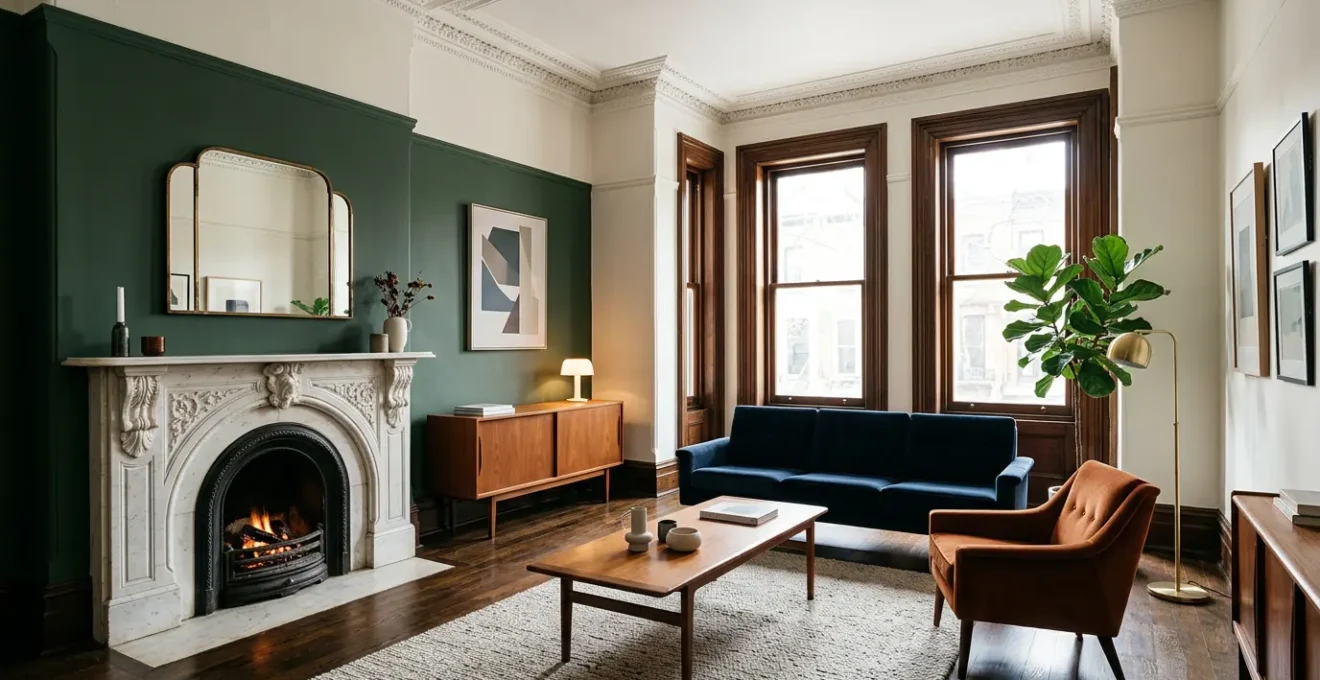
The key to a successful Victorian-modern blend isn’t ‘mixing’ styles, but learning to speak your home’s unique ‘architectural grammar’ to create a timeless and personal narrative.
- Preserving original features like cornicing is not just about aesthetics; it’s about retaining the foundational syntax of your home’s design language.
- Lasting style comes from filtering trends through a framework that respects your property’s inherent character, ensuring choices remain relevant for decades.
Recommendation: Identify your ‘Homeowner Archetype’ (Caregiver or Innovator) to clarify your design priorities before making any major decisions.
Owning a Victorian property is a custodianship of history, a daily dialogue with the past. Yet, the desire to make it your own, to reflect a contemporary life, presents a daunting challenge. The internet is filled with advice to simply “mix old and new,” a vague platitude that often leads to a disjointed collection of beautiful objects rather than a cohesive home. You see stunning photos of mid-century sideboards against ornate mouldings, but the magic formula remains elusive, leaving you with the fear of making an expensive mistake that strips your home of its soul.
This fear is valid. Many well-intentioned renovations fall into the trap of either creating a sterile museum piece or erasing the very character that made the property special. But what if the secret wasn’t about mixing, but about understanding? What if the key was to see your home not as a blank canvas, but as a text written in a specific ‘architectural grammar’—a language of proportion, light, and detail? The real art of curating a style for a period home lies in learning to speak this language fluently.
Instead of imposing a foreign style, this approach allows you to add new ‘sentences’ that are grammatically correct, creating a rich and evolving narrative. This guide will provide a framework for this dialogue. We will explore why original features are the foundation of this grammar, how to introduce modern elements without creating discord, and how to use colour and light to honour the home’s spirit. By the end, you will have a new lens through which to view your home, empowering you to make choices that are both personal and timeless.
To help you navigate this design journey, this article is structured to build your understanding step-by-step. The following summary outlines the key concepts we will explore to help you master the art of blending heritage with modern living.
Contents: How to Master the Dialogue Between Victorian Heritage and Modern Design
- Why Removing Original Cornicing Devalues Your Period Home?
- How to Mix Mid-Century Furniture With Victorian Bones?
- Heritage Paint vs Modern Brights: Which Honours the Light?
- The “Pinterest Trend” Mistake That Dates Your Home in 2 Years
- How to Style a Non-Working Fireplace to Make It the Star?
- Why Gothic Architecture Still Evokes Awe in the 21st Century?
- Innovator vs Caregiver: Which Brand Archetype Resonates in Your Sector?
- Where to Find Timeless Architectural Charm in Europe for a Weekend Break?
Why Removing Original Cornicing Devalues Your Period Home?
Before any discussion of adding modern flair, we must address the foundation: preservation. It’s tempting to see original features like cornicing, ceiling roses, or picture rails as fussy, decorative elements that can be stripped away for a cleaner, modern look. This is the first and most critical misunderstanding. These features are not mere decoration; they are the foundational grammar of your home’s architectural language. Cornicing, for example, is not just a trim; it’s a carefully proportioned element that mediates the transition between wall and ceiling, defining the room’s scale and drawing the eye upward, celebrating the classic Victorian high ceilings.
Removing them is like deleting the punctuation and syntax from a classic novel—the story becomes flat, loses its rhythm, and its value plummets. This isn’t just an aesthetic loss. While it’s difficult to quantify precisely, the value of period properties is intrinsically linked to their character. In fact, recent property data from Victoria shows that of 743 locations, 232 saw median house price increases, often driven by the desirability of well-preserved character homes. The presence of intact original features is a primary driver of this desirability.
Consider the restoration of the 1881 Victorian villa, St Benedict B&B. Here, illusionary gilded plasterwork was recreated with wallpaper borders and historic wallpapers were painstakingly sourced. This commitment to preserving the home’s original narrative language didn’t just restore its beauty; it enhanced its commercial and cultural value. These details tell a story of craftsmanship and history that cannot be replicated. By protecting them, you aren’t just being a caretaker; you are preserving the very essence and value of your investment.
How to Mix Mid-Century Furniture With Victorian Bones?
Once you accept the architectural grammar of your home, you can begin a respectful dialogue with other design languages. The pairing of Victorian architecture with Mid-Century Modern (MCM) furniture is a classic for a reason, but its success hinges on understanding the principles of contrast and balance, not just juxtaposition. The key is to create a curated tension between the verticality of Victorian spaces and the low-slung, horizontal lines of MCM design.
Victorian rooms, with their high ceilings, tall sash windows, and vertical fireplace surrounds, naturally draw the eye upwards. An Eames lounge chair or a long, low teak sideboard introduces a strong horizontal counterpoint. This doesn’t create a clash; it creates balance. The modern piece anchors the space, preventing the grand proportions from feeling overwhelming and making it feel liveable and human-scaled. The image below perfectly illustrates this dialogue: the low profile of the furniture grounds the room, while the soaring height of the original mouldings is allowed to shine.
To achieve this successfully, think beyond individual pieces. Create an open-plan feel by removing non-structural partition walls, allowing modern furniture arrangements to breathe. Use consistent flooring, like parquet, to create a continuous canvas that unifies the old and new. In alcoves, a classic Victorian feature, install timeless shaker-style storage with hardware that bridges both eras, such as brass. This creates a cohesive visual story where each element, whether 150 years old or 60, is in conversation with the others, contributing to a single, harmonious narrative.
Heritage Paint vs Modern Brights: Which Honours the Light?
Colour is one of the most powerful tools for bridging the gap between historical architecture and contemporary living. However, the choice between a heritage palette and modern brights is not just about personal taste; it’s about how you want the room to interact with its most crucial element: natural light. Victorian homes were designed to capture light in specific ways, and your paint choice should honour this intention. As designer Shalini Misra notes, “The Victorians were fond of jewel tones… which ties the space back to its heritage and creates a dialogue between a decorative scheme and the architectural bones.”
Heritage paints, formulated with natural mineral pigments, have a unique softness and depth. Their complex composition means they interact with light dynamically, shifting in tone and mood as the sun moves across the sky. This creates a living, breathing surface that accentuates the shadows of ornate plasterwork and adds a layer of historical authenticity. They are perfect for creating intimate, grounded spaces like formal living rooms or studies, often applied up to the picture rail to make high ceilings feel less cavernous.
Modern brights, on the other hand, offer a different kind of energy. Their synthetic pigments create a flat, uniform colour that acts as a clean, contemporary backdrop. A crisp white or a bold, primary colour can be used to treat the walls as a modern canvas, making the Victorian features—like a dark wood fireplace or intricate cornicing—pop in high contrast. This approach is particularly effective in kitchens, bathrooms, or modern extensions where you want to signal a shift in function and mood. The following table breaks down these characteristics to help guide your choice.
| Aspect | Heritage Paints | Modern Brights |
|---|---|---|
| Light Interaction | Mineral pigments shift tone throughout day | Uniform color regardless of lighting |
| Recommended Application | Up to picture rail for intimacy | Upper walls and ceiling for light reflection |
| Emotional Association | History, stability, ‘Caregiver’ archetype | Energy, optimism, ‘Innovator’ archetype |
| Best Room Types | Formal living rooms, dining rooms | Kitchens, bathrooms, modern extensions |
Ultimately, the choice isn’t about which is “better,” but which best serves the room’s function and your home’s overall narrative. Many successful schemes even use both, employing heritage tones in reception rooms and brights in private or functional spaces, creating a journey through different moods as one moves through the house.
The “Pinterest Trend” Mistake That Dates Your Home in 2 Years
In the age of social media, it’s easy to fall for the “fast-fashion” of interior design. A certain style of boucle chair, a specific shade of green, or a particular tiling pattern floods your feed, and the temptation to replicate it is immense. This is the biggest mistake a period homeowner can make. Trends are fleeting by nature, designed for mass appeal and quick consumption. Your Victorian home, however, is built on principles of longevity and craftsmanship. Chasing a Pinterest trend without considering its context within your home’s architectural grammar will not only look dated in a few years but can actively work against the property’s character.
True style is timeless. It arises from choices that are deeply connected to the building’s “bones” and your personal story. As one designer noted after a project, “I once worked on a project where we paired a Victorian chaise lounge with a sleek glass coffee table, and the contrast was simply stunning. The key was respecting the architectural context.” The success came not from copying a look, but from applying an enduring principle—the power of contrast. To avoid the trend trap, you need a framework for decision-making. Before committing to a purchase or design element, put it through a “10-Year Test.”
This isn’t about predicting the future but about filtering for enduring quality. It forces you to distill a trend to its core principle. Do you love the *idea* of a fluted-glass partition, or is it the principle of “creating zones with translucent light” that truly appeals to you? The former is a product; the latter is a timeless design strategy that can be interpreted in countless ways. This framework helps you become a curator, not a consumer.
Your Action Plan: The 10-Year Test for Victorian Home Trends
- Principle vs. Product: Is this trend based on an enduring design principle (e.g., symmetry, natural materials, craftsmanship) or is it a fleeting product?
- Architectural Respect: Does the trend honour and enhance the architectural ‘bones’ of your Victorian property, or does it fight against them?
- Distillation: Can you distill the trend to its underlying idea rather than copying the exact product you saw online?
- Future-Proofing: Would this design choice still make sense and feel intentional to someone viewing your home in 10 years, or would it scream “2024”?
- Contextual Coherence: Does it create ‘context collapse’ by clashing jarringly with your home’s formal Victorian architecture, or does it establish a respectful dialogue?
How to Style a Non-Working Fireplace to Make It the Star?
The fireplace is the heart of a Victorian room, its undeniable focal point. But what happens when it’s no longer functional? A black, empty void can feel like a dead space that drains energy from the room. The solution is not to ignore it but to re-imagine its purpose. A non-working fireplace is a perfect stage for a curated display—a three-dimensional still life that tells a story about you and the home. The key is to apply principles of composition, turning a collection of objects into a cohesive and impactful statement.
Forget random arrangements. A powerful mantelpiece display can be created using the “Anchor, Weight, and Connector” formula. This simple but effective method provides a structure for your creativity, ensuring the result feels balanced and intentional rather than cluttered. It’s a technique used by professional stylists to create visual harmony.
- The Anchor: This is the hero piece. A large, central item placed on the wall above the mantel. An oversized mirror is a classic choice in Victorian homes, as it amplifies light and reflects the room’s beauty. Alternatively, a significant piece of art can set the tone and colour palette for the entire space.
- The Weight: These are two objects of differing heights placed at either end of the mantelpiece. They “ground” the composition and prevent the eye from sliding off the edges. Think a tall vase on one side and a shorter, heavier sculpture or a pair of candlesticks on the other. This asymmetry adds dynamism.
- The Connectors: These are the smaller, personal items that fill the spaces in between. They bridge the gap between the Anchor and the Weights, adding layers of texture and personality. This is where you can display ceramics, vintage collectibles, or natural elements like dried foliage under a glass bell jar.
The fireplace interior itself also offers a canvas. Instead of leaving it empty, consider painting the firebox a shocking neon or a deep, glossy black for dramatic contrast. For a more elaborate statement, fill it with an artfully stacked tower of design books or commission a custom sculpture. Another sophisticated option is to install custom shelving to create a “cabinet of curiosities” for displaying a cherished collection. This transforms the void into a celebrated feature, making the fireplace the star of the room once more.
Why Gothic Architecture Still Evokes Awe in the 21st Century?
To truly master your home’s architectural grammar, it helps to understand its origins. Much of Victorian design, especially from the mid-19th century onward, is deeply influenced by the Gothic Revival movement. This wasn’t just a stylistic choice; it was a philosophical one. Inspired by the soaring cathedrals and dramatic castles of the Middle Ages, architects and designers sought to recapture a sense of awe, drama, and craftsmanship that they felt was lost in the industrial age. As noted by WOOLF Interior Architects, this style “became fashionable after the design of the Houses of Parliament.”
The power of Gothic architecture, and its Victorian interpretation, lies in its ability to manipulate emotion through space, light, and form. Pointed arches, vaulted ceilings, and intricate carvings create a sense of verticality that lifts the spirit. The play of light through stained glass or detailed tracery adds a layer of mystery and reverence. These are not just aesthetic choices; they are tools for creating a specific emotional response. This is the “awe” that we still feel today when entering a grand cathedral or a well-preserved Gothic Revival building.
This principle of “domestic drama” was translated into Victorian homes. For example, the Loeb Townhouse family room embodies a Modern Gothic style, featuring a custom Knole sofa and an oak sideboard with intricate foliate carvings inspired by designers like Charles Locke Eastlake. These elements are not just furniture; they are architectural pieces in their own right, using the language of Gothic design—strong forms, rich materials, and detailed craftsmanship—to create a sense of history and gravitas within a domestic setting. Understanding this emotional root helps you appreciate why preserving a pointed arch window or a dark, carved staircase is so important. You are preserving a piece of the home’s intended dramatic narrative.
Innovator vs Caregiver: Which Brand Archetype Resonates in Your Sector?
Now that we understand the architectural grammar and its historical roots, the final layer is you. How do you, the homeowner, want to participate in this ongoing story? Your personal design philosophy can often be clarified by understanding two key homeowner archetypes: the Caregiver and the Innovator. This isn’t about boxing you in, but about giving you a compass to guide your thousands of small decisions, ensuring they align with a consistent vision.
The Caregiver homeowner feels a deep sense of duty to the property’s history. Their priority is authentic restoration and heritage preservation. They will spend months sourcing the perfect antique light fitting or commissioning a specialist to repair original plasterwork. For them, the house is a historical trust, and their role is to protect its integrity for future generations. Their design choices gravitate towards deep jewel tones, heritage paint palettes, and traditional textiles, creating a home that feels stable, timeless, and deeply connected to its past.
The Innovator homeowner, while respecting the past, is driven by personal expression and modern functionality. They see the Victorian shell as a dramatic backdrop for contemporary life. They are more likely to propose a minimalist glass extension, commission a bold piece of contemporary art for the hallway, or integrate the latest smart-home technology. For them, the home is a canvas for self-expression, and their choices lean towards contemporary brights, minimalist whites, and modern furniture. They are creating a dialogue where the 21st century speaks clearly and confidently.
Most successful and liveable Victorian renovations are not purely one or the other but an 80/20 Hybrid. They adopt a Caregiver mindset in the primary, architecturally significant public spaces (like the living room and hallway) while allowing their Innovator side to emerge in private or functional areas (like the kitchen, home office, or bathrooms). This blended approach respects the home’s public-facing story while allowing for modern comfort and personal expression where it matters most for daily life.
Key takeaways
- Honour the Grammar: View your home’s original features not as decoration, but as the essential grammar of its design. Preservation is the foundation of all successful modern interventions.
- Create Dialogue, Not Contrast: Blend styles by establishing a conversation. Use the horizontal lines of modern furniture to ground the verticality of Victorian spaces, creating a balanced and curated tension.
- Filter Trends Through a Timeless Lens: Avoid fleeting trends by applying the “10-Year Test.” Focus on enduring principles like craftsmanship, symmetry, and natural materials to ensure your choices last.
Where to Find Timeless Architectural Charm in Europe for a Weekend Break?
The final and perhaps most enjoyable part of this journey is to train your eye. Developing a sophisticated understanding of design is like learning a language: immersion is the best teacher. Reading about principles is one thing, but seeing them executed in the real world sharpens your instincts and builds your visual library. A weekend trip to a city renowned for its architectural heritage can be more educational than a dozen design magazines. It teaches you to look beyond the surface and see the “why” behind a beautiful facade or a well-composed room.
Think of it as a field study. A walk through the Haussmannian apartments of Paris teaches a masterclass in layering ornate mouldings with rich textiles to achieve a form of elegant maximalism. Visiting the Arts & Crafts houses of the Cotswolds, with their original William Morris interiors, provides a direct connection to the Victorian principle of valuing craftsmanship and natural materials. Even a stroll through London’s Victorian terraces reveals a thousand different ways contemporary designers are blending period features with the demands of modern urban living. Each city offers a different lesson in the dialogue between history and modernity.
This practice of active observation is what separates a consumer of style from a true curator. It builds an intuitive sense of what works. The ultimate goal is to internalise these principles so deeply that your choices become second nature. It’s about reaching the state described by the great Victorian designer William Morris, in a philosophy that remains the ultimate guide for any homeowner:
If you want a golden rule that will fit everything, this is it: Have nothing in your houses that you do not know to be useful or believe to be beautiful.
– William Morris, Victorian Design Philosophy
Now that you have this framework, the next step is to apply it. Begin by walking through your own home with this new lens. Identify its core architectural grammar, define your homeowner archetype, and start making choices that are not only beautiful and useful but are also part of a coherent, timeless story.
Frequently Asked Questions on Victorian Home Design
How do I know if I’m a Caregiver or Innovator homeowner?
Caregivers feel a duty to preserve history and prefer authentic materials, while Innovators prioritize personal expression and modern functionality. Most successful Victorian renovations adopt an 80/20 approach.
Can I change archetypes between rooms?
Yes, the 80/20 strategy suggests being a Caregiver in architecturally significant public rooms while expressing your Innovator side in private spaces like bathrooms or home offices.
Which archetype maintains better property value?
Properties that respect original features (Caregiver approach) in main rooms while modernizing functional spaces typically achieve the best market valuations.