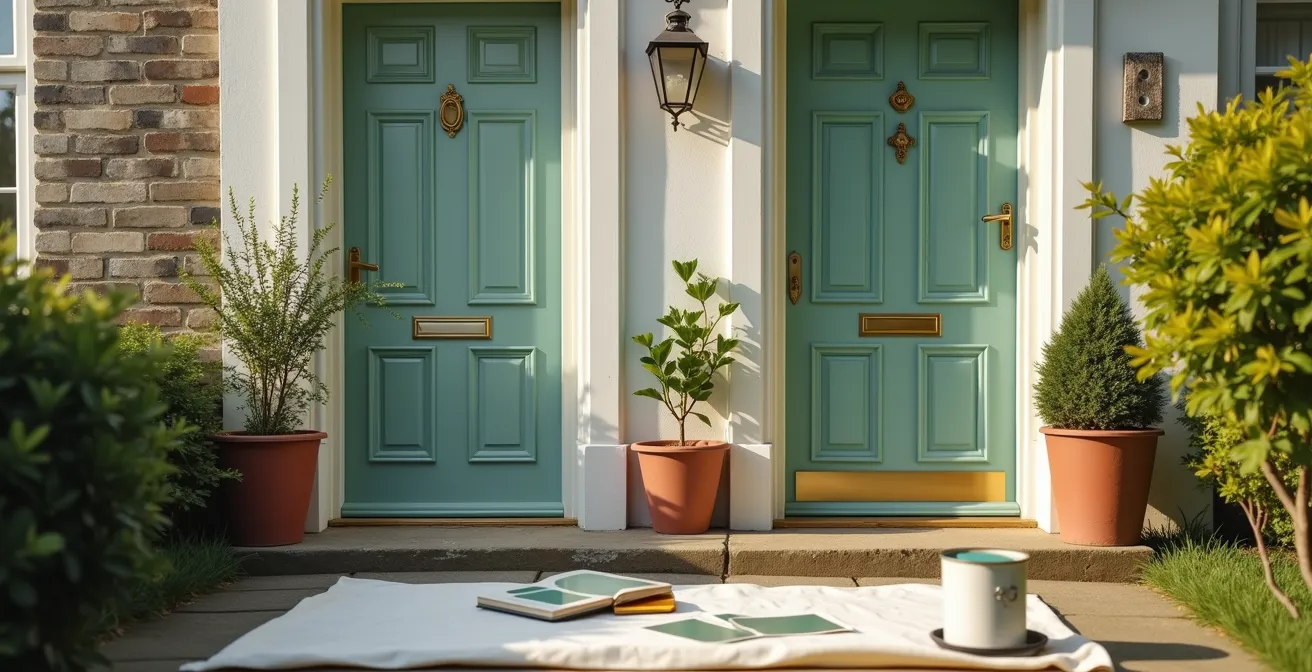
Achieving a £5,000 value boost in one weekend is about triggering positive buyer psychology, not expensive construction work.
- First impressions are solidified in seconds, making high-impact, low-cost “aesthetic hacks” your most powerful tool.
- Strategic use of paint, light, and scent creates perceived value far beyond the initial investment.
Recommendation: Instead of focusing on major renovations, spend your weekend transforming your property into an aspirational “lifestyle template” that buyers can emotionally connect with instantly.
You need to sell your home, and you need to sell it fast. The estate agent has given you a valuation, but you know it could be better. The conventional wisdom shouts from the rooftops: “Install a new kitchen! Convert the loft! Redo the bathroom!” This advice, while sound, often involves eye-watering sums of money and weeks, if not months, of disruption—luxuries you simply don’t have.
What if the path to a higher sale price wasn’t paved with builder’s dust and hefty invoices? What if you could add thousands to your home’s perceived value with a budget of a few hundred pounds and a single, focused weekend? This is not about cutting corners; it’s about being strategic. It’s about understanding buyer psychology and executing a series of high-impact “aesthetic hacks” that create an immediate emotional response.
The secret lies in shifting your mindset from a homeowner to a home presentation expert. You are not just selling bricks and mortar; you are selling a dream, a future, a feeling. Many sellers make the mistake of either doing too little (a quick tidy-up) or planning too much (a renovation they’ll never see the return on). The real leverage is in the middle ground: targeted, psychologically-driven improvements that make your home feel more valuable, spacious, and desirable the moment a potential buyer walks through the door.
This guide is your fast-paced, actionable plan. We will move beyond the generic “declutter and paint” advice to give you the specific strategies—from the exact shade of paint that sells to the sensory trick that can make or break an offer—that deliver the biggest return on your weekend’s effort. Prepare to transform your home’s appeal and its final sale price.
Summary: A Weekend Guide to Boosting Your Home’s Value
- Why a Painted Front Door Can Increase Viewing Requests by 20%?
- How to Depersonalize Your Home so Buyers Can Imagine Living There?
- Greige vs White: Which Neutral Shade Sells Houses Faster?
- The Smell Error That Subconsciously Lowers Offers
- How to Light a Dark Hallway to Make It Feel Spacious?
- How to Position Mirrors to Bounce Light Into Dark Corners?
- Donating vs Selling: Which Is the Most Ethical Way to Clear Out?
- Which Essential Home Renovations Add the Most Asset Valuation in the UK Market?
Why a Painted Front Door Can Increase Viewing Requests by 20%?
Your front door is the first physical handshake with a potential buyer. It sets the tone for the entire viewing before they’ve even stepped inside. A tired, peeling, or bland entrance can subconsciously plant a seed of doubt: “If they haven’t maintained the outside, what else has been neglected?” Conversely, a freshly painted, stylish door signals care, pride, and quality, immediately elevating the property’s perceived status. This isn’t just theory; it has a quantifiable impact on market value.
Colour psychology plays a huge role here. While personal taste varies, certain colours have been shown to perform exceptionally well in the UK property market. For instance, research from Safestyle UK revealed that homes with a classic red front door can command a significant premium. Their analysis showed that homes with red front doors sold for 36% above the national average price. Blue is another strong performer, suggesting serenity and stability. Your weekend mission is to choose a colour that complements your property’s brickwork and style, apply it with a professional finish, and upgrade the hardware for a complete transformation.
Case Study: The Power and Peril of Door Colour
The importance of door colour was highlighted when an Edinburgh homeowner faced a potential £20,000 fine for her vibrant pink front door, which fell foul of conservation area rules. While her choice was a personal statement, the ensuing legal battle demonstrates how directly door colour impacts property perception, regulations, and ultimately, value. It’s a powerful reminder to choose a colour that adds appeal within the context of your neighbourhood to maximise positive impact.
Investing a weekend and under £100 on paint and new hardware (a smart handle, letterbox, and house number) is one of the highest ROI projects you can undertake. It’s an aesthetic hack that works, creating powerful curb appeal that not only increases viewing requests but also frames the rest of the home in a more positive light.
How to Depersonalize Your Home so Buyers Can Imagine Living There?
“Depersonalize” is perhaps the most misunderstood term in home staging. It doesn’t mean stripping your home of all personality until it resembles a sterile hotel room. It means editing your personal story to create a beautiful, aspirational ‘lifestyle template’ where buyers can instantly project their own lives. When a buyer sees your treasured family photos on the mantelpiece, they see your family. When they see a piece of abstract art, they see *their* art fitting perfectly in that space.
The goal is to move from ‘your home’ to ‘a house’ that feels like it could be ‘their home’. This involves a strategic removal of overly personal items. Pack away family portraits, children’s drawings, quirky collections, and any bold decor that screams your specific taste. Replace them with more neutral, lifestyle-oriented accessories: a stack of design books on the coffee table, a beautiful vase with fresh flowers, a plush throw draped over the sofa. These elements suggest a sophisticated, comfortable lifestyle without being specific to one person. Research from the National Association of Realtors confirms the power of this approach, showing that staging helps 83% of buyers find it easier to visualize the property as their future home.
This process of creating a lifestyle template allows buyers to emotionally ‘move in’ during the viewing, a crucial step towards making an offer. The image below perfectly captures this balance.
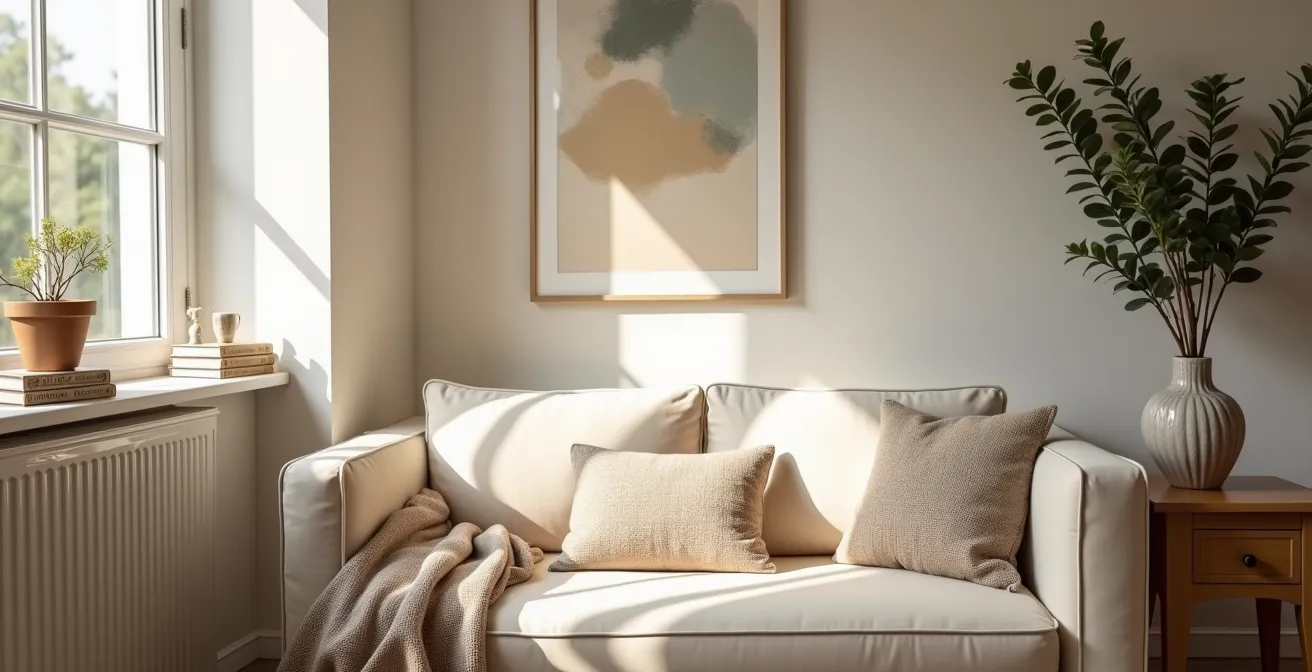
As you can see, the room is warm and inviting, not cold or empty. It has style and character, but the character is universally appealing. It offers a canvas for imagination, which is far more valuable than a gallery of your personal memories. Your weekend task is to audit every room and swap personal artifacts for aspirational props.
Greige vs White: Which Neutral Shade Sells Houses Faster?
A fresh coat of neutral paint is a classic piece of pre-sale advice for a reason: it works. It’s the ultimate reset button, erasing years of personal taste and creating a clean, bright backdrop that makes spaces feel larger and more move-in-ready. But the question is, which neutral? The debate between brilliant white and warmer tones like ‘greige’ (a mix of grey and beige) is a hot topic in home staging.
Brilliant white offers maximum light reflection and a sense of pristine cleanliness. It can be incredibly effective in modern homes or smaller rooms that need to feel as spacious as possible. However, in some properties, particularly older ones or north-facing rooms with cool light, pure white can feel stark, cold, and clinical. This is where greige and other warm off-whites come in. These shades contain subtle undertones that add warmth and sophistication, creating a cosy, inviting atmosphere without sacrificing the feeling of space. They provide a more ‘decorated’ feel that appears high-end and intentional, helping buyers to see the potential of the space.
Ultimately, the choice depends on your property’s specific lighting and character. A good rule of thumb is to use brilliant white for ceilings to maximize height, and a soft, warm neutral like greige or an off-white for the walls. The key is to create a cohesive, light-filled environment that appeals to the broadest possible audience. The impact of the right colour choice is not to be underestimated, as it directly influences buyer psychology and perceived value.
The following table, based on UK market analysis, shows how different colour families can impact a property’s final sale price, proving that your weekend paint job is a serious financial decision. As the data from a recent analysis of UK home values shows, colour is a powerful tool.
| Paint Colour | Value Impact | Best Application | Buyer Psychology |
|---|---|---|---|
| Blue | +£4,000 | Front doors, accent walls | Serenity, trust, freedom |
| White | +£3,400 | Interiors, modern homes | Clean, organized, peaceful |
| Grey/Greige | +20% viewing requests | North-facing rooms | Modern sophistication |
| Red | +36% above average | Traditional exteriors | Warmth, confidence |
| Brown | -£700 | Avoid for resale | Dated, less appealing |
The Smell Error That Subconsciously Lowers Offers
Of all the senses, smell is the most powerfully linked to memory and emotion. A buyer’s decision-making process can be influenced by scent before they have even consciously registered the layout of a room. In fact, research from BMO Financial Group reveals that 80% of prospective buyers know within seconds of entering a home whether it’s right for them. A pleasant, subtle aroma can create an instant feeling of comfort and ‘home’, while an unpleasant or overpowering one can be an immediate and irreversible deal-breaker.
The biggest smell error sellers make is not masking bad odours, but trying to cover them up with strong, artificial fragrances. The scent of a cheap plug-in air freshener, a heavy floral spray, or a cloying potpourri immediately makes buyers suspicious. “What are they trying to hide?” they wonder. Lingering smells from pets, smoking, or strong cooking can significantly decrease offers. The goal is not to add a strong scent, but to achieve a state of ‘clean air’ with a subtle, natural undertone. This means deep cleaning is non-negotiable.
As the home staging experts at Staging Rooms UK note in their analysis on the subject, the impact of scent is deeply psychological:
Smells have a unique ability to evoke strong emotional responses and memories.
– Staging Rooms UK, The Psychology of Smells in Home Staging
This emotional response is what you are aiming to influence. Once the house is truly clean and aired out, a light, welcoming scent like freshly brewed coffee, a hint of vanilla from a candle lit 30 minutes before a viewing, or the natural fragrance of fresh flowers can work wonders. This sensory staging makes the house feel cared for and inviting.
Your Weekend Scent Strategy for Viewings
- The Great Deodorization: Your first step is eradication. This means professionally cleaning carpets and rugs, washing all curtains and soft furnishings, and thoroughly cleaning pet areas.
- Airing Out: After cleaning, open all windows for at least two hours, regardless of the weather, to completely flush out stale air and cleaning product smells.
- Natural Fragrance Introduction: Place a vase of fresh, lightly scented flowers (like eucalyptus or lilies) in the hallway or main living area.
- Pre-Viewing Boost: Thirty minutes before viewers are due to arrive, brew a fresh pot of coffee or bake a simple batch of cookies. The scent is universally associated with home and comfort.
- What to Avoid: Steer clear of all plug-in air fresheners, automatic sprays, and strong incense or candles. Subtlety is key; the goal is a barely-there scent that registers as clean and pleasant.
How to Light a Dark Hallway to Make It Feel Spacious?
The hallway is the artery of the home, but in many UK properties, it can be a dark, narrow, and uninspiring space. It’s the first interior impression buyers get, and a poorly lit one can make the entire property feel cramped and gloomy. Transforming a dark hallway is a weekend project that punches far above its weight, creating an immediate sense of space and flow that benefits the whole house.
The key to success is a technique called ‘layered lighting’. Instead of relying on a single, often inadequate, ceiling pendant, you introduce three distinct types of light to work in harmony. This approach not only brightens the space but also adds depth, character, and a sense of luxury. The three layers are:
- Ambient Light: This is the overall illumination. Your weekend task is to replace the old, dated ceiling fixture with a modern, brighter design. Choose a semi-flush or flush-mount fixture that doesn’t hang too low, which can make ceilings feel lower.
- Task Light: This is functional, focused light. If you have space for a slim console table, adding a stylish table lamp provides a warm, welcoming glow at eye level.
- Accent Light: This is the secret weapon for creating depth. An affordable, battery-powered LED uplighter placed on the floor behind a tall plant or at the base of a piece of art can create beautiful shadows and draw the eye upwards, making the space feel taller.
This layered approach, combined with a light-reflecting paint colour (with a satin or eggshell finish) and the strategic placement of a large mirror, can completely transform a dingy corridor into a bright and welcoming entrance.
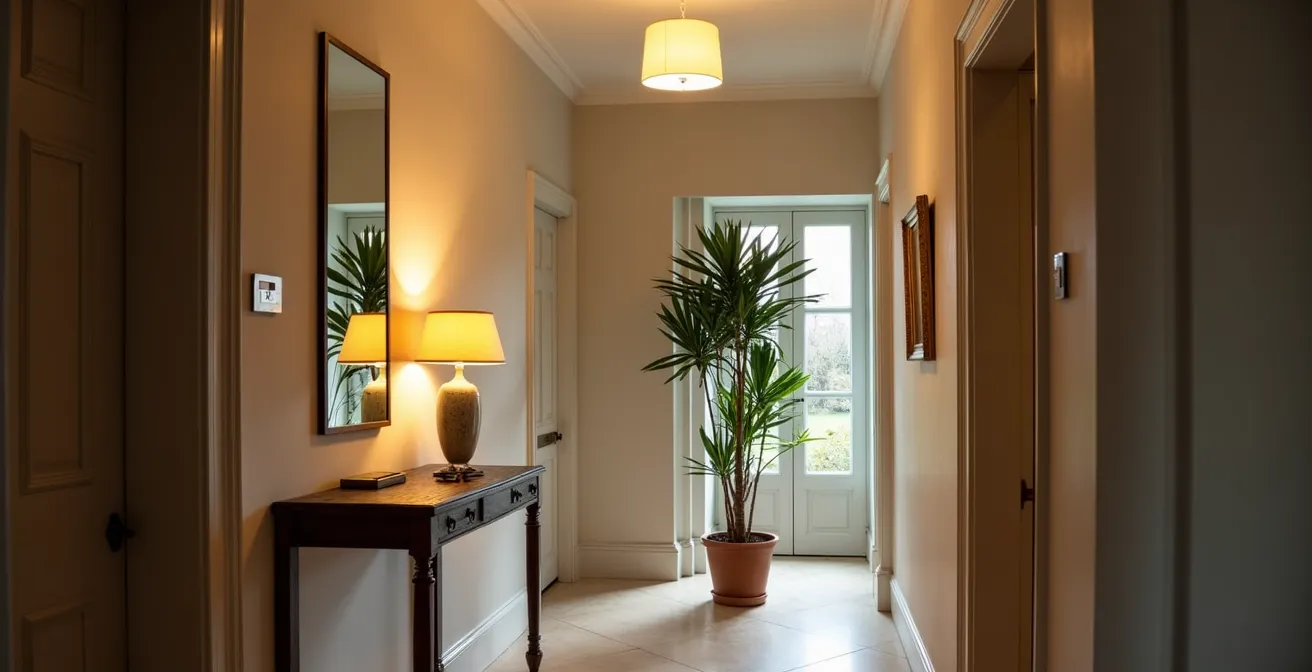
As the image demonstrates, the combination of different light sources and reflective surfaces work together to eliminate dark corners and create an illusion of a much larger, more inviting space. This is an aesthetic hack that buyers will feel, even if they don’t consciously notice each element.
How to Position Mirrors to Bounce Light Into Dark Corners?
After upgrading your lighting, mirrors are your next best friend in the battle against dark spaces. They are the ultimate aesthetic hack for amplifying light and creating the illusion of depth. However, simply hanging a mirror on any available wall is a missed opportunity. Strategic positioning is everything, and the most effective principle to follow is the ‘Rule of Opposition’.
This rule is simple yet powerful: place a large mirror on the wall directly opposite your primary light source. In a hallway or room, this usually means opposite a window, a glazed door, or the brightest entranceway. By doing this, the mirror captures the maximum amount of natural or artificial light and bounces it back into the room, effectively doubling the brightness and pushing light into the darkest corners. This single move can make a narrow hallway feel wider and a small room feel significantly larger.
The shape and style of the mirror also matter. A tall, vertical mirror will draw the eye upwards, creating an illusion of height in a room with a low ceiling. A wide, horizontal mirror, placed above a console table or sofa, will make a narrow room feel broader and more expansive. For the purpose of selling, opt for simple, elegant frames—or even a frameless design. The goal is for buyers to notice the incredible light and space you’ve created, not the ornate frame of the mirror itself. A thin metallic or simple wood frame often works best, adding a touch of style without becoming the focal point.
This is a zero-mess, high-impact weekend task. By carefully considering the placement and shape of one or two key mirrors, you can manipulate the perception of light and space in your home for a minimal cost, adding directly to its perceived value and appeal.
Donating vs Selling: Which Is the Most Ethical Way to Clear Out?
The process of depersonalizing and staging your home inevitably leads to one crucial task: clearing out the clutter. You’re left with piles of furniture, electronics, and household goods that you no longer need. The question then becomes what to do with it all. The decision often boils down to a trade-off between time, money, and social impact. While selling items on platforms like Facebook Marketplace or eBay can yield some cash, it’s a time-intensive process involving photography, listing, and coordinating with buyers—time you may not have.
For a fast, efficient, and socially responsible clear-out, donation is an outstanding option. Many UK charities offer services that make the process incredibly simple. A prime example is the British Heart Foundation’s free furniture and electrical item collection service. They operate across the UK and will collect large items directly from your home, saving you the time and effort of transporting them. The items are then sold in their stores to fund life-saving research, adding a significant layer of social value to your decluttering efforts.
This approach transforms a stressful chore into a positive action. You clear your home quickly to prepare it for sale, you help a good cause, and you avoid the hassle of selling. For a seller on a tight schedule, the value of having large items removed for free, with zero effort, is immense. It allows you to focus your precious weekend hours on value-adding activities like painting and staging, rather than haggling over a second-hand bookshelf.
The right choice depends on your priorities. This framework can help you decide the best path for each item you’re clearing out.
| Method | Time/Effort | Financial Return | Social Impact | Best For |
|---|---|---|---|---|
| Selling (eBay/Marketplace) | High (photographing, listing, meeting buyers) | Potential cash return | Low | Valuable items with time to spare |
| Charity shop donation | Low (drop-off required) | None | Medium | Small items, local impact |
| BHF collection service | Zero (they collect) | None | High (funds research) | Large furniture, weekend clearouts |
| Freegle/Facebook groups | Minimal (post & arrange) | None | Direct community benefit | Quick disposal, local help |
Key Takeaways
- The Front Door is a Gateway: It’s your highest ROI project. A freshly painted door in a psychologically appealing colour creates powerful curb appeal and sets a positive tone for the entire viewing.
- Create a Lifestyle Template: Depersonalizing isn’t about making a home sterile. It’s about removing personal specifics to create an aspirational canvas where buyers can project their own lives.
- Sensory Staging Sells: Buyers make decisions based on emotion. Strategic lighting to create space and subtle, natural scents to create a feeling of ‘home’ are powerful, low-cost tools that influence offers.
Which Essential Home Renovations Add the Most Asset Valuation in the UK Market?
While this guide focuses on fast, low-cost aesthetic hacks, it’s crucial to understand where they fit in the broader context of home value. The most impactful weekend projects are those that mimic the feel of a major renovation for a fraction of the cost. They target the two rooms that hold the most sway over buyers: the kitchen and the bathroom. A full kitchen renovation can cost upwards of £10,000, but a ‘kitchen facelift’ can be completed in a weekend for under £250 and create a perception of a £5,000+ upgrade.
This involves painting dated wooden or laminate cabinets with a specialist furniture paint, replacing all the old handles with modern brass or matte black hardware, and installing a simple peel-and-stick tile splashback. These three actions combined can completely transform the look and feel of a tired kitchen, making it appear clean, modern, and expensive. Similarly, a bathroom can be refreshed by re-grouting tiles, replacing the shower curtain with a glass screen, and upgrading taps.
These projects deliver an outsized return on investment because they address major buyer turn-offs without the associated cost. As the table below shows, while major projects like a new garage door offer a huge ROI, smaller, targeted jobs like painting and cleaning deliver exceptional value and are well within the scope of a weekend warrior. Your goal is to identify the projects that have the highest impact on buyer perception for the lowest cost and effort.
| Weekend Project | Cost Range | Time Required | Average ROI | Buyer Impact |
|---|---|---|---|---|
| New garage door | £500-1500 | 4-6 hours | 194% | Instant curb appeal boost |
| Bathroom refresh | £200-300 | Weekend | 66% | Eliminates major turn-offs |
| Front door painting | £40-100 | Weekend | Up to £4,000 value | 20% more viewing requests |
| Kitchen cabinet painting | £200-250 | Weekend | 70-80% | Feels like new kitchen |
| Carpet deep cleaning | £87 DIY | 1 day | 169% | Fresh, move-in ready feel |
By executing this focused plan, you are taking control of your sale. You are not just tidying up; you are curating an experience. You are using proven psychological triggers and high-ROI aesthetic hacks to present your property in its absolute best light. Now is the time to trade anxiety for action. Start planning your transformation weekend today and unlock the hidden value in your home.