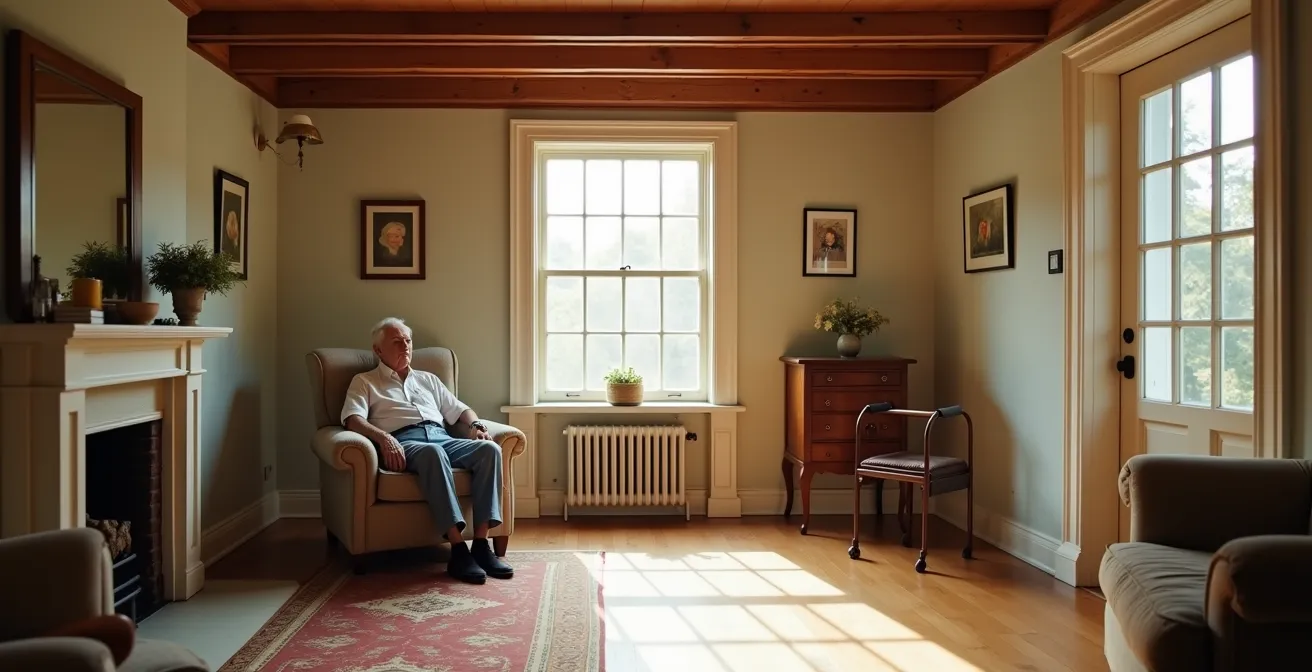
The real value of remote monitoring isn’t just reacting to falls, but proactively understanding your parent’s daily rhythm to keep them safer and more independent for longer.
- It provides a reliable safety net where simple panic buttons can fail, especially in cases of cognitive decline.
- Modern systems are non-invasive and can be installed without rewiring, even in older period properties.
Recommendation: Shift your focus from simple alerts to interpreting daily activity patterns—this is the key to true peace of mind for you and your parent.
The phone call we all dread is the one that tells us a parent has had a fall. For the millions of us in the UK with ageing parents living alone, this anxiety is a constant, low-level hum. The default solution for decades has been a panic button pendant. It feels like a practical step, a tangible safety measure. But as a geriatric care specialist, I see families discover its limitations, often after an incident has already occurred. What if the button isn’t worn? What if they are confused or unable to press it? This is where the conversation about safety needs to evolve.
The true peace of mind you’re searching for doesn’t come from a reactive button. It comes from a deeper, more gentle understanding of your parent’s daily life. We’re not talking about cameras or intrusive surveillance. We’re talking about an intelligent, discreet safety net that learns your parent’s unique rhythm of life. This modern approach to telemedicine uses subtle sensors to understand patterns—when they get up, how active they are, whether their routine is changing. It’s about shifting from reacting to emergencies to proactively spotting the small signs that might suggest a problem is developing.
Of course, introducing any technology requires a sensitive conversation. The goal is always to frame it as a tool to *support* their independence, not to take it away. By focusing on how it helps them stay in their own home safely, you can turn a difficult topic into a collaborative plan. This guide will walk you through how this modern approach works, why it’s more effective than traditional alarms, and how you can configure it to bring reassurance, not more anxiety.
To help you navigate this important decision, this article breaks down the key considerations, from the limitations of old technology to the practical steps for setting up a modern, data-driven safety net for your loved one.
Summary: A Practical Guide to Modern Elderly Care at Home
- Why a Panic Button Is Not Enough for Dementia Patients Living Alone?
- How to Install a Medical Monitoring System in a Victorian House Without Rewiring?
- Live-In Carer vs Remote Monitoring: Which Is Best for Early-Stage Frailty?
- The Setup Mistake That Causes 90% of False Emergency Calls
- How to configure Alerts to Sleep Better While Caring for Remote Parents?
- Why Owning Less Stuff Actually Gives You More Free Time?
- The “Boom and Bust” Activity Error That Worsens Fatigue
- Why Spending £300 on a Private Checkup Is Your Best Investment This Year?
Why a Panic Button Is Not Enough for Dementia Patients Living Alone?
A panic button provides a single, crucial function: it allows a person to call for help. But its effectiveness relies on one fragile assumption: that the user is able and willing to activate it during an emergency. For an older person experiencing the early to mid-stages of dementia or even just the confusion that can follow a fall, this assumption often breaks down. The reality is that these devices are frequently not worn, left uncharged, or simply forgotten in the “fog of emergency.”
As experts from Envoy at Home highlight, you cannot rely on the judgement of someone with cognitive decline during a crisis. They may be overwhelmed, injured, or incapacitated, rendering the button useless. This is the fundamental flaw of an ‘active’ system; it places the responsibility for activation on the person who is most vulnerable. It waits for a problem to be declared, rather than looking for signs that a problem is occurring.
This is why the future of home safety lies in passive monitoring. Instead of waiting for a button press, a passive system uses discreet sensors to learn a person’s normal routine—their “digital body language.” It automatically detects significant deviations, such as a lack of movement for an unusual period (which could indicate a fall) or increased wandering at night. This ‘intelligent safety net’ removes the burden of action from your parent, providing a far more reliable layer of protection, especially when memory and judgement are compromised.
How to Install a Medical Monitoring System in a Victorian House Without Rewiring?
One of the most common concerns I hear from families in the UK is about installation. The thought of drilling into the lath and plaster walls of a cherished Victorian or Edwardian home is a significant barrier. Many assume that a ‘smart’ system requires extensive, disruptive, and expensive rewiring. Thankfully, modern remote monitoring technology has been designed specifically to overcome this challenge.
The key is to use wireless, battery-powered sensors. These small, discreet devices communicate using robust local network technologies like Z-Wave or Zigbee, which are designed to send signals effectively through the thick walls typical of older British houses. Because they run on long-life batteries (often lasting 2-5 years), there is no need to place them near a power outlet. This gives you complete freedom to position them in the most effective and unobtrusive locations.
Installation is a simple, damage-free process. Instead of screws, these lightweight sensors are mounted using high-bond adhesive strips that can be removed without leaving a mark. This preserves the integrity and character of your parent’s home. The central hub, which collects the data, is the only component that requires power, and good systems include a battery backup to ensure they remain online during any power fluctuations.
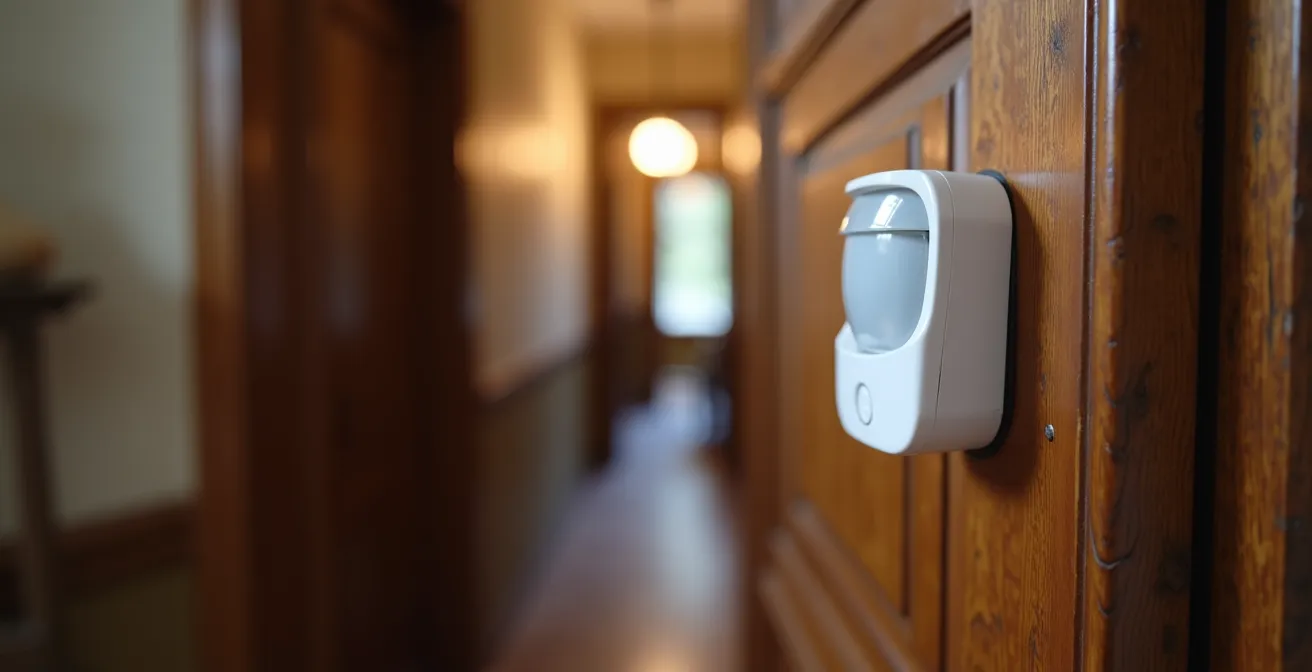
As you can see, the technology is designed to blend into the background. A motion sensor can be placed discreetly on a skirting board behind a piece of furniture, or a door sensor can be tucked away on the frame. The goal is a system that provides comprehensive insight without making your parent’s home feel like a clinical environment. It’s about adding a layer of safety without sacrificing the feeling of home.
Live-In Carer vs Remote Monitoring: Which Is Best for Early-Stage Frailty?
As a parent’s needs begin to increase, families often face a difficult and expensive decision: is it time for a live-in carer? While 24/7 human presence offers comprehensive support, it represents a significant financial commitment and a major change to a parent’s sense of independence. For those in the early stages of frailty—perhaps experiencing reduced mobility or slight memory issues—it can be an excessive step. This is where remote monitoring provides a powerful, affordable, and dignity-preserving alternative.
The cost difference is staggering. A live-in carer can be a substantial financial burden, whereas a comprehensive remote monitoring service provides a constant safety net for a small fraction of the price. The key is understanding what level of care is truly needed. For early-stage frailty, the primary need is often oversight and rapid emergency response, not constant hands-on assistance. In fact, a study on telehealth highlighted that remote monitoring devices have demonstrated a remarkable 45% reduction in mortality rates for older adults, proving their effectiveness as a standalone safety measure.
This comparative table illustrates the financial reality. The figures are based on US data but show the proportional difference, which is similar in the UK (with a live-in carer typically costing £1,200-£1,800 per week).
| Care Type | Estimated Annual Cost (GBP) | Key Features |
|---|---|---|
| Live-in Caregiver | ~£100,000+ | 24/7 physical presence, sleep breaks included |
| Remote Monitoring | £600 – £1,200 | 24/7 monitoring, alerts only when needed, preserves independence |
For many families, the ideal path is a hybrid one. Remote monitoring can serve as the foundational safety net, delaying the need for expensive live-in care by months or even years. It empowers your parent to maintain their independence and routine, while giving you the data-driven confidence that they are safe. It’s not about replacing human care, but about applying the *right level of care* at the right time.
The Setup Mistake That Causes 90% of False Emergency Calls
An intelligent safety net is only as smart as its setup. The single biggest issue that erodes trust in a new monitoring system is a high rate of false alarms. A flurry of unnecessary alerts creates stress, causes you to second-guess the system, and can ultimately lead to it being ignored or switched off. The vast majority of these false positives are not due to faulty technology, but to simple and avoidable mistakes in sensor placement.
The environment of a home is dynamic. Heat sources, pets, and even sunlight can trigger a poorly placed motion sensor. For instance, a sensor pointing towards a window can be triggered at night by passing car headlights. One placed too close to a radiator or heating vent can be activated by a sudden change in temperature. Similarly, a sensor installed too low to the ground will inevitably be triggered by a roaming pet, leading to a cascade of pointless notifications.
Avoiding these issues requires a thoughtful approach to installation, not a technical one. It’s about looking at each room and identifying potential environmental triggers before you even place a sensor. Starting with the sensitivity setting at its lowest and only increasing it if necessary is another key tactic. This methodical process ensures the system is calibrated to the unique environment of your parent’s home, learning to distinguish between normal activity and a genuine cause for concern.
Your Action Plan to Eliminate False Alarms
- Map the Triggers: Before installation, walk through each room and identify potential sources of false alarms: radiators, heating vents, windows facing a busy road, and areas where pets frequently roam.
- Check Sensor Height and Angle: Install motion sensors at a height of 2-2.5 metres and angle them slightly downwards. This captures human movement while largely ignoring pets on the floor. Crucially, never point them directly at windows.
- Calibrate Sensitivity: Start with every sensor on its lowest sensitivity setting. Live with the system for a few days. Only increase the sensitivity on a specific sensor if you find it’s failing to detect genuine movement.
- Secure the Environment: Ensure there are no loose items, like balloons or hanging decorations, in the direct line of sight of a motion sensor that could be moved by a draft and cause an alert.
- Review and Refine: After the first week, review any alerts that were triggered. If you notice a pattern of false alarms from one sensor, reconsider its placement or angle. A small adjustment can make all the difference.
How to configure Alerts to Sleep Better While Caring for Remote Parents?
For a concerned child, a remote monitoring system can feel like a double-edged sword. While it offers reassurance, it also threatens a constant stream of notifications that can shatter your own peace and lead to caregiver burnout. The fear of being woken at 3 AM for a non-emergency is very real. This is why intelligent alert configuration is not just a feature—it’s the key to making the system work for you, not against you.
A well-designed system allows you to create a tiered alert strategy. Not every event requires an urgent, middle-of-the-night phone call. The goal is to match the alert type to the severity of the event. For example, knowing your parent has gotten up to use the bathroom is useful information, but it doesn’t require immediate action. This can be configured as a silent, informational ‘text’ or ‘log’ entry that you can review in the morning. A more concerning event, like the front door opening after 10 PM, might warrant a ‘push notification’ to your phone—an alert that gets your attention but doesn’t necessarily scream ’emergency’.
The critical, sleep-interrupting alerts, such as a phone call from the monitoring centre, should be reserved for only the most serious potential events: a fall detected by a wearable device or a prolonged period of no movement when activity is expected. By creating these tiers, you filter out the noise and ensure that when a critical alert does come through, you take it seriously. This data-driven approach is proven to work; studies show that real-time health monitoring can reduce emergency room visits among seniors, preventing crises before they happen.
The following steps provide a framework for creating an alert strategy that protects your parent while also protecting your own well-being.
- Informational Alerts (e.g., in-app log): Use for routine events like ‘Parent is up and in the kitchen’ or ‘Bathroom visit’. These build a picture of the day without causing alarm.
- Warning Alerts (e.g., push notification): Configure for unusual but not necessarily critical events. Examples include ‘Front door opened after 10 PM’ or ‘Medication cabinet not opened by 10 AM’.
- Critical Alerts (e.g., phone call): Reserve these for true emergency indicators, such as ‘Fall detected’ or ‘No movement in the house for 3 hours during daytime’.
- Establish ‘Safe Windows’: Set up periods, such as between 8 AM and 9 PM, where only critical alerts are sent. This stops your phone from buzzing with informational updates while you are at work.
- Create an Alert Rota: If you have siblings, a great feature is to establish a rotation for who receives critical alerts overnight, sharing the responsibility and ensuring everyone gets a good night’s sleep.
Why Owning Less Stuff Actually Gives You More Free Time?
When we think about safety for an older person at home, we tend to focus on adding things: grab rails, non-slip mats, and monitoring technology. However, one of the most effective safety strategies involves taking things away. A cluttered home is a significant hazard. It not only increases the risk of trips and falls but also undermines the effectiveness of the very monitoring systems designed to protect your parent. The connection between minimalism and safety is direct and powerful.
The statistics on falls are sobering. In the UK, it’s estimated that around one-third of people aged 65 and over will fall at least once a year. Many of these falls are preventable and happen within the home, often caused by environmental hazards. Loose rugs, trailing cables, and stacks of books or magazines create an obstacle course. Excess furniture can create narrow, difficult-to-navigate pathways. For a remote monitoring system, this clutter is also a problem. It can block the line of sight for motion sensors, leading to ‘dead zones’ where activity isn’t registered, or cause false alarms when a precariously balanced object finally topples over.
Helping your parent to declutter is a sensitive but vital conversation. It’s not about throwing away cherished memories, but about creating a safer, more manageable living space. The process gives you ‘more free time’ in the long run by reducing the time spent worrying about falls and dealing with false alarms. By clearing pathways and surfaces, you make the home physically safer while also optimising the environment for the intelligent safety net to work effectively. It’s a simple, no-cost action that dramatically enhances both physical safety and digital oversight.
A clutter-free environment allows for clear lines of sight for sensors, reduces trip hazards, and makes it easier for your parent to move around confidently. The focus should be on creating clear zones around doorways and in main living areas, ensuring that both your parent and the technology have room to operate safely.
The “Boom and Bust” Activity Error That Worsens Fatigue
One of the most valuable insights a remote monitoring system can provide has little to do with emergencies. It’s about understanding energy patterns. As a geriatric specialist, I often see older adults fall into a debilitating cycle of activity known as “boom and bust.” This is particularly common in those managing long-term conditions like chronic fatigue, arthritis, or post-viral recovery. The pattern is simple: on a “good day,” feeling a rare burst of energy, they try to do everything at once—housework, gardening, shopping. This overexertion leads to a “crash,” resulting in several “bust” days of exhaustion and inactivity, which in turn reinforces a sense of frailty and limitation.
Without objective data, this cycle is incredibly hard to break. A person’s own perception of their energy can be unreliable. They “boom” because they feel they must make the most of the good day, not realising it’s perpetuating the problem. This is where the ‘digital body language’ captured by the monitoring system becomes a powerful clinical tool. By reviewing weekly activity reports from a source like the NHS guidance on activity management, you and your parent can clearly see the pattern: a day of extremely high activity followed by two or three days of near-total inactivity.
This objective data is the key to breaking the cycle. It allows you to move the conversation away from feelings and towards facts. You can work with your parent, and even their GP, to establish a consistent daily activity baseline—a gentle level of movement that can be sustained every day, rather than saved for one heroic effort. The monitoring data can then be used to track progress, providing positive reinforcement as the “bust” days become fewer and the overall activity level becomes more stable and consistent. This is a perfect example of using the system for proactive health management, not just reactive safety.
Using the data, you can help your parent pace themselves, spreading tasks throughout the week. This approach, known as ‘pacing’, helps to manage fatigue, improve overall function, and restore a sense of control and confidence. The system transforms from a safety net into a personal coaching tool.
Key Takeaways
- True safety comes from understanding daily routines (the “rhythm of life”), not just from reactive panic buttons.
- Modern wireless systems are non-invasive and perfectly suited for older UK properties without needing to rewire.
- Configuring tiered alerts is crucial to get meaningful information without causing caregiver burnout.
- The data from a monitoring system is a powerful tool for proactive health management, helping to identify patterns like “boom and bust” fatigue cycles.
Why Spending £300 on a Private Checkup Is Your Best Investment This Year?
A remote monitoring system is exceptional at gathering one thing: data. It provides a continuous, objective record of your parent’s activity, sleep patterns, and daily routines. But data is only as valuable as the actions it inspires. The single best way to leverage this wealth of information is to pair it with a comprehensive private health checkup. This combination transforms the monitoring data from a simple safety log into a powerful diagnostic tool, making that £300 checkup one of the wisest investments you can make in your parent’s long-term health.
Imagine your parent visiting their GP. They might say they feel “more tired lately” or “aren’t sleeping well.” This is subjective and hard for a doctor to act upon. Now, imagine they go to that appointment with a report that shows, for the past three months, they’ve been getting up to the bathroom 4-5 times a night, compared to 1-2 times previously. It shows their daytime activity levels have dropped by 30%. This is objective, actionable data that points a clinician towards specific investigations for conditions like a urinary tract infection, heart issues, or diabetes. Furthermore, telehealth consultations themselves become more effective; some data even suggests they have led to a significant reduction in missed appointments among the elderly.
The annual cost of remote monitoring (around £600) plus a one-off private checkup (around £300) may seem like a significant outlay. But when you view it as a single, synergistic system, its value becomes clear. It’s an investment in preventive, data-driven healthcare. It enables early intervention, helps manage chronic conditions more effectively, and can prevent the costly and traumatic hospital admissions that often result from unaddressed health issues.
| Investment | Approx. Annual Cost | Benefits |
|---|---|---|
| Remote Monitoring Only | £600 | Daily data collection, basic alerts, peace of mind. |
| Private Checkup Only | £300 | One-time, subjective snapshot of health. |
| Combined Approach | £900 | Data-driven diagnosis, early intervention, targeted preventive care. |
This combined approach bridges the gap between home and clinic, creating a holistic circle of care. It empowers you, your parent, and their healthcare provider to make better, more informed decisions, ensuring they can live independently, healthily, and safely in their own home for as long as possible.
By shifting your perspective from simple alarms to an intelligent, data-rich safety net, you can provide a level of care that is both more effective and more respectful of your parent’s independence. To take the next step, evaluate your parent’s specific needs and start the conversation about building a personalised safety plan today.