The secret to cutting your water bill isn’t taking shorter showers; it’s making small, one-time hardware upgrades that deliver permanent, passive savings.
- Replacing inefficient fixtures offers a much higher return on investment (ROI) than relying on changing daily habits.
- Many high-impact upgrades, like tap aerators and pipe insulation, cost little and can be installed yourself in minutes.
Recommendation: Start by identifying and fixing your single most wasteful component—likely your shower head or a silent leak—to see immediate results on your next bill.
As a homeowner in the UK, you’ve undoubtedly noticed the steady creep of utility costs. Water bills, in particular, are on an upward trajectory, a trend that puts a constant strain on household budgets. Many believe the solution lies in disciplined, daily habits: shorter showers, turning off taps, and a general sense of water-related guilt. While these actions are commendable, they are often difficult to sustain and represent a fundamental misunderstanding of where the real waste occurs.
The common advice overlooks the crucial role of your home’s plumbing infrastructure itself. Inefficient hardware is a silent drain on your finances, wasting water and the energy used to heat it, 24/7. This is the core of the water-energy nexus in your home; every drop of hot water wasted is also wasted energy. The most effective strategy for significant, long-term savings isn’t about changing your family’s behaviour—it’s about changing your hardware.
This guide reframes the problem from a daily chore into a series of smart, one-time financial decisions. We will move beyond the platitudes and provide a technical, money-saving roadmap. We will analyse the plumbing ROI of specific upgrades, showing you which investments pay for themselves fastest. By focusing on targeted, energy-efficient plumbing upgrades, you can achieve substantial, passive savings that work for you long after the initial installation is complete.
This article will guide you through the most impactful upgrades, from simple DIY fixes to larger renovations that boost your property’s value. We’ll break down the costs, the savings, and the technical know-how you need to take control of your water consumption for good.
Summary: Your Financial Roadmap to Water Bill Reduction
- Why Your Power Shower Is Costing You More Than Your Bath?
- How to Install Tap Aerators in 5 Minutes Without Tools?
- Dual Flush vs Low Flow: Which Toilet Saves More Water?
- The Dripping Tap Mistake That Wastes 5,000 Litres a Year
- How to Insulate Pipes to Keep Water Hotter for Longer?
- How to Use Vibration Sensors to Cut Energy Bills by 12% This Winter?
- Why a £200 Coat Is Cheaper Than Four £50 Jackets?
- Which Essential Home Renovations Add the Most Asset Valuation in the UK Market?
Why Your Power Shower Is Costing You More Than Your Bath?
The belief that a quick shower is always more economical than a bath is one of the most persistent myths in home efficiency. While true for a modern, low-flow showerhead, it’s dangerously false for the power showers common in many UK homes. These devices deliver a high-pressure experience by using an internal pump to boost flow rate, consuming vast quantities of water and the energy needed to heat it. This creates a significant hidden cost in your utility bills, which are set to rise. For context, Ofwat’s 2024 price review projects an average £31 per year increase between 2025 and 2030, making every drop saved more valuable.
The technical reason for this high cost is the flow rate, measured in gallons or litres per minute. A standard bath uses a fixed volume of water, whereas a power shower’s consumption is a function of time. A 10-minute power shower can easily use as much water as a bath, but the real cost multiplier is the energy. The constant heating of this high-volume flow makes it one of the most energy-intensive activities in the household, directly impacting both your water and electricity or gas bills.
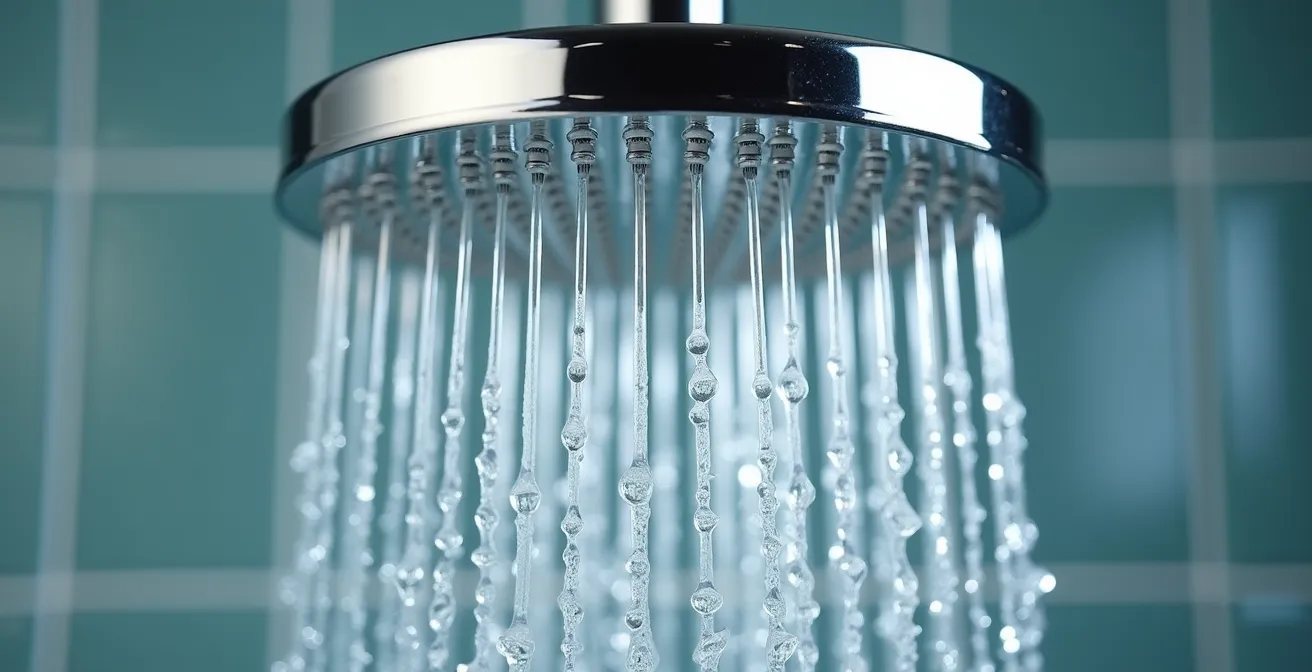
As you can see, the dense, powerful streams of a power shower are fundamentally different from the aerated, lighter flow of an efficient model. The following data breaks down the staggering difference in annual running costs. It highlights the principle of the water-energy nexus: reducing hot water usage creates a dual saving.
This comparison table clearly illustrates the financial penalty of using an inefficient power shower versus other methods. The numbers reveal that a low-flow shower offers a far better plumbing ROI than a power shower, and is even more cost-effective than a standard bath over a year.
| Method | Water Usage (per use) | Annual Cost (UK Estimate) | Energy Required (per use) |
|---|---|---|---|
| 10-minute Power Shower (2.5 gpm) | 25 gallons | £312 | 1.8 kWh |
| Standard Bath | 30 gallons | £187 | 2.2 kWh |
| Low-flow Shower (2.0 gpm) | 20 gallons | £250 | 1.4 kWh |
How to Install Tap Aerators in 5 Minutes Without Tools?
If you’re looking for the single highest-impact, lowest-cost upgrade you can make, the tap aerator is the undisputed champion. This small, inexpensive device screws onto the end of your existing kitchen and bathroom taps and works by mixing air into the water stream. This maintains the feeling of strong water pressure while reducing the actual volume of water flowing through the tap by 30% or more. It is the epitome of a smart hardware investment that generates passive savings from the moment it’s installed.
The beauty of the aerator lies in its simplicity. It requires no professional plumber, no specialist tools, and just a few minutes of your time. By optimising the flow rate without sacrificing performance, it directly cuts water usage and, just as importantly, the energy used to heat that water for tasks like washing hands or dishes. Over the lifetime of a tap, the accumulated savings are substantial. While UK-specific data varies by water company, the U.S. Environmental Protection Agency (EPA) reports that similar certified aerators can save a household thousands of gallons.
Installing one is a simple DIY task. You don’t need a wrench; hand-tightening is sufficient and prevents damage to the threads. The process is so straightforward that you can upgrade every tap in your house in under an hour, immediately starting your journey to lower bills.
Your 5-Minute Plan for Installing a Tap Aerator
- Unscrew the old aerator or spout end by turning it counter-clockwise with your fingers. A cloth can be used for extra grip if needed.
- Clean the faucet’s screw threads with the cloth to remove any built-up limescale or debris. This ensures a good seal.
- Check the new aerator to ensure the small rubber washer is correctly seated inside. This washer is critical for preventing leaks.
- Gently screw the new aerator onto the tap, turning it clockwise by hand until it is snug. Do not overtighten.
- Turn on the tap to test the new water flow. You should notice a softer, aerated stream and can be confident you are now saving water.
Dual Flush vs Low Flow: Which Toilet Saves More Water?
The toilet is one of the largest consumers of water in any home, making it a prime target for an efficiency upgrade. For years, the standard has been to rely on behavioural changes—the “if it’s yellow, let it mellow” approach. However, modern plumbing technology offers a far more reliable and hygienic solution through hardware. In fact, a landmark study in Singapore demonstrated that hardware changes like replacing taps and toilets are significantly more effective for long-term water conservation than public campaigns focused on behaviour modification.
When upgrading, homeowners are typically faced with two main choices: low-flow or dual-flush models. A “low-flow” toilet uses a standard 1.6 gallons (or 6 litres) per flush. A “dual-flush” toilet offers two options: a full flush for solid waste (typically 1.6 gallons) and a reduced flush for liquid waste (as low as 0.8 gallons). By using the appropriate flush, a dual-flush system offers superior water savings over time. The financial case is compelling, with UK-based research showing the potential for significant annual savings. For instance, research by Kingfisher shows moving from traditional to dual-flush toilets saves a typical household around £109 per year.
While the upfront cost of a new toilet is higher than a tap aerator, the plumbing ROI is excellent. A modern, efficient toilet will pay for itself in just a few years through bill reductions and will continue to deliver passive savings for its entire lifespan.
The following table provides a clear breakdown of water usage and estimated annual costs for a typical four-person household in the UK, demonstrating the clear financial advantage of upgrading from an older, inefficient model.
| Toilet Type | Gallons Per Flush (GPF) | Annual Water Use (4-person household) | Annual Cost (UK Estimate) |
|---|---|---|---|
| Pre-1994 Standard | 3.5-7.0 | 18,250 gallons | £420 |
| Low-Flow (post-1994) | 1.6 | 8,320 gallons | £192 |
| Dual-Flush | 0.8 / 1.6 | 6,570 gallons | £151 |
| High-Efficiency (WaterSense) | 1.28 | 6,656 gallons | £153 |
The Dripping Tap Mistake That Wastes 5,000 Litres a Year
A slowly dripping tap is often dismissed as a minor annoyance, but from a technical standpoint, it is a significant and continuous financial leak. While the title’s figure of 5,000 litres is a conservative estimate for a slow drip, the volume can be much higher. The U.S. Department of Energy calculates that one drip per second wastes over 1,661 gallons (approximately 6,300 litres) annually. If it’s a hot water tap, you are also paying to heat that water before it goes straight down the drain, compounding the cost.
Ignoring a drip is one of the most common and costly mistakes a homeowner can make. Unlike a power shower, which only consumes resources when in use, a drip wastes water 24 hours a day, 7 days a week. The cause is almost always a worn-out, inexpensive internal component: either a rubber washer or a ceramic disc. Fixing it is a classic DIY job that prevents hundreds of pounds in waste over the long term.
The key is correctly identifying the type of tap you have to get the right replacement part. Taps with separate hot and cold handles are typically compression washer taps, while single-lever mixer taps usually contain a ceramic disc cartridge. The repair for a washer can cost as little as 50p for the part, making the ROI almost immediate.
Your Action Plan: Diagnosing and Fixing a Dripping Tap
- Points of contact: Check all taps, including kitchen, bathrooms, utility room, and any outdoor taps. Also, listen for toilets that may be running silently.
- Collecte: To diagnose a toilet leak, add a few drops of food colouring to the cistern (the tank). Wait 15 minutes without flushing. If any colour appears in the bowl, you have a silent leak.
- Cohérence: For taps, identify the type. Do you have two separate handles (likely a compression washer) or a single lever (likely a ceramic disc)? This determines the repair part needed.
- Mémorabilité/émotion: Note the drip rate. Is it one drip per second, or faster? This helps you quantify the urgency and potential savings. A fast drip is a financial emergency.
- Plan d’intégration: After turning off the water supply under the sink, dismantle the tap, replace the worn washer (a 50p part) or the ceramic cartridge (£10-£20), and reassemble.
How to Insulate Pipes to Keep Water Hotter for Longer?
Another crucial aspect of the water-energy nexus is heat loss from your hot water pipes. As hot water travels from your boiler or water cylinder to the tap, it passes through unheated spaces like lofts, basements, or wall cavities. During this journey, unprotected copper pipes radiate a significant amount of heat, forcing your boiler to work harder and for longer to deliver water at the desired temperature. This is a constant, passive energy drain on your system.
The solution is simple and highly effective: pipe insulation. This involves fitting foam tubes, known as lagging, around your exposed hot water pipes. It’s an inexpensive, straightforward DIY job that has a surprisingly high ROI. By insulating the first few metres of pipework coming from your hot water cylinder, you can raise the water temperature at the tap by 2-4 degrees and reduce the wait time for hot water to arrive. This small change means you waste less water while waiting for it to heat up and, more importantly, you cut down on energy consumption.
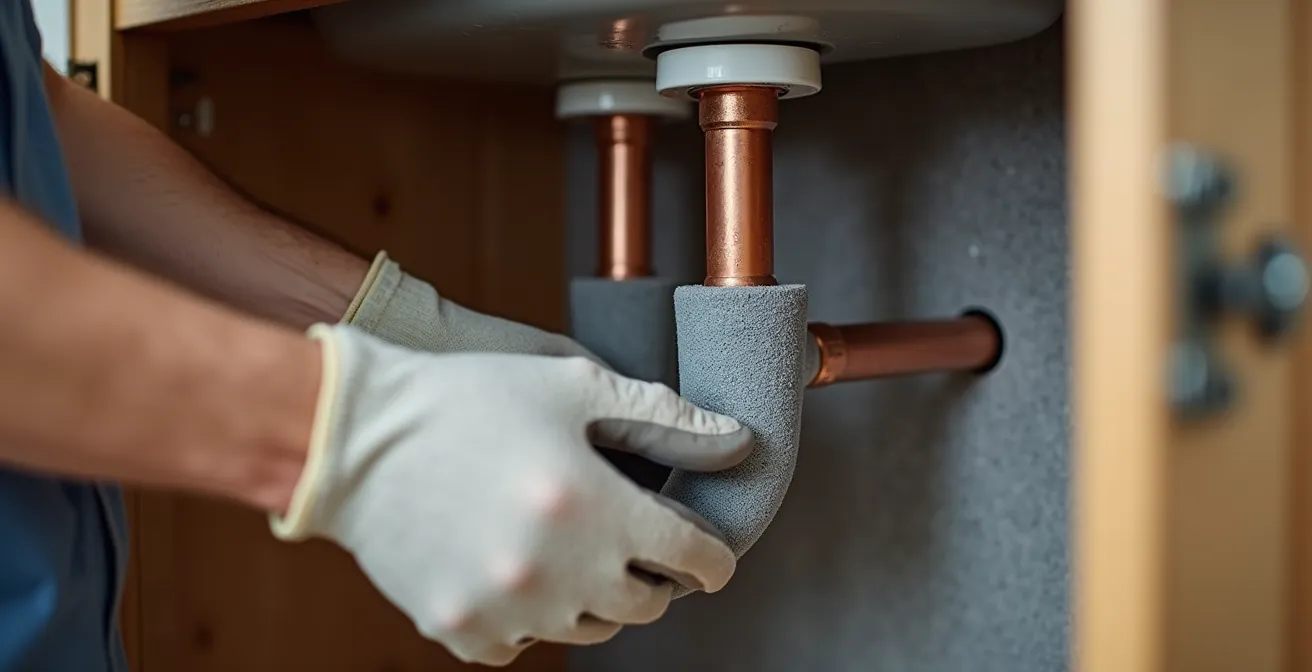
As the image shows, installation is as simple as cutting the foam sleeve to length and clipping it over the pipe. The financial benefits are well-documented by UK water authorities. For example, some regional water companies have found that customers implementing efficiency measures, including proper insulation, achieve significant savings. One such report states that Wessex Water reports that customers switching to efficient systems save an average of £125 per year. This makes pipe insulation one of the quickest ways to see a return on a very small investment.
How to Use Vibration Sensors to Cut Energy Bills by 12% This Winter?
While traditional plumbing upgrades provide a solid foundation for savings, smart home technology offers the next frontier in efficiency. Vibration sensors, often sold as part of a broader smart home security or monitoring system, can be repurposed to provide valuable data on your water and energy usage. By placing these small, inexpensive sensors on key plumbing components, you can turn your standard system into an intelligent one that alerts you to waste and inefficiency.
How does it work? A vibration sensor detects micro-vibrations. When placed on a water pipe, it can feel the flow of water. If it detects continuous vibration on your main water inlet for an unusually long period, it could signify a forgotten running tap or, more critically, a hidden leak. This early detection is a core principle behind the large-scale infrastructure investments being made by UK water companies, which are using smart systems to proactively find and fix leaks in their networks.
Beyond leak detection, these sensors can optimise daily routines. Placed on a hot water boiler, a sensor can monitor how often it fires up, helping you diagnose issues like poor insulation. Attached to a washing machine or dishwasher, it can send a notification to your phone the moment the cycle finishes, preventing you from forgetting a load and having to re-wash it. This is a perfect application of technology to create passive savings and reduce redundant energy use, helping you make a dent in that 12% winter energy bill increase many face.
Why a £200 Coat Is Cheaper Than Four £50 Jackets?
This principle of value over initial cost applies directly to plumbing fixtures. It can be tempting to opt for the cheapest tap, showerhead, or toilet from a big-box store. However, from a technical and financial standpoint, this is often a false economy. The total cost of a fixture isn’t just its purchase price; it’s the purchase price plus all future repair and replacement costs over its lifespan. This is what engineers refer to as the component lifecycle cost.
Higher-quality plumbing fixtures are manufactured with superior materials, such as brass fittings instead of plastic and more durable ceramic discs in taps. These components are designed to withstand years of use and resist the corrosive effects of hard water and limescale. Budget options, on the other hand, often fail much sooner, leading to drips, leaks, and the need for a complete replacement. A cheap tap that needs replacing every five years will ultimately cost you more in money, time, and wasted water than a quality one that lasts for two decades.
This long-term view is critical for any homeowner making an investment in their property. The difference in durability is not marginal; research shows tankless water heaters and quality fixtures last for 20 years or more, whereas their budget counterparts often fail in as little as 5 to 7 years. When you factor in the cost of multiple replacements and the potential water damage from a failed cheap fixture, the more expensive initial purchase proves to be the far cheaper long-term option.
Key Takeaways
- The biggest savings come from upgrading inefficient hardware, not just changing habits.
- Focus on the water-energy nexus: saving hot water saves significant energy costs.
- Small, cheap upgrades like tap aerators and pipe insulation offer the fastest and highest return on investment.
Which Essential Home Renovations Add the Most Asset Valuation in the UK Market?
The benefits of energy-efficient plumbing upgrades extend far beyond monthly bill savings. In an increasingly eco-conscious and cost-aware property market, these features are becoming a significant factor in a home’s overall asset valuation. A house that can demonstrate low running costs is inherently more attractive to potential buyers, who are looking not just at the purchase price but at the total cost of ownership.
Features like a new high-efficiency boiler, dual-flush toilets, a water-wise shower, and a fully insulated pipe system are no longer just “nice-to-haves.” They are tangible assets. When you sell your home, being able to provide evidence of low utility bills is a powerful marketing tool. It gives buyers confidence and can be a deciding factor that sets your property apart from others in the same price bracket. This is especially true as water costs continue to rise, making efficiency a key selling point.
According to market analysis, the trend is clear. A recent report in MoneyWeek highlights that homes with water meters and efficient plumbing are becoming more desirable as buyers factor in potential annual savings of £55 or more. While a bathroom remodel has always been a way to add value, focusing specifically on the water and energy efficiency of that renovation provides a double benefit: you save money while you live there, and you increase the home’s marketability when you decide to sell. These renovations are not just expenses; they are direct investments in your property’s long-term financial value.
By shifting your mindset from behavioural change to strategic hardware investment, you can secure permanent, passive savings on your utility bills and simultaneously increase the value of your most important asset. Start with one small upgrade today to begin your journey towards a more efficient and economical home.