
Standing out on a UK shelf isn’t about being the loudest; it’s about being the most instantly understood.
- Functional claims are the bare minimum; emotional connection is what builds unshakeable loyalty that withstands price competition.
- Your packaging must communicate your entire value proposition in under three seconds, acting as a silent salesperson.
Recommendation: Audit your brand’s ‘signal system’—from packaging hierarchy to staff language—to ensure every touchpoint reinforces one single, compelling idea.
As a brand manager, you know the feeling. You walk into a major UK supermarket and see it: a wall of colour, claims, and competition. Your new drink or snack, the result of months of development, is just one face in a seemingly endless crowd. The conventional wisdom says you need a catchy logo, a big marketing budget, and to shout about being “high quality.” But in the split-second world of the Fast-Moving Consumer Goods (FMCG) aisle, this advice often falls flat. Shoppers are overwhelmed, and their brains are programmed to take shortcuts.
The truth is, most brands fail not because their product is poor, but because their positioning is invisible. They blend into the noise, making the same vague promises as everyone else. But what if the key wasn’t to shout louder, but to whisper a clearer, more compelling message directly to the shopper’s subconscious? What if you could master the science of perception to become one of the few brands a consumer instinctively reaches for? This is the core of effective brand positioning: it’s less about creative art and more about the architecture of decision-making.
This guide moves beyond the generic advice. We will deconstruct the psychological and strategic framework required to build a brand that doesn’t just occupy shelf space but commands mental space. We will explore how to craft a message that sells in seconds, choose a positioning that builds deep loyalty, avoid the “quality” trap, and ensure your brand’s story is told consistently, from the packaging to the people who stock the shelves.
To navigate this complex challenge, this article provides a structured roadmap. The following sections break down each critical element of building a standout brand, offering actionable frameworks and real-world UK examples to guide your strategy.
Summary: Your Roadmap to Dominating the UK Supermarket Shelf
- Why Consumers Only Remember 3 Brands per Category?
- How to Write a USP That Fits on a Packaging Label and Sells?
- Functional vs Emotional Positioning: Which Builds Stronger Loyalty?
- The “High Quality” Claim Trap That Makes You Invisible to Shoppers
- How to Ensure Every Employee Speaks Your Brand Language Fluently?
- Innovator vs Caregiver: Which Brand Archetype Resonates in Your Sector?
- Why Logic Rarely Drives the Purchase of Luxury Goods in the UK?
- How to Map Your Competitive Ecosystem to Find Gaps in the UK Market?
Why Consumers Only Remember 3 Brands per Category?
The human brain is a master of efficiency. When faced with the overwhelming choice in a typical supermarket aisle, it doesn’t meticulously evaluate every option. Instead, it relies on mental shortcuts, defaulting to a pre-approved shortlist. This phenomenon, known as the “evoked set,” is why most consumers can only name about three to five brands per category off the top of their head. Your primary goal isn’t just to be on the shelf; it’s to secure a spot in that exclusive mental real estate. Brands like Coca-Cola and Nestlé have invested billions to become the automatic, low-risk choice in their respective categories.
Breaking into this set is a formidable challenge because it requires building mental availability. It’s not just about being seen, but about being remembered. Research confirms this is a gradual process; studies show it takes 5-7 impressions for people to even begin to remember a brand. Each time a consumer sees your package, reads your claim, or hears your name, a tiny neural pathway is reinforced. Without a clear, consistent, and distinctive message, these impressions are fragmented and fail to build the cognitive momentum needed to earn a place in the shopper’s top three.
Therefore, your positioning strategy must be designed for repetition and instant recognition. A complex or muddled message, no matter how clever, will be filtered out by a brain that’s actively trying to conserve energy. The challenge isn’t to tell your whole story at once, but to deliver a single, powerful signal so consistently that your brand becomes a familiar and trusted shortcut. This is the foundation upon which all other branding efforts must be built.
How to Write a USP That Fits on a Packaging Label and Sells?
Your Unique Selling Proposition (USP) is your sharpest tool, but on a crowded shelf, you don’t have a full page to make your case. You have about three seconds. In this tiny window, your packaging must function as a silent salesperson, conveying your core benefit with absolute clarity. This requires a ruthless hierarchy of information. Too many messages, fonts, or colours create cognitive friction, causing the shopper’s eye to simply move on. Your USP must be distilled into a visual and textual ‘signal system’ that can be decoded in an instant.
A proven method for this is the 3-Second Messaging Hierarchy. It forces you to prioritise what truly matters at the point of sale:
- Level 1 – Brand Identity: Before they even read a word, shoppers should recognise you. This is achieved through a distinctive colour palette and unique pack shape. Think of the iconic Toblerone triangle or the Innocent bottle shape.
- Level 2 – Core Promise: This is your USP, presented in the largest, clearest text. It must be a single, compelling benefit. Is it the “Tastiest,” “Healthiest,” “Fastest,” or “Most Ethical”? You can only win on one.
- Level 3 – Proof Point: Once you’ve hooked them with the promise, you provide a reason to believe. This is where you place smaller badges for awards (e.g., Great Taste), origin (e.g., Made in Cornwall), or certifications (e.g., Organic).
This challenge is further compounded by UK-specific regulations. For instance, new HFSS (High in Fat, Sugar, or Salt) rules restrict volume-based promotions on packaging, meaning your core message must work even harder, without the crutch of a “2 for 1” flash. The focus shifts entirely to the intrinsic value communicated by the design itself.

As the image above illustrates, even without legible text, premium cues like embossed textures and metallic foils can signal quality. This sensory information is processed subconsciously, supporting your core promise and helping your USP to not only be read but to be *felt*.
Functional vs Emotional Positioning: Which Builds Stronger Loyalty?
Many brands, especially in the FMCG space, fall into the trap of competing solely on functional benefits: “more protein,” “less sugar,” “50% extra free.” While these claims are important, they represent the ‘Functional Floor’—the minimum ticket required to enter the game. In today’s market, competitors, and especially supermarket own-brands, can match your functional specs surprisingly quickly. Relying on function alone is a race to the bottom on price and promotion.
True, defensible loyalty is built on the ‘Emotional Ceiling’. This is where your brand transcends its physical attributes and connects with a shopper’s values, identity, or aspirations. It’s the difference between buying “tea” and buying “a proper brew.” This emotional connection is far harder for a competitor to replicate. The UK-based brand Yorkshire Tea is a masterclass in this. Functionally, it’s dried leaves in a bag, just like any other tea. Emotionally, however, it has been positioned through wit, self-deprecation, and a “down-to-earth” British humour to represent the comforting ritual of ‘a proper brew’. This emotional territory is something a budget own-label brand simply cannot occupy, even if its tea bags are identical.
This isn’t just a creative theory; it’s backed by data. A compelling 2023 report on branding statistics found that 64% of consumers feel they can more easily create a trusting relationship with a brand that shares their values. When your brand stands for something—be it comfort, rebellion, adventure, or sustainability—it stops being a mere commodity and becomes a badge of identity for the consumer. This creates a powerful moat of loyalty that functional superiority alone can never achieve.
The ‘High Quality’ Claim Trap That Makes You Invisible to Shoppers
The phrase “high quality” is one of the most overused and least effective claims in marketing. It’s a lazy shortcut that has been rendered meaningless by repetition. Every brand, from the budget freezer-filler to the artisanal luxury good, claims to be of high quality. For the time-poor shopper, this claim is simply noise. It’s an empty assertion with no proof, so their brain ignores it. To truly communicate premium value, you must stop *telling* and start *signalling*.
Signalling quality is about providing tangible, sensory, and verifiable cues that allow the shopper to conclude for themselves that your product is superior. It’s a more sophisticated approach that respects the consumer’s intelligence. In the UK market, this can be achieved through a clear Quality Signal Framework:
- Provenance Signals: Specificity builds trust. “Scottish Smoked Salmon” is infinitely more powerful than “Quality Fish.” Leveraging the equity of specific UK regions creates an instant story of authenticity.
- Process Indicators: Describe *how* your product is made. Terms like “slow-churned,” “hand-crafted,” “oak-aged,” or “sun-dried” paint a picture of care and expertise that “high quality” cannot.
- Third-Party Validation: Use the credibility of others. Prominently displaying a Great Taste Award, Red Tractor certification, or, for the ultimate UK endorsement, a Royal Warrant, outsources the proof of quality to a trusted authority.
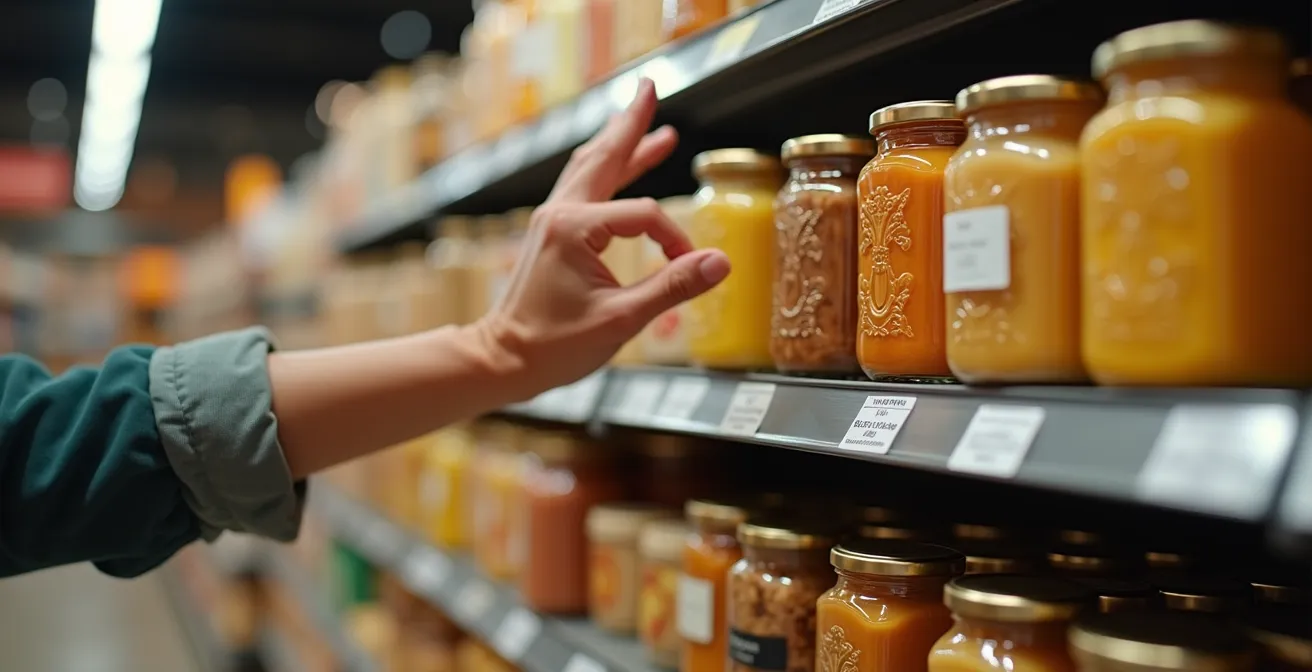
Furthermore, the context of the shelf itself is a powerful signal. As the image shows, a heavy glass jar feels more premium than a flimsy plastic one. Even shelf placement matters; retail placement research confirms that eye-level placement not only receives the most attention but also implicitly signals to the shopper that this is a leading, premium product. By orchestrating these signals, you create a compelling case for quality without ever having to use the empty words.
How to Ensure Every Employee Speaks Your Brand Language Fluently?
A brilliant positioning strategy conceived in a boardroom is worthless if it doesn’t survive contact with reality. Your brand is not just what you say in your advertising; it’s every interaction a customer has with your product. This includes the crucial “last 50 yards” in a retail environment. In the UK, many brands face “The Saturday Staff Problem”: the person stocking the shelf or advising a customer may not be a direct employee but temporary retail staff with zero brand training. If your brand’s essence is complex, it will be lost at this final, critical touchpoint.
Positioning must therefore be so clear and robust that it can be understood and executed by everyone, not just the marketing team. This is positioning-in-practice. The solution is to design your brand assets to speak for themselves. This can involve shelf-ready packaging that tells a story visually, clear planogram guidance that ensures your product is always placed correctly to communicate its value, or even QR codes that link to your brand story for curious shoppers. The goal is to make your positioning self-explanatory, even in the absence of a trained brand ambassador.
To achieve this internal alignment, the most effective tool is a radically simple ‘One-Page Brand Bible’. It’s not a 50-page brand guidelines document that no one reads, but a single, memorable sheet that can be shared with every employee, supplier, and retail partner. This ensures everyone is singing from the same hymn sheet.
Action Plan: Build Your One-Page Brand Bible
- Mission Statement: Write one memorable sentence that encapsulates your purpose. Can a new employee recite it after hearing it once?
- Brand Voice: Define your personality with three adjectives and provide a clear “do this, not that” example (e.g., “Witty like Innocent Drinks, not sarcastic like Paddy Power”).
- Key Messages: List a maximum of three core points about what makes you different. These are the talking points everyone should know.
- Visual Identity: Show your core logo, colour palette, and primary font. Simplicity is key.
- Do’s and Don’ts: Provide five concrete behavioural examples. For staff, this could be about how they describe the product or handle customer queries.
This document transforms your brand from an abstract concept into a practical, everyday tool. It ensures that whether it’s your Head of Sales or a weekend merchandiser, everyone is reinforcing the same powerful idea, making your positioning fluent and consistent across the board.
Innovator vs Caregiver: Which Brand Archetype Resonates in Your Sector?
Positioning is not just about what you do; it’s about who you are. Brand archetypes provide a powerful framework for defining your brand’s personality, drawing on universal patterns of storytelling that humans have understood for centuries. An archetype gives your brand a recognisable character, making it more relatable and memorable. Choosing the right archetype is critical, as it must resonate with both your target audience and the inherent nature of your product category.
Are you a Rebel, like BrewDog, challenging the conventions of the staid beer industry? Or are you an Innocent, like the eponymous smoothie brand, promising simple, wholesome goodness? Perhaps you’re a Caregiver, like Bisto, embodying warmth, comfort, and family tradition. Each archetype comes with its own set of expectations, visual language, and tone of voice. A Rebel brand will use bold, disruptive graphics and defiant language, while a Caregiver will use warm colours and reassuring messaging. A mismatch between your archetype and your category can create confusion and distrust.
The UK market provides fascinating examples of how brands use and adapt these archetypes. Marks & Spencer, for instance, has demonstrated a remarkable evolution. It traditionally held a ‘Ruler’ archetype, signifying quality, authority, and control. However, to stay relevant, it has skilfully incorporated ‘Lover’ aspects into its food division (think of its sensual food ads) and ‘Everyman’ elements to appear more accessible and relatable to modern UK shoppers. This shows that archetypes aren’t rigid boxes but flexible foundations for building a rich brand personality.
The following table illustrates how specific archetypes have found a natural home in different UK sectors:
| Archetype | UK Brands | Sector Strength |
|---|---|---|
| Everyman | Hovis, Bisto | Food staples |
| Rebel | BrewDog | Craft beverages |
| Sage | BBC | Media/Information |
| Innocent | Innocent Drinks | Health beverages |
By consciously selecting and embodying an archetype, you give your brand a soul. This moves the purchase decision from a logical comparison of features to an emotional recognition of character, a far more powerful driver of choice.
Why Logic Rarely Drives the Purchase of Luxury Goods in the UK?
When a consumer pays a significant premium for a product, the decision is rarely rooted in a logical calculation of its functional value. A £20 box of chocolates does not contain ten times the nutritional value of a £2 one. The purchase of luxury or premium FMCG goods is driven almost entirely by emotion, identity, and trust. The product itself becomes a vehicle for a story the consumer wants to tell about themselves: their taste, their status, their values, or their commitment to quality.
Trust is the cornerstone of this emotional transaction. As a Salsify study on consumer trust found, this feeling has a direct commercial value:
46% of consumers are willing to pay more for a brand they trust.
– Salsify Research, 2022 Consumer Trust Study
This trust isn’t built on a list of ingredients; it’s built on a consistent narrative of heritage, craftsmanship, and exclusivity. In the UK, this dynamic is uniquely intertwined with the nuances of the class system. Iconic British luxury brands like Burberry have masterfully navigated this by offering different signals to different audiences. For an ‘old money’ clientele, they offer understated quality and heritage, where the value is in the discreet craftsmanship. For a ‘new money’ consumer, they may offer more overt branding that acts as a clear status signal.
The ultimate non-logical value creator in the UK luxury market remains the Royal Warrant. This seal of approval, indicating that a brand supplies the Royal Household, is an unparalleled signal of quality and prestige. It’s a purely historical and symbolic endorsement, yet it provides a level of trust and desirability that no functional claim could ever hope to match. It proves that in the premium space, you are not selling a product; you are selling a story, a symbol, and a piece of a legacy that defies logical explanation.
Key takeaways
- Shopper cognition is limited: Your brand must be one of the top 3 memorable options in its category to be chosen.
- Emotional connection trumps functional claims: Loyalty is built on shared values, not just product features.
- Clarity over cleverness: A simple, hierarchical message on your packaging will beat a complex story every time.
How to Map Your Competitive Ecosystem to Find Gaps in the UK Market?
To find your unique space on the shelf, you must first understand the entire landscape. Too many brands make the mistake of only looking at their direct competitors—the other craft beer or premium crisp brand next to them. This is a dangerously narrow view. Your true competition is any alternative a consumer might choose instead of you. A thorough mapping of your competitive ecosystem is the only way to identify genuine gaps and opportunities for differentiation.
A 3-Tier Mapping Framework is essential for a complete picture of the UK market:
- Tier 1: Direct Competitors. These are the brands in your immediate category. Analyse their price points, messaging, target audience, and brand archetypes. Where are they strong? Where are their claims weak or generic?
- Tier 2: Supermarket Own-Labels. In the UK, this is a critical battleground. You must map the different tiers, from a budget line like Asda’s ‘Just Essentials’ to a premium tier like their ‘Extra Special’. Your positioning must justify why a customer should choose you over a functionally similar (and often cheaper) own-label product.
- Tier 3: Indirect Substitutes. What else might a consumer do or buy? A premium frozen pizza isn’t just competing with other frozen pizzas; it’s competing with Domino’s, the local pizzeria, and even a ready-meal for a convenient Friday night dinner. Understanding these alternatives reveals the true context of your customer’s decision.
This analysis must also have a regional dimension. The competitive landscape and consumer preferences in London are vastly different from those in Manchester or Glasgow. Looking beyond the capital can often reveal underserved markets or less crowded competitive sets. The ultimate goal of this mapping is to create a positioning chart that plots competitors based on key axes (e.g., ‘Traditional vs. Modern’ or ‘Value vs. Luxury’). The empty spaces on this map are your potential territories for growth.
This strategic work has never been more urgent. The battle for consumer attention is intensifying, and loyalty is becoming more fragile. A recent study on UK consumer behaviour revealed that 64% of consumers considered themselves loyal to brands in 2023, a significant drop from 73% in 2022. In this environment, a weakly positioned brand is not just overlooked; it’s abandoned. A clear, unique, and emotionally resonant position is no longer a ‘nice-to-have’—it’s a fundamental requirement for survival.
Now that you have the complete framework, from understanding shopper psychology to mapping the competitive terrain, the next step is to apply this rigorous thinking to your own brand. Conducting a thorough audit using these principles will reveal the strengths and weaknesses of your current positioning and illuminate the path to becoming truly unforgettable on the shelf.