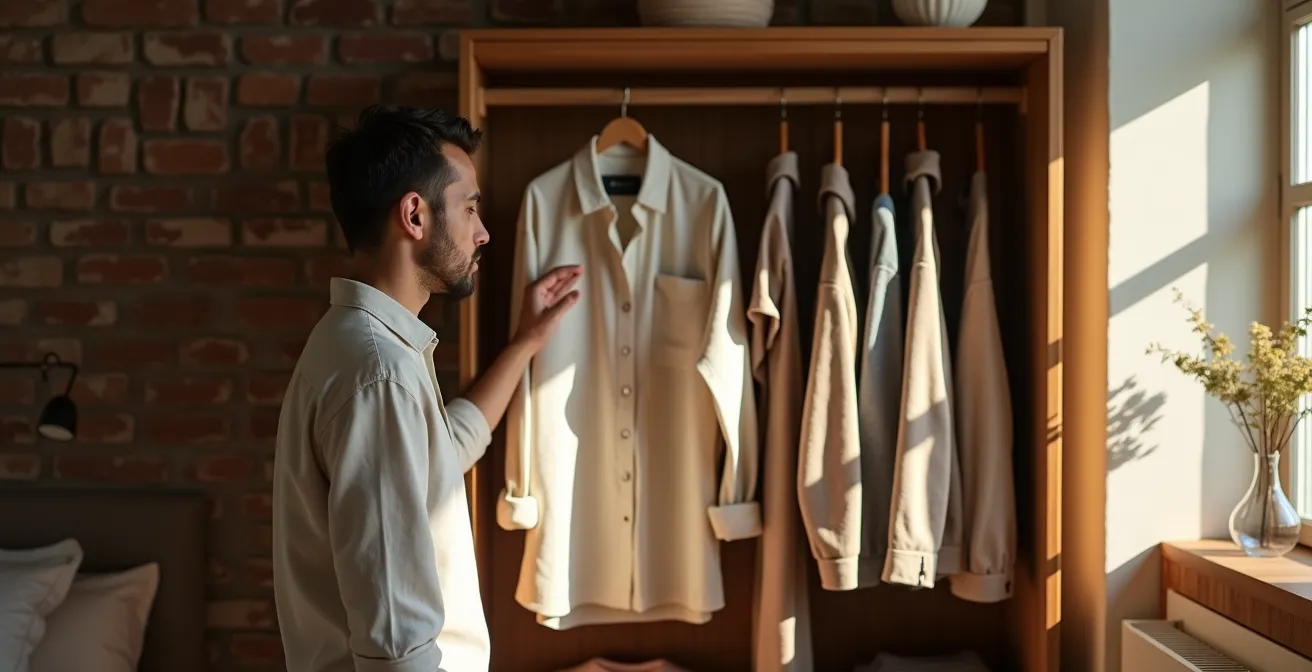
In summary:
- Building an ethical wardrobe isn’t about buying new ‘eco’ items; it’s about strategically detoxing from fast fashion’s psychological traps.
- Start by replacing high-frequency wear items like synthetic basics, not by doing a complete overhaul.
- Focus on “cost-per-wear” instead of the initial price tag to see how quality slow-fashion pieces save you money in the long run.
- True sustainability comes from owning fewer, better pieces you love, which frees up both your time and mental space.
Does the thought of quitting fast fashion feel overwhelming? You’re not alone. Many fashion-conscious people feel a conflict between their desire for style and their concern for the planet. The high street tempts us with an endless cycle of new trends, and the common advice—”buy less, choose well”—often feels vague and unhelpful. We’re told to look for organic cotton or second-hand treasures, but this rarely addresses the core problem: a closet overflowing with clothes we barely wear and a lingering feeling of dissatisfaction.
The truth is, the industry is designed to keep you buying. It creates psychological traps, from the illusion of a bargain on the sale rail to the misleading “eco-friendly” labels that are little more than greenwashing. Simply swapping one shopping habit for another, even if it’s for “sustainable” brands, doesn’t break the cycle. It just replaces one form of consumption with another.
But what if the key wasn’t about finding the perfect sustainable brand, but about fundamentally changing your relationship with your clothes? This guide offers a different path. It’s not a shopping list, but a strategic framework for becoming the curator of your own wardrobe. We will dismantle the psychological hold of fast fashion, build a versatile and stylish collection from just a few key pieces, and prove that true style isn’t about quantity, but about intention.
This article will guide you through a strategic process, from understanding the hidden pollution in your clothes to building an emotional connection with your wardrobe. Follow along to discover a more intentional and fulfilling way to express your style.
Contents: How to Build a Sustainable Wardrobe That Lasts
- Why Polyester Is the Plastic Pollution You Wear Every Day?
- How to Build a 30-Piece Wardrobe That Covers Every Occasion?
- Greenwashing vs True Sustainability: Which Certifications Can You Trust?
- The “Sale Rail” Trap That Fills Your Closet With Unworn Clothes
- In What Order Should You Replace Items to Build a Sustainable Wardrobe?
- Why Owning Less Stuff Actually Gives You More Free Time?
- Functional vs Emotional Positioning: Which Builds Stronger Loyalty?
- How Slow-Fashion Clothing Saves You Money Over 5 Years?
Why Polyester Is the Plastic Pollution You Wear Every Day?
Before we can build a better wardrobe, we must first understand the invisible problem hiding in our current one. Polyester, the most common fabric in our clothes, is essentially a plastic. While it’s praised for its durability and low cost, its environmental impact is staggering. Every time you wash a polyester garment, it sheds thousands of microscopic plastic fibres. These microplastics are too small to be caught by wastewater treatment plants and end up polluting our oceans, rivers, and even our drinking water.
This isn’t a minor issue; the fashion industry’s reliance on synthetic fabrics is a primary driver of plastic pollution. In fact, a significant portion of microplastic pollution in the ocean comes directly from our laundry. The problem is so vast that fashion is responsible for 10% of global carbon emissions, more than maritime shipping and international flights combined, with polyester production being a major contributor due to its fossil fuel origins.

As you can see from this microscopic view, the very structure of these fabrics is designed to break apart. Choosing natural fibres like organic cotton, linen, and Tencel is a crucial first step. But what about the polyester already in your closet? It’s not realistic to throw it all away. Instead, we can mitigate the damage with a few simple changes in our laundry routine.
- Use Guppyfriend bags or washing machine filters to catch microfibers during laundry.
- Wash polyester garments less frequently and on cold cycles to minimize fiber shedding.
- Choose recycled polyester when natural fibers aren’t available for your needs, but still wash it with care.
- Properly dispose of worn-out polyester through textile recycling programs, never in regular trash.
How to Build a 30-Piece Wardrobe That Covers Every Occasion?
The idea of a minimal wardrobe often conjures images of bland, boring outfits. But the reality is the opposite. A well-curated collection of 25-30 versatile pieces can offer more creative freedom and styling options than a closet overflowing with fast fashion. The key is to shift from a “capsule” mindset, which is often rigid and seasonal, to a more flexible “modular” approach. This is about wardrobe curation, not restriction.
A traditional capsule wardrobe focuses on a fixed set of basics. A modular wardrobe, however, is built around 2-3 signature “anchor” pieces that truly reflect your personal style. These could be a perfectly cut blazer, a unique pair of boots, or a timeless dress. The other items are then selected to complement these anchors, creating a system where almost every piece works with every other piece. As YouTuber Jessica Harumi has shown, a 30-item wardrobe is more than enough to create 30 entirely different outfits through strategic layering and accessorizing.
This table illustrates the fundamental differences in approach:
| Aspect | Traditional Capsule | Modular Wardrobe |
|---|---|---|
| Flexibility | Fixed seasonal pieces | Adaptable year-round items |
| Size | 33-37 items typically | 25-30 core pieces |
| Style Evolution | Complete seasonal refresh | Gradual piece replacement |
| Investment Focus | Basics first | 2-3 signature pieces as anchors |
The goal is to create a small, hard-working collection of clothes that you absolutely love. This approach not only simplifies your daily routine but also ensures that every item you own is a true expression of your style, rather than a fleeting trend. It transforms your wardrobe from a source of stress into a source of joy and creativity.
Greenwashing vs True Sustainability: Which Certifications Can You Trust?
As consumers become more eco-conscious, brands have been quick to respond with green marketing. We’re bombarded with terms like “eco-friendly,” “conscious,” and “recycled,” but these labels often hide more than they reveal. This practice, known as greenwashing, makes it incredibly difficult to distinguish genuine sustainable efforts from clever marketing ploys. While certifications like GOTS (Global Organic Textile Standard) and Fair Trade are valuable indicators, they don’t tell the whole story and aren’t always accessible to smaller, truly ethical brands.
The rise in greenwashing is a direct response to consumer demand. In fact, one report noted a 71% rise in searches for sustainable goods over 5 years, creating a huge incentive for brands to appear greener than they are. To cut through the noise, we need to become investigators. Instead of passively trusting a logo, we must actively question brands and demand transparency. True sustainability is about radical honesty, not just a “conscious collection” made from recycled polyester while the main business model remains unchanged.
You don’t need to be an expert to spot the red flags. By asking the right questions, you can empower yourself to make informed decisions beyond the marketing hype. A truly sustainable brand will be proud to answer these questions with specific, verifiable information.
Here are five critical questions to ask before you buy:
- Who made my clothes? Ask for specific factory locations and evidence of fair worker conditions. Vague answers are a red flag.
- What is the exact material composition? Demand a full breakdown of all materials used, not just the “at least 50% sustainable” line.
- How many items are produced per style? Limited, thoughtful production runs are a hallmark of slow fashion, whereas massive volumes signal a fast-fashion model.
- Does the brand offer repair services or take-back programs? A brand committed to the full lifecycle of its products is a brand that believes in durability.
- Can they provide supply chain documentation beyond marketing claims? Ask for proof, not just promises.
The “Sale Rail” Trap That Fills Your Closet With Unworn Clothes
We’ve all felt it: the rush of finding a stylish item at a 70% discount. That feeling is no accident. The “sale rail” is one of the most effective psychological traps deployed by fast fashion retailers. It creates a false sense of urgency and triggers our brain’s reward system, making us feel like we’re being savvy shoppers. In reality, we’re often being manipulated into buying things we don’t need, don’t truly love, and will barely wear.
This cycle of impulse buying is a cornerstone of the fast fashion business model, which thrives on overconsumption. The statistics are damning: while global clothing production has doubled in the last 15 years, the number of times each item is worn has dropped by approximately 40% in many developed countries. The sale rail is a major contributor to this phenomenon, filling our closets with “bargains” that ultimately become clutter and waste.
Breaking free from this trap requires a conscious shift in mindset, from hunting for discounts to investing in value. The “30-Day Wishlist” method is a powerful tool for this. It introduces a crucial pause between the impulse to buy and the actual purchase, allowing your logical brain to catch up with your emotional one. It’s a simple but transformative practice that helps you distinguish a fleeting want from a genuine need.
The 30-Day Wishlist: Your Defence Against Impulse Buys
- Create a wishlist (in a notebook or on your phone) for any item you want to buy, instead of purchasing immediately.
- Wait a full 30 days before revisiting the list to evaluate if you still truly want and need the item.
- Before buying, calculate the potential “cost-per-wear” by dividing the price by the estimated number of times you’ll wear it.
- Consider if the item works with at least three other pieces you already own to ensure versatility.
- Always “shop your closet” first. Try to create a new outfit with what you have before deciding you need something new.
In What Order Should You Replace Items to Build a Sustainable Wardrobe?
Deciding to build a sustainable wardrobe can feel like a monumental task. The temptation is to throw everything out and start from scratch with ethically sourced pieces. However, this approach is both wasteful and expensive. The most sustainable garment is the one you already own. The transition should be a slow, deliberate process of systematic replacement as items wear out, focusing on impact and frequency of use.
So, where do you begin? The key is to prioritise. You should focus first on replacing items that have the highest frequency of wear and the most significant negative impact. This typically means starting with the pieces that are in direct contact with your skin and are washed most often, as they are a primary source of microplastic shedding and expose you to residual chemicals. Items you wear only for special occasions should be the last on your list to replace.
This priority matrix helps you identify a logical starting point. Instead of being overwhelmed, you can create a clear, step-by-step plan. Start with an audit of your current wardrobe to identify your most-worn items and the materials they are made from. This will give you a clear roadmap for your sustainable journey.
Your Wardrobe Detox: A 5-Step Action Plan
- Points of Contact: Identify all your high-frequency wear items. List your daily go-to pieces like underwear, socks, t-shirts, and jeans.
- Collection Audit: Go through your wardrobe and inventory the items made from polyester or other synthetics, as well as cheap, poor-quality fast-fashion pieces.
- Coherence Check: Confront these items with your true personal style and quality standards. Do they fit you well? Do you feel good wearing them? Or are they just “filler”?
- Emotional Assessment: Separate items that hold genuine sentimental value or you love wearing from those that are just taking up space. A dress worn once to a wedding is different from a cheap t-shirt you bought on a whim.
- Integration Plan: Based on this audit, create a prioritized replacement list. Focus on replacing the high-wear, low-quality synthetic items first as they reach the end of their life.
Why Owning Less Stuff Actually Gives You More Free Time?
We are conditioned to believe that more choice is a good thing. A closet packed with options should, in theory, make getting dressed easier and more exciting. The reality, however, is often the opposite. An overstuffed wardrobe leads to what psychologists call decision fatigue—the mental exhaustion that comes from making too many choices. This is the hidden cost of overconsumption, a phenomenon that has seen some research show humans now consume 400% more clothing than just 20 years ago.
Every morning, you stand in front of your wardrobe, faced with dozens, if not hundreds, of choices. Many items don’t fit right, some are out of style, and others are “special occasion” pieces you never wear. This daily struggle to assemble an outfit consumes precious time and mental energy that could be better spent elsewhere. It’s a subtle but significant source of daily stress.
Adopting a minimalist, curated wardrobe flips this dynamic. By owning fewer, better pieces that you love and that all work together, you eliminate the noise. Getting dressed becomes a simple, joyful, and creative act. You move from being a stressed “consumer” to a confident “curator” of your own style. This mental shift is one of the most profound benefits of sustainable fashion. It’s not just about saving the planet; it’s about reclaiming your time and peace of mind.
This mindful approach turns your wardrobe from a source of anxiety into a tool for self-expression. You spend less time deciding what to wear and more time living your life, confident in the knowledge that whatever you choose, it will make you look and feel great.
Functional vs Emotional Positioning: Which Builds Stronger Loyalty?
Why do we hold on to certain garments for years, even decades, while others are discarded after a few wears? The answer rarely lies in the item’s function. It’s about emotion. Fast fashion operates on a purely functional (and disposable) level: you need a top for a party, you buy it, you wear it, you forget it. Slow fashion, on the other hand, aims to build an emotional connection with our clothes, transforming them from disposable commodities into cherished possessions.
This emotional bond is the bedrock of a truly sustainable wardrobe. It’s what makes you want to mend a sweater instead of replacing it, or to find new ways to style a dress you’ve had for years. This connection can be forged in several ways: through the story of who made the garment, the quality of the material that feels good against your skin, or the memories associated with wearing it. As sustainable fashion advocate Kristen Leo puts it:
Real fashion is about following movements that bring us into a better future, and the greatest movement right now is sustainability.
– Kristen Leo, in How To Be A Real Fashionable Girl
When you invest in a piece from a brand that shares its artisans’ stories, or you buy a vintage jacket with a history of its own, you are acquiring more than just an item of clothing. You are acquiring a story. This narrative value fosters a sense of loyalty and care that is impossible to replicate with mass-produced, anonymous garments. Sustainable fashion empowers us to make conscious choices that align with our identity and values, building a wardrobe that is not only stylish but also meaningful.
Key Takeaways
- Polyester is a form of plastic pollution; washing it less and using filters can significantly reduce your environmental impact.
- A small, modular wardrobe of 25-30 pieces built around “anchor” items offers more versatility and style than a large, disjointed one.
- The “cost-per-wear” metric is the most accurate way to assess the true value of a garment, proving quality is cheaper over time.
How Slow-Fashion Clothing Saves You Money Over 5 Years?
One of the biggest myths about sustainable fashion is that it’s unaffordable. While the upfront cost of a well-made garment is higher than a fast-fashion alternative, the long-term economics tell a very different story. The key is to shift your financial perspective from the initial price tag to the cost-per-wear. A £20 t-shirt that falls apart after five washes is far more expensive than an £80 t-shirt that lasts for a decade.
Fast fashion is a false economy. It’s designed for obsolescence, forcing you into a constant cycle of replacement. This not only drains your bank account over time but also contributes to staggering amounts of waste. For instance, the average American generates 82 pounds of textile waste yearly, a trend mirrored in the UK, much of it from discarded cheap clothing. Slow fashion breaks this cycle by prioritizing quality, durability, and timeless design.
When you invest in a high-quality piece, you’re not just buying a garment; you’re buying longevity. These items can be worn hundreds of times, repaired when needed, and often retain a higher resale value. Let’s break down the 5-year cost of a few wardrobe staples to see the savings in action.
| Item Type | Fast Fashion (5 years) | Sustainable Fashion (5 years) | Savings |
|---|---|---|---|
| Basic T-Shirt | £20 x 10 replacements = £200 | £80 x 1 (or 2) = £80-£160 | £40+ |
| Jeans | £40 x 8 pairs = £320 | £150 x 2 pairs = £300 | £20 |
| Winter Coat | £100 x 3 = £300 | £300 x 1 = £300 | £0 (with far superior quality) |
| Leather Boots | £60 x 5 pairs = £300 | £250 x 1 pair + £30 repairs = £280 | £20 |
| Total | £1120 + time spent shopping | £940-£1040 + higher resale value | £80-£180 minimum |
Building a sustainable wardrobe is a journey of intention, not deprivation. By applying these strategic principles, you can create a collection of clothes that truly reflects your style, aligns with your values, and simplifies your life. The next logical step is to begin your own wardrobe audit and start curating a collection you love.