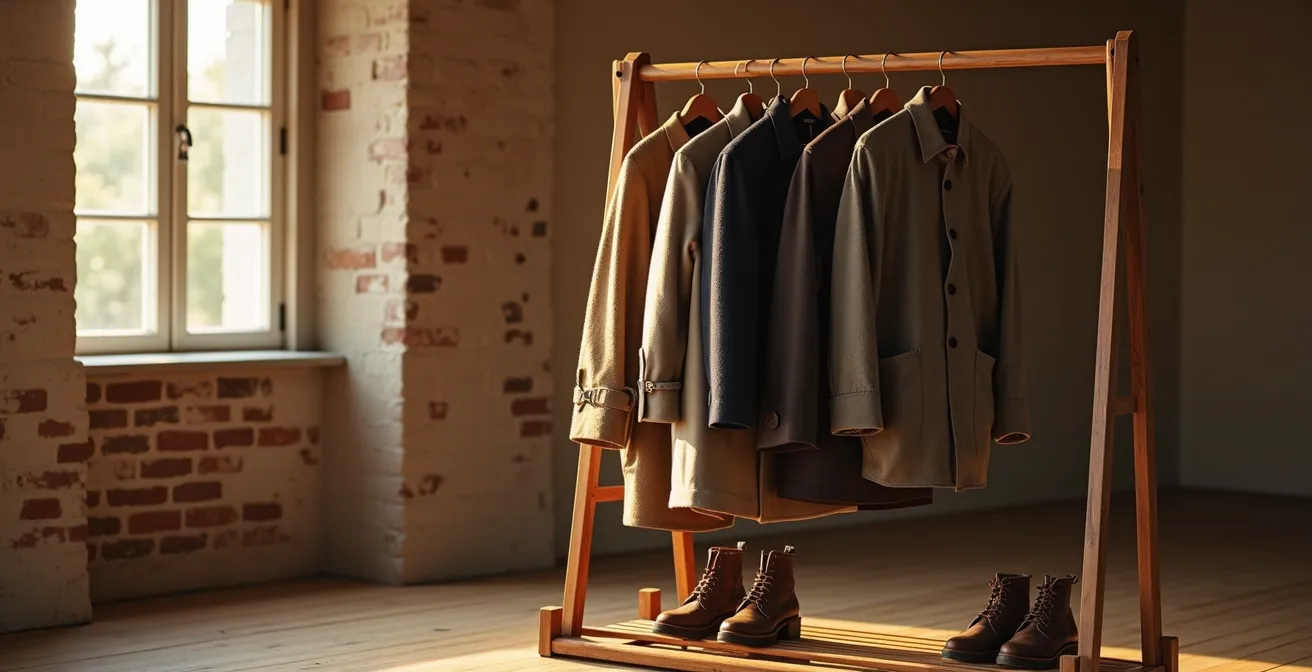
The core finding is that a higher initial price on a quality garment leads to a lower Total Cost of Ownership (TCO) and slower asset depreciation over time.
- Fast fashion acts like a rapidly depreciating asset, losing almost all its value within a year.
- Key quality indicators like stitching density and material integrity are measurable predictors of a garment’s financial longevity.
Recommendation: Shift your mindset from ‘cost per item’ to ‘cost per year of use’ by treating clothing purchases as long-term investments in a functional wardrobe portfolio.
For the budget-conscious shopper, the concept of “slow fashion” often triggers an immediate red flag: the price tag. The idea of spending £200 on a single coat when a similar-looking one costs £50 seems financially illogical. This initial sticker shock is the single biggest barrier, creating a perception that sustainable and ethical fashion is a luxury reserved for the wealthy. It’s a conclusion based on a simple, but flawed, calculation that only considers the immediate cost of acquisition.
Most advice encourages you to think about “cost per wear,” a step in the right direction but still an incomplete formula. The real economic picture is far more detailed. As a fashion economist, I argue that to truly understand the financial impact of your clothing choices, you must stop thinking like a consumer and start thinking like an investor. Your wardrobe is not a collection of expenses; it’s a portfolio of functional assets, each with its own rate of depreciation, maintenance cost, and residual value.
This analysis moves beyond platitudes. We will build a financial model that treats your clothes like any other asset, from cash to real estate. By dissecting the concepts of Total Cost of Ownership and Garment Depreciation Rate, we will mathematically demonstrate how a strategic, quality-focused approach to your wardrobe doesn’t just align with ethical values—it actively saves you significant money over a five-year period. It’s not about spending more; it’s about allocating capital more efficiently.
This article provides a structured economic analysis of your wardrobe. We will break down the true cost of quality, identify measurable quality indicators, and apply financial principles to your clothing choices to build a more durable and cost-effective personal style.
Summary: An Economist’s 5-Year Analysis of Wardrobe Costs
- Why a £200 Coat Is Cheaper Than Four £50 Jackets?
- How to Spot Poor Stitching Before You Buy a Garment?
- Wool vs Acrylic: Which Knitwear Lasts Longer in UK Weather?
- The Washing Mistake That Ruins Your High-Quality Jeans
- When to Buy Winter Staples for the Best Price and Selection?
- Why Keeping Cash in a Savings Account Is Costing You Real Wealth Daily?
- Why You Should Never Renovate Beyond Your Street’s Value Ceiling?
- How to Structure Asset Management to Beat UK Inflation of 5%?
Why a £200 Coat Is Cheaper Than Four £50 Jackets?
The fundamental error in comparing a £200 coat to a £50 one is focusing solely on the initial capital outlay. This ignores the primary driver of long-term cost: the Garment Depreciation Rate. Fast fashion is designed for rapid turnover, a model fuelled by a culture of constant acquisition. In fact, research shows the average consumer now buys 60% more clothing than they did just 15 years ago, yet each item is kept for half as long. This cycle of buying, wearing a few times, and discarding is a significant and recurring drain on personal finances.
To illustrate this, let’s analyze the Total Cost of Ownership (TCO) over a five-year horizon. The TCO includes not just the purchase price but also factors in the asset’s lifespan and its residual or resale value. The following financial model compares the two purchasing strategies as revealed in a recent comparative analysis.
| Metric | £200 Quality Coat | Four £50 Jackets |
|---|---|---|
| Initial Cost | £200 | £200 (£50 x 4) |
| Lifespan | 5+ years | 1 year each |
| Cost Per Wear (100 wears) | £2.00 per wear | £2.00 per wear (25 wears each) |
| Resale Value | £40-80 (20-40%) | £0-5 each |
| Final 5-Year Cost | £120-£160 | £195-£200 |
The numbers are clear. While the initial investment is identical, the quality coat retains a significant portion of its value, making its final cost to you, the owner, substantially lower. The four fast-fashion jackets, with their near-total depreciation, represent a recurring £50 annual expense disguised as a bargain. This shift in consumer thinking from quantity to quality is not just hypothetical.
Case Study: The Impact of Education on Consumer Choice
A study on consumer preferences found that when participants were educated on the principles of quality and longevity, their purchasing behaviour shifted. The study noted that while initial preference was for more items, there was “an increase in participants’ preference towards the single, more expensive item (in other words, trading off quantity for quality) immediately after education.” This demonstrates that understanding the economics of durability directly influences purchasing decisions towards more financially sound, high-quality options.
How to Spot Poor Stitching Before You Buy a Garment?
The economic longevity of a garment is physically built into its construction. While fabric quality is crucial, the true sign of a durable asset is the quality of its assembly. Poor stitching is the first point of failure, leading to premature depreciation. An educated investor can spot these weaknesses before purchase, avoiding assets destined for rapid decline. You don’t need to be a tailor; you just need to know what to look for. The key is to examine the stitching density and reinforcement at key stress points.
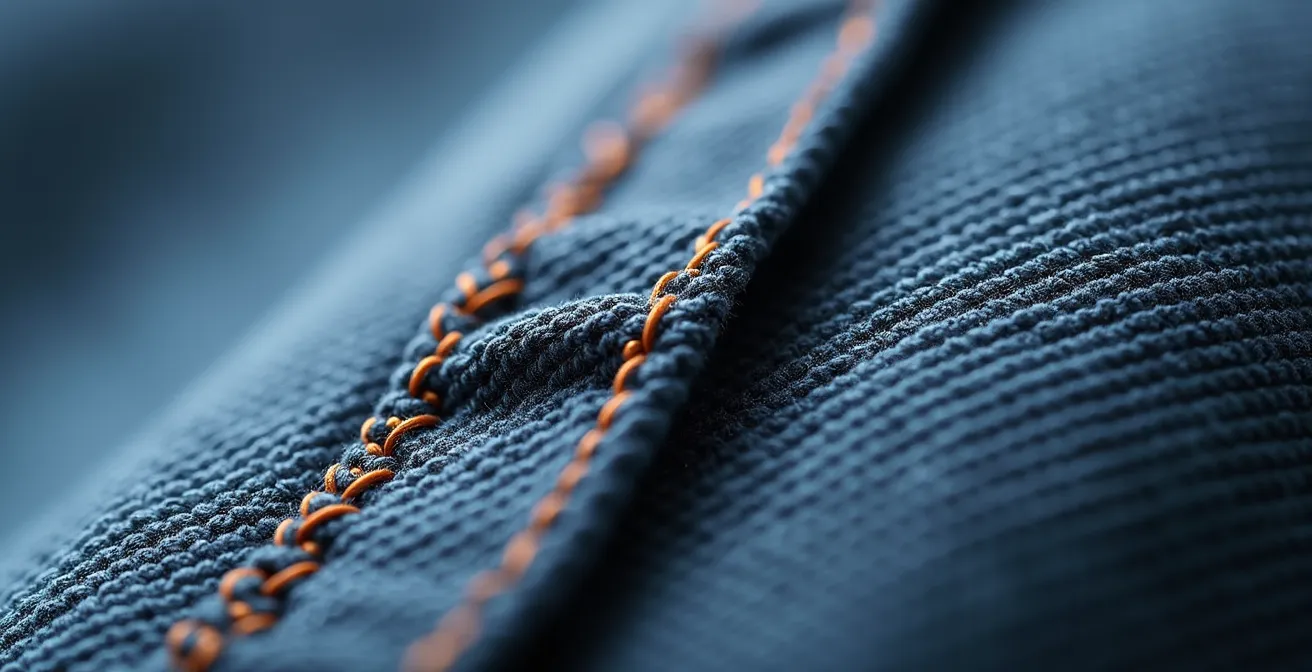
As the image above illustrates, quality is visible at a micro level. High-quality garments feature tight, consistent stitches, often with 8-12 stitches per inch (SPI) on a well-made shirt. Cheaper items will have a lower SPI, which saves thread and time during manufacturing but creates weaker seams prone to puckering and splitting. Look for reinforced areas, like bar tacks (a series of dense stitches) at pocket corners, belt loops, and the fly of a pair of trousers. The absence of these reinforcements is a clear red flag indicating a low-quality build.
To develop an investor’s eye for garment quality, you need a systematic audit process. The following framework helps you move from a passive consumer to an active quality assessor, ensuring your clothing capital is allocated to assets built to last.
Your 5-Point Garment Quality Audit
- Identify Key Quality Touchpoints: Before you even look at the price tag, list the physical indicators of quality on the garment. Examine seam finishing, button attachment, fabric weave, and how the material feels.
- Collect Comparative Data: Inventory the high-quality and low-quality items you already own. Note how the stitching, fabric, and shape have held up over time in relation to their initial cost.
- Assess for Coherence: Confront the garment’s physical quality with its brand positioning and price. Does the stitching density and material feel consistent with the value being asked for?
- Evaluate Long-Term Value: Judge the garment’s design for mémorability and emotional connection. Is this a classic piece with long-term style potential or a disposable trend item?
- Create an Investment Plan: Based on your audit, define the specific quality markers you will look for on your next purchase to fill a genuine gap in your wardrobe with a durable asset.
Wool vs Acrylic: Which Knitwear Lasts Longer in UK Weather?
A garment’s material composition is a primary determinant of its performance and lifespan, particularly in a variable climate like the UK’s. The choice between a natural fibre like wool and a synthetic one like acrylic is not merely aesthetic; it’s a financial decision with long-term consequences. Extending the functional life of clothing has a massive economic impact; research from Oxfam shows that extending the average life of clothes by just nine months would save billions in resources and consumer spending.

Acrylic is a plastic fibre made from fossil fuels. It is cheap to produce, which is why it’s ubiquitous in fast fashion knitwear. However, its fibres are weak, prone to pilling (forming small balls of fluff), and have poor moisture-wicking properties, trapping sweat and leading to odours. Crucially, every time an acrylic garment is washed, it sheds microplastics. Wool, conversely, is a natural, renewable, and biodegradable fibre. Its inherent properties make it a superior long-term asset for UK weather. It is naturally thermoregulating, breathable, and water-resistant. The complex, crimped structure of wool fibres allows them to bend thousands of times without breaking, giving the garment superior shape retention and durability.
This isn’t just a qualitative assessment; it’s a matter of material science. As experts who have studied the properties of these fibres confirm, the difference in longevity is significant. In a direct comparison, the TBCo Research Team stated in their study:
Wool surpasses acrylic in terms of durability and longevity. Wool fibres are naturally strong and elastic, making them resistant to wear and tear. Wool garments can withstand repeated use and maintain their shape and structure for years.
– TBCo Research Team, TBCo Wool vs Acrylic Comparison Study
Choosing wool over acrylic is a clear investment in an asset with a lower depreciation rate. An acrylic jumper may lose its shape and texture after one season, rendering its value near zero. A quality wool jumper, with proper care, can serve as a functional asset for a decade or more, resulting in a far lower cost per year of use.
The Washing Mistake That Ruins Your High-Quality Jeans
Investing in a high-quality garment is only the first step. Protecting that asset through correct maintenance is essential to realizing its long-term value. One of the most common ways consumers prematurely depreciate a quality asset is through improper laundering. High-quality raw or selvedge denim is a perfect case study. A £150 pair of jeans is an investment in superior cotton and construction, designed to mould to your body over time. The most common maintenance error? Washing them too frequently in hot water.
Hot water, combined with harsh detergents and the agitation of a washing machine, is destructive to cotton fibres. It causes the natural indigo dye to bleed excessively, the fibres to shrink and weaken, and the unique wear patterns (the very reason for investing in quality denim) to be washed away into a uniform, faded blue. This effectively accelerates the garment’s depreciation, stripping it of both its aesthetic and financial value. An investor wouldn’t willingly degrade their assets, yet this happens in laundry rooms every day.
To maximize the lifespan of your denim, adopt a minimalist care regimen. Experts recommend washing jeans as infrequently as possible—only when visibly dirty or odorous. When you do wash them, turn them inside out and use a cold-water cycle with a mild, colour-safe detergent. To go a step further, hand-washing in a tub of cold water with a small amount of detergent is even better. Always hang them to air dry; the high heat of a tumble dryer is the fastest way to damage the cotton fibres and cause unwanted shrinkage.
Think of it this way: a single hot wash can strip a year of potential life from your investment. By simply changing your washing habits, you are actively preserving the capital you’ve invested in your wardrobe, ensuring each piece delivers its maximum functional and aesthetic return over its intended lifespan.
When to Buy Winter Staples for the Best Price and Selection?
Strategic acquisition is a cornerstone of any successful investment philosophy. Just as a stock market investor doesn’t buy at the peak of a hype cycle, a savvy wardrobe economist doesn’t buy winter staples in the middle of a cold snap in November. Understanding the retail cycle allows you to acquire high-quality assets at a significant discount, lowering your initial capital outlay and dramatically improving the overall return on your investment.
The retail market operates on predictable seasonal cycles. The worst time to buy a winter coat or wool jumper is from October to December, when demand is at its peak and prices are at their highest. The key is to buy counter-cyclically. The two best windows for purchasing winter staples are:
- End-of-Season Sales (Late January to March): This is when retailers are clearing out winter inventory to make room for spring collections. You can often find high-quality, classic pieces from premium brands at discounts of 30-70%. The selection may be slightly more limited, but the value is exceptional. This is the equivalent of buying a solid, blue-chip stock after a market dip.
- Pre-Season (Late August to September): While there are fewer discounts, this is the best time for selection. New collections arrive in-store, and you have the full range of sizes and styles to choose from. Some brands offer small “early bird” incentives, but the main advantage here is securing the exact asset you want before it sells out.
By planning your purchases and buying off-season, you can acquire a £300 wool coat for £150. This single action cuts your initial investment in half and doubles the financial efficiency of the purchase. It requires patience and foresight—the hallmarks of a good investor—but it is the most effective way to build a high-quality wardrobe on a budget. Never let an immediate need dictate a high-price purchase; anticipate your needs and align your buying with the market’s cycles.
Why Keeping Cash in a Savings Account Is Costing You Real Wealth Daily?
In personal finance, holding too much cash is seen as a mistake. While it feels safe, money in a low-interest savings account is constantly being eroded by inflation. Its purchasing power silently decreases every day. A wardrobe composed entirely of cheap, fast-fashion items operates on the exact same principle. It creates the illusion of wealth (a closet full of clothes) while your actual “wardrobe equity” is in a state of constant decline.
Each £15 t-shirt or £30 pair of trousers is a micro-asset with a hyper-accelerated depreciation schedule. Its value isn’t slowly decreasing; it’s falling off a cliff. After a few washes, the fabric pills, the seams twist, and the shape is lost. Like cash eaten by inflation, its functional value—its ability to do its job and make you feel good—plummets towards zero. You are left with a closet full of items that are technically “there” but are functionally worthless.
This forces you into a cycle of constant replenishment, spending more money just to maintain the same baseline level of functionality. Your clothing budget is perpetually spent on replacing failed assets, never on building lasting equity. A quality garment, like a well-chosen investment, is designed to hold its value. It resists the “inflation” of wear and tear. Shifting your capital from disposable items to durable ones stops this silent erosion of your wealth and allows you to build a stable, functional asset base.
Why You Should Never Renovate Beyond Your Street’s Value Ceiling?
In real estate, there’s a concept known as the “value ceiling.” You could install a gold-plated kitchen in a modest suburban house, but you will never recoup that investment because the value of the property is capped by the surrounding neighbourhood. Spending money to “improve” an asset beyond its fundamental potential is a guaranteed financial loss. This principle applies directly to how we should think about clothing repair and maintenance.
Attempting to perform significant repairs on a poorly made fast-fashion garment is the wardrobe equivalent of over-renovating. You can spend time and money sewing a split seam on a £20 dress, but you cannot fix the underlying problems: the low-grade fabric that will tear elsewhere, the cheap thread that will break again, and the poor cut that will never hang correctly. You are investing in an asset with a low value ceiling. No matter how much you patch it up, it will never perform like a well-made garment.
The economically sound decision is to recognize when an asset is fundamentally flawed. Instead of pouring good money (and time) after bad, that capital is better allocated towards acquiring an asset with a higher “value ceiling”—a garment made from durable materials and with strong construction from the start. Your maintenance budget should be focused on preserving high-quality assets (like replacing a button on a good coat), not on trying to salvage assets that were designed to fail.
This isn’t to say all repair is bad. Mending a quality piece is a wise investment. But knowing when to stop investing in a failing asset is a critical financial skill that separates a savvy wardrobe manager from a sentimental hoarder.
Key takeaways
- The true cost of clothing is its Total Cost of Ownership (Initial Price – Resale Value), not just its price tag.
- Quality is measurable through physical indicators like stitching density (SPI) and material integrity, which predict a garment’s financial longevity.
- Adopting an investor’s mindset—buying off-season and performing correct maintenance—maximizes the return on your wardrobe capital.
How to Structure Asset Management to Beat UK Inflation of 5%?
The challenge of beating inflation in financial markets requires a strategic, diversified, and long-term approach. It’s about making your money work for you, rather than letting it be eroded by economic forces. Structuring your “wardrobe asset management” to beat the “inflation” of fast fashion—the constant need to spend more to replace failing items—requires the exact same mindset. The goal is to build a core portfolio of high-performing assets that deliver value year after year.
Your strategy should be built on the economic principles we’ve established. First, you must allocate capital strategically, directing funds away from rapidly depreciating “junk bonds” (fast fashion) and towards “blue-chip stocks” (well-made, classic garments). This means saving up for a key purchase rather than making several impulse buys. Second, you must perform due diligence before every acquisition, using the quality audit checklist to assess each potential asset’s construction and material integrity. Third, you must have a long-term holding strategy, protecting your assets through proper maintenance and resisting the urge to sell low (i.e., discard) at the first sign of a new trend.
By viewing your wardrobe as a managed portfolio, you shift from being a passive consumer to an active investor in your own life. Every pound you allocate to a quality piece that lasts five years instead of one is a pound that is working five times as hard. This is how you beat the relentless “inflation” of a disposable culture and build real, lasting wardrobe equity. It is the most logical and financially sustainable path to a better wardrobe.
The final step is to move from theory to practice. Begin by auditing one section of your current wardrobe—your knitwear or your outerwear—using these economic principles. Assess each item’s quality, estimate its remaining functional life, and identify the gaps where a single, strategic investment could replace several failing assets.