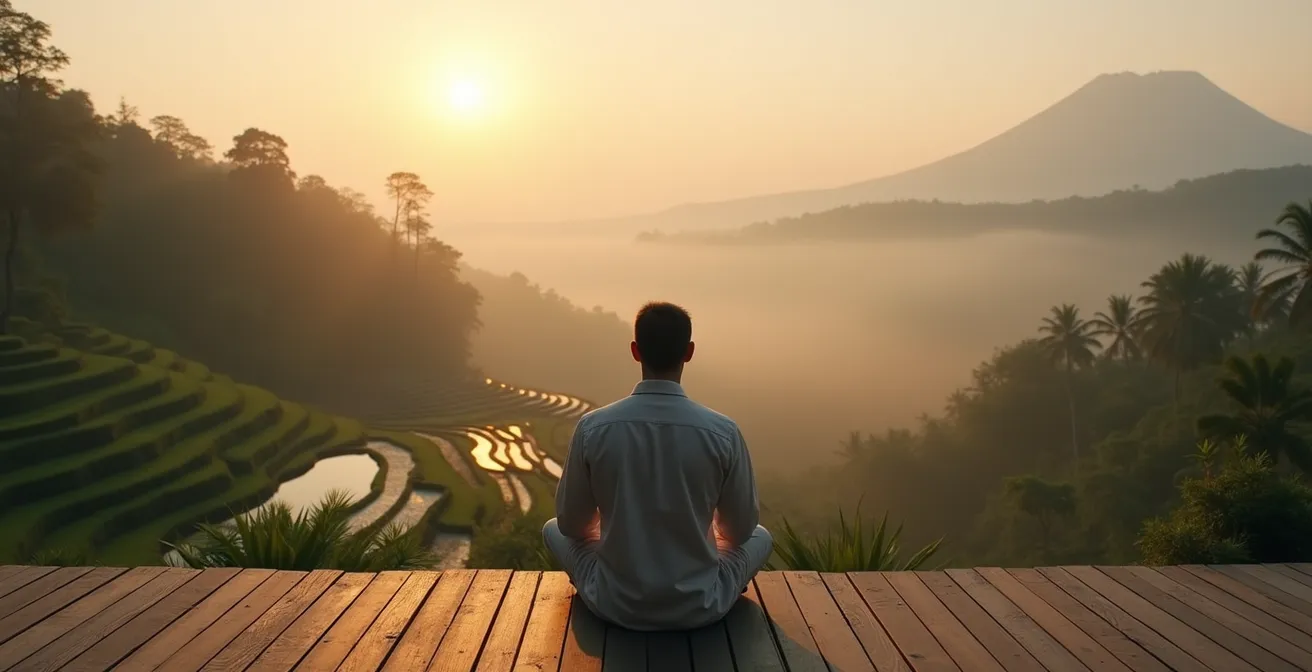
A Bali wellness retreat is not a simple vacation; it is a precise neurological recalibration that reverses executive burnout by systematically replacing corporate cognitive load with nature’s restorative complexity.
- The unique sensory environment of Bali measurably reduces stress hormones like cortisol more effectively than a standard break.
- True recovery involves adopting minimalist principles, from packing to daily life, to reduce decision fatigue and reclaim mental energy.
Recommendation: To sustain the benefits, focus on an “intentional re-entry” plan that integrates mindful practices into your daily corporate routine upon return.
For the high-achieving executive, burnout is not a sign of weakness; it’s a system failure. The relentless pace, the digital saturation, and the weight of constant decision-making create a state of chronic cognitive overload. The default solution is often a short holiday, a frantic attempt to disconnect that rarely addresses the root cause. We tell ourselves we just need to “relax,” but the mind, conditioned for performance, struggles to power down. The email notifications may be off, but the internal server is still running at full capacity.
This is where the conventional approach to recovery falls short. You might return from a week in Cornwall or the Cotswolds feeling momentarily rested, but the underlying fatigue quickly resurfaces. The environment is different, but the internal operating system remains the same. But what if the key wasn’t just to escape your environment, but to immerse yourself in one so fundamentally different that it forces a complete neurological reset? The true value of a Bali wellness retreat lies not in its beauty, but in its ability to facilitate this deep, systemic recalibration.
This guide moves beyond the picturesque postcards to explore the mechanisms behind this transformation. We will delve into the science of why Bali’s environment accelerates stress reduction, provide a blueprint for mindful preparation, and reveal the strategies needed to integrate this newfound equilibrium back into your demanding life in the UK. This is not about leaving your life behind; it’s about finding a more sustainable way to lead it.
text
This article explores the complete journey, from the scientific basis of recovery in Bali to the practical steps for maintaining your newfound balance back in the corporate world. The following sections will guide you through each stage of this transformative process.
Summary: The Executive’s Path to Recovery in Bali
- Why Your Cortisol Levels Drop Faster in Ubud Than in Cornwall?
- How to Pack for a Yoga Retreat Without Exceeding Carry-On Limits?
- Silent Retreat vs Active Yoga: Which Recharges Your Batteries Better?
- The Etiquette Mistake That Offends Balinese Locals Instantly
- How to Maintain Your “Bali Zen” When Returning to a London Commute?
- Why Owning Less Stuff Actually Gives You More Free Time?
- The “Boom and Bust” Activity Error That Worsens Fatigue
- How Ethical Minimalism Reduces Stress and Clutter in Small UK Apartments?
Why Your Cortisol Levels Drop Faster in Ubud Than in Cornwall?
The feeling of calm that descends in Bali is not just a placebo effect; it is a measurable biochemical reaction. An executive’s brain is typically wired for the structured, often-manmade environment of a city like London. The cognitive load is high, and the sensory input is predictable. A trip to a UK countryside location like Cornwall offers a break, but the natural patterns are relatively simple. Bali, and specifically a region like Ubud, presents something entirely different: restorative complexity.
This environment is dense with natural fractals—the intricate, repeating patterns found in fern leaves, jungle canopies, and tropical flowers. This visual complexity captivates the brain’s attention effortlessly, a process that actively lowers stress. Scientific evidence supports this phenomenon; research published in Frontiers in Psychology demonstrates that just 20-30 minutes of nature exposure can lead to a significant drop in the stress hormone cortisol. In Bali, this exposure is constant and immersive, accelerating the effect.

As this image illustrates, the dense, layered textures of a tropical jungle provide a far richer sensory diet for a depleted mind than simpler coastal landscapes. For executives whose burnout stems from over-stimulation, this is a critical distinction. Specialised programs like The Place Retreats in Bali focus specifically on this process, helping C-suite leaders disconnect from the “not good enough” pressure of corporate life by reconnecting them with this powerful, natural state of being. The recovery is not just in the absence of work, but in the presence of a neurologically restorative environment.
How to Pack for a Yoga Retreat Without Exceeding Carry-On Limits?
The process of “cognitive unloading” begins long before you arrive in Bali. It starts with the act of packing. For an executive accustomed to having options for every scenario, intentionally limiting oneself to a carry-on bag is a powerful first step in the minimalist mindset taught at wellness retreats. It forces you to distinguish between what is essential and what is superfluous—a practice you will hone throughout your journey.
The goal is a versatile, capsule wardrobe built on high-quality, quick-drying fabrics. Start with 3-4 mix-and-match yoga outfits. Think two pairs of full-length leggings and one pair of shorts or capris, complemented by two supportive sports bras and two or three tops. For footwear, discipline is key. Limit yourself to three pairs: supportive trainers for walks, comfortable sandals for around the retreat, and perhaps a pair of grip socks for yoga sessions. A single lightweight cardigan or hoodie provides a versatile layer for cooler evenings or air-conditioned spaces.
This curated approach eliminates decision fatigue from the moment you begin your trip. By freeing yourself from the burden of excess possessions, you are already directing your mental energy toward the true purpose of the retreat. The table below provides a clear framework for what to bring and, more importantly, what to leave behind.
| Category | Essential Items | Leave Behind |
|---|---|---|
| Tech | E-reader, journal, phone for emergencies | Laptop, tablets, multiple devices |
| Clothing | 3-4 yoga outfits, 1 casual outfit | Business attire, excess clothing options |
| Footwear | 3 pairs max: sneakers, sandals, yoga socks | Multiple shoe options, dress shoes |
| Toiletries | Travel-size basics under 100ml | Full-size products, makeup kit |
| Props | Travel yoga mat or mat towel | Full props set (usually provided) |
Silent Retreat vs Active Yoga: Which Recharges Your Batteries Better?
Once on the ground in Bali, the path to recovery is not one-size-fits-all. A common question for executives is whether to pursue total stillness in a silent retreat (Vipassanā) or engage in dynamic physical practice through active yoga. The answer depends on the nature of your specific burnout. Both paths are designed to quiet the mind, but they work on different aspects of the body’s stress response system.
Active yoga, involving movement and controlled breathing (pranayama), is highly effective at processing and releasing stored physical tension. It directly engages the parasympathetic nervous system, calming the fight-or-flight response that is often in overdrive in corporate leaders. Conversely, a silent retreat focuses on cognitive and emotional detoxification. By eliminating external communication, you are forced to observe the frantic inner monologue of the “executive mind” without judgment, allowing it to gradually settle. This practice can be challenging but offers profound clarity.
As Men’s Travel Retreat Thailand notes in its research, addressing stress early is key. Waiting for burnout to become severe makes recovery a longer, more arduous process. An expert opinion on this is clear:
One of the biggest mistakes many executives make is waiting until burnout becomes severe before seeking recovery. Addressing stress early helps leaders regain clarity faster and prevents deeper fatigue from developing.
– Men’s Travel Retreat Thailand, Where Do Burnt Out CEOs Go to Recover in 2026
Many retreats, like Desa Seni, find that guests arrive seeking a simple getaway but leave with something far more profound. According to Beyond Blue, with one in two Australians experiencing workplace burnout, the need for effective recovery is widespread. The right modality—be it silence or movement—can turn a simple trip into a significant step toward a more purposeful and balanced life.
The Etiquette Mistake That Offends Balinese Locals Instantly
A true “cognitive unload” requires more than just meditation; it demands a full detachment from your default cultural programming. For a Western executive, whose communication style is often direct, efficient, and assertive, this can be the most challenging and transformative aspect of a Bali retreat. What is considered effective leadership in a London boardroom can be perceived as aggressive or disrespectful in Balinese culture, which values indirectness and the preservation of “face.”
The most common and jarring mistake is applying a transactional mindset to interactions. This is especially true when bargaining in markets. The goal is not to “win” the negotiation but to build a connection and goodwill. Similarly, pointing with your foot, touching someone’s head, or failing to remove your shoes before entering a home or sacred space are considered deeply offensive. These are not just arbitrary rules; they are outward expressions of a philosophy centered on respect, humility, and spiritual awareness.
Embracing these customs is a powerful mindfulness practice. It forces you to slow down, observe, and adapt, pulling you out of your head and into the present moment. A UK executive who went on a Bali retreat captured this feeling of disconnection and the need for a new perspective perfectly:
Well where do I start explaining on how I’ve grown as a person?! I felt I needed a detox from my heavy technology focused job, and a break away from the pollution of London as I was feeling exhausted, disconnected and spiritually empty.
– Anonymous, Being Well Holistic Health
Successfully navigating these cultural nuances is a key part of the healing process. It replaces the ego-driven mindset of the executive with the heart-centered awareness of the Balinese, which is the ultimate form of mental detox.
How to Maintain Your “Bali Zen” When Returning to a London Commute?
The greatest challenge of any retreat is not finding peace in paradise, but sustaining it amidst the pressures of daily life. The return to a packed London tube and a full inbox can quickly undo the benefits of your 10-day recalibration. This is why a successful retreat must include a strategy for intentional re-entry. The goal is to integrate the practices you’ve learned into your existing routine, creating a buffer against the return of old, stressful patterns.
The first week is critical. Treat it as a “re-entry buffer zone.” Avoid scheduling major decisions or back-to-back meetings. Consider working half-days if possible to ease the transition. In the following weeks, focus on setting new boundaries. This might mean renegotiating meeting culture with your team, blocking non-negotiable wellness time in your calendar for a short walk or meditation, and designing your workspace to be more restorative. Adding plants, maximizing natural light, or using an essential oil diffuser can bring a small piece of the Bali sensory experience back to your office.
The most effective approach is a structured integration plan. A 30-day protocol can help solidify new habits before the momentum of the retreat fades. Here is a simple framework:
- Week 1: The Re-entry Buffer. Schedule only half-days of work. Avoid all major decisions and focus on observing your internal state as you reacclimate.
- Week 2: Boundary Setting. Proactively communicate your new availability with your team. Decline meetings that aren’t essential and protect your lunch break.
- Week 3: Environmental Design. Introduce natural elements into your workspace. Add plants, a natural light lamp, and declutter your desk to create a zone of visual calm.
- Week 4: Sustain the Practice. By now, your small rituals—a five-minute morning breathing exercise, a mindful walk at lunch—should be blocked in your calendar as non-negotiable appointments.

The aim is not to replicate the retreat, but to carry its essence forward. Small, consistent rituals are far more powerful than sporadic, grand gestures. They create a foundation of resilience that protects your “Bali Zen” even during the most demanding days.
Why Owning Less Stuff Actually Gives You More Free Time?
Maintaining inner calm upon your return is not just about post-retreat habits; it is rooted in a deeper philosophy of simplicity that starts with our relationship to possessions. The minimalist packing exercise for your Bali trip is a microcosm of a much larger principle: owning less “stuff” directly translates into having more free time and mental energy. This is a crucial lesson for executives living in a culture of accumulation.
Every object you own carries a hidden time-cost. It requires cleaning, organizing, storing, and maintaining. More profoundly, it contributes to decision fatigue. A wardrobe overflowing with clothes forces a complex decision every morning. A cluttered home presents constant visual stimuli, subtly draining your cognitive resources. Research on cognitive load suggests that simplifying one’s environment can save significant mental energy, which can be redirected toward more meaningful pursuits.
Consider a quick audit of the time spent managing your possessions. This includes hours spent shopping for non-essentials, organizing closets, and simply tidying up. A capsule wardrobe alone can save 10-15 minutes of decision-making time each day. When you extrapolate these small savings across all areas of your life, the cumulative effect is staggering. It can equate to several hours of reclaimed time each week—time that can be used for mindfulness, exercise, or connecting with loved ones, thereby reinforcing the benefits gained during your retreat.
The “Boom and Bust” Activity Error That Worsens Fatigue
A core symptom of executive burnout is a behavioural pattern known as the “boom and bust” cycle. On a “good” day, feeling a flicker of energy, the executive over-commits—clearing the inbox, tackling a backlog of projects, and attending every meeting. This “boom” of activity inevitably leads to a “bust,” a period of profound exhaustion where even simple tasks feel impossible. This cycle doesn’t lead to progress; it deepens the fatigue and reinforces a sense of failure.
As research from Men’s Travel Retreat points out, high-level burnout is often invisible from the outside. The executive continues to function, but internally, they are running on empty. A wellness retreat’s purpose is to break this cycle by teaching sustainable pacing. It replaces the all-or-nothing approach with a philosophy of consistent, moderated effort. Instead of a punishing 90-minute workout, it might be a gentle 30-minute yoga session. Instead of a full day of touring, it might be a quiet morning of reading followed by a short afternoon walk.
Burnout at the top does not always look dramatic. Many executives continue functioning at a high level while internally feeling exhausted and mentally overloaded. The key to recovery is recognising that leadership pressure requires deliberate reset, not just occasional time off.
– Men’s Travel Retreat Research, Where Do Burnt Out CEOs Go to Recover in 2026
Luxury recovery programs are specifically designed to address this. They implement personalized strategies to balance the nervous system naturally, improving sleep, energy, and focus. The goal is to move away from the “boom and bust” dynamic and toward a state of steady, sustainable energy. This is not about doing less; it’s about doing things more intelligently, a lesson that is perhaps the most valuable takeaway for any leader.
Key takeaways
- True burnout recovery is a neurological process, not a vacation. Bali’s unique environment provides the “restorative complexity” needed for a mental reset.
- Minimalism is a core tool. Starting with carry-on packing and extending to your home environment, owning less reduces decision fatigue and frees up vital mental energy.
- The most critical phase is the “intentional re-entry.” A structured 30-day plan is essential to integrate retreat practices into your corporate life and prevent a relapse into old patterns.
How Ethical Minimalism Reduces Stress and Clutter in Small UK Apartments?
The final stage of integrating your Bali experience is to apply its core philosophy to your primary environment: your home. For many UK executives, this is a small city apartment where physical and mental clutter can easily accumulate, mirroring the chaos of a high-pressure job. Ethical minimalism, a principle discovered and honed during your retreat, offers a direct antidote. It’s not about sterile, empty spaces, but about creating a decision-free home environment that actively supports your well-being.
This means consciously curating your space to eliminate “homeless” objects and visual noise. Every item should have a designated place. Implementing a “one-in, one-out” rule for new purchases prevents the slow creep of clutter. In the context of a compact UK flat, choosing multi-functional furniture is key. Most importantly, it involves establishing “visual calm zones”—areas like a reading nook or a meditation corner that are deliberately kept free from any decorative clutter, allowing your mind a place to rest.
This approach transforms your home from a source of low-grade stress into a sanctuary that reinforces the clarity and peace you cultivated in Bali. It is the ultimate expression of the retreat’s teachings, proving that the principles of simplicity are not just for a 10-day escape, but are a practical blueprint for a more intentional life back in London.
Your Action Plan: Creating a Decision-Free Home Environment
- Designate Homes: Walk through your apartment and identify every item that doesn’t have a designated storage space. Your mission is to find a permanent home for each “homeless” object or decide to let it go.
- Implement the One-In, One-Out Rule: For the next 30 days, for every non-essential item you bring into your home (e.g., clothing, books, decor), you must remove one similar item. This stops clutter accumulation at the source.
- Confront One Clutter Hotspot: Choose the single most cluttered area in your flat (e.g., the “junk drawer,” a pile of papers, a chaotic shelf). Schedule 30 minutes to apply the minimalist principles and clear it completely.
- Establish a Visual Calm Zone: Select one small area—a single chair, a corner of a room, or just your bedside table. Remove everything from it except the absolute essentials. This is now your dedicated space for quiet reflection.
- Conduct a Wardrobe Audit: Apply the retreat packing mindset to your main wardrobe. Identify five items of clothing you haven’t worn in the last year and commit to donating or selling them.
The journey from executive burnout to sustainable well-being is a strategic process. It begins with the understanding that a change of scenery is not enough; a fundamental recalibration is required. By embracing the lessons of a Bali retreat—from neurological reset to ethical minimalism—you can transform your approach to both work and life. To explore how a personalised recovery program can be tailored to your specific needs, the next step is to consult with a wellness travel specialist.