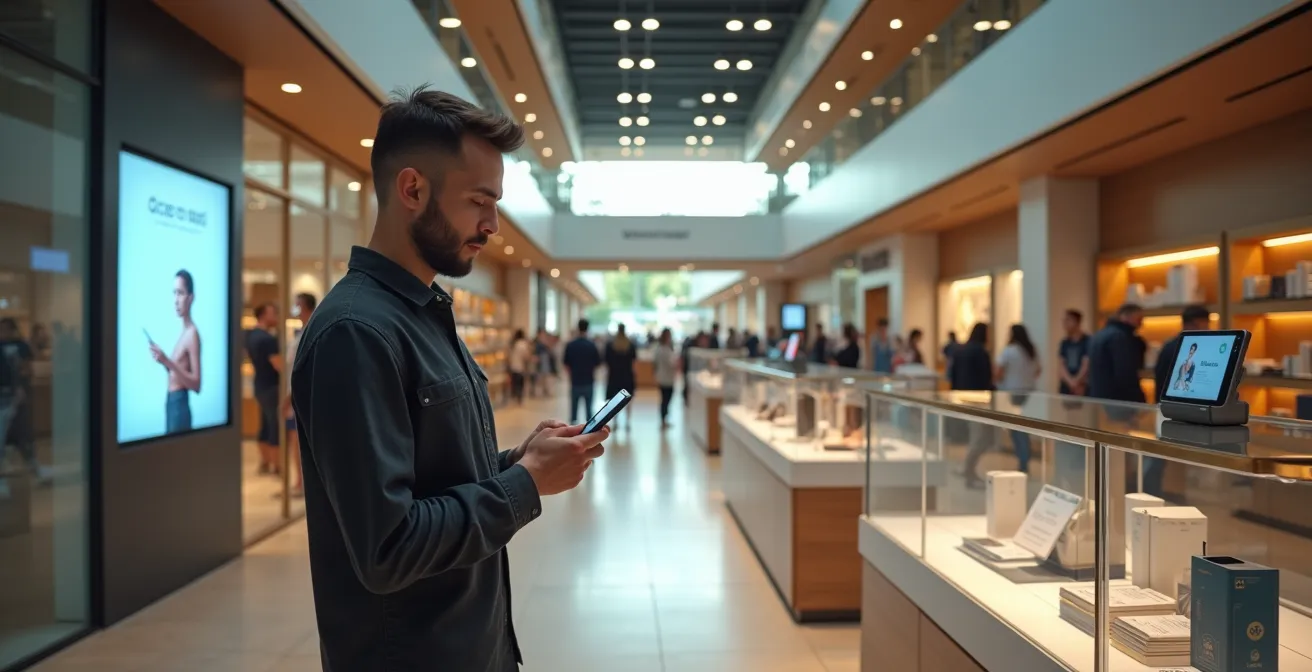
Achieving a 40% lift in loyalty usage isn’t about adding more features; it’s about systematically eliminating the operational friction between your digital and physical stores.
- Disconnected data silos are the primary barrier, leaving staff blind to the customer’s journey and unable to provide personalized service.
- High-friction app logins and poorly designed click-and-collect flows actively discourage in-store digital engagement and kill impulse purchase opportunities.
Recommendation: Shift focus from launching new initiatives to conducting a “friction audit” of your existing data systems, in-store processes, and staff training to create a truly seamless experience.
As a retail manager, you’ve invested heavily in a loyalty app, an e-commerce platform, and digital tools. Yet, you still see the disconnect every day: a customer in-store asks about a product they viewed online, and your staff has no idea. A shopper tries to use their loyalty app at the checkout, but a clunky login process forces them to give up. These moments aren’t just minor inconveniences; they are fractures in the customer experience that erode loyalty and leave revenue on the table.
The common advice is to “unify the customer view” or “personalize the journey.” While true, these platitudes ignore the root cause of the problem. Most omnichannel strategies fail not because of a lack of ambition, but because they overlook the small but critical points of friction in the operational chain—in data visibility, in-store workflows, and staff enablement. The result is a collection of siloed channels masquerading as an integrated experience.
But what if the key to unlocking that 40% increase in loyalty card usage wasn’t a new feature, but a forensic focus on removing what’s already broken? This guide provides a strategic framework for conducting a “friction audit.” We will move beyond high-level concepts to dissect the specific operational hurdles that prevent seamless retail integration and provide a clear roadmap for resolving them, transforming disconnected touchpoints into a powerful, loyalty-building ecosystem.
This article dissects the core challenges and presents actionable solutions for creating a truly integrated customer journey. Explore the key areas where friction arises and learn how to resolve them to boost loyalty and sales.
Summary: The Friction Audit for a Seamless Omnichannel Experience
- Why Your Staff Can’t See what The Customer Bought Online Yesterday?
- How to Design a Click-and-Collect Flow That Drives Impulse Buys?
- Points vs Perks: Which Reward Structure Drives Frequent Visits?
- The Login Barrier That Stops Customers Using Your App In-Store
- In Which Order Should You Train Staff on New Omnichannel Tools?
- How to Connect Your Physical Store POS With Your Online Store Inventory?
- How to Use Regional Data to Stock the Right Sizes in the Right Stores?
- How Omnichannel Consistency Prevents UK Customers From Abandoning Carts?
Why Your Staff Can’t See What The Customer Bought Online Yesterday?
The most significant point of friction in any omnichannel strategy is the information gap between your digital and physical worlds. When a customer interacts with your brand online—browsing, adding to cart, or making a purchase—they create a data trail. Yet, when they walk into your store the next day, they effectively become a stranger. This disconnect stems directly from entrenched data silos, where customer, inventory, and order information are locked in separate, non-communicating systems.
This isn’t just a technical problem; it’s a customer experience disaster. It prevents your staff from offering relevant recommendations, resolving issues efficiently, or even acknowledging a customer’s loyalty status. The result is a clunky, impersonal interaction that makes the customer feel unseen and undervalued. This is a widespread issue; according to recent research, 43% of companies identify data silos as their primary obstacle to a seamless omnichannel experience. Without a single, accessible source of truth, your team is flying blind.
Breaking down these silos requires a shift towards “data empathy”—designing systems from the customer’s perspective. It means implementing a unified commerce platform that merges online and offline data into a single, real-time profile. This empowers your staff with the context they need, turning a potentially frustrating interaction into a personalized and loyalty-building moment. The goal is for your team to know, “This is Jane; she bought a blue dress online yesterday and has been a loyalty member for three years.” That level of insight is the foundation of true omnichannel service.
How to Design a Click-and-Collect Flow That Drives Impulse Buys?
Click-and-collect should be more than a logistical convenience; it should be a powerful engine for in-store revenue. Too often, retailers treat it as a back-of-house function, tucking the pickup counter away in a forgotten corner. This approach completely misses the opportunity to engage a high-intent customer who is already in a buying mindset. The key is to transform the collection point from a simple counter into a curated “experience hub” designed to spark curiosity and drive impulse purchases.
Instead of a sterile transaction, the pickup process should feel like an extension of the shopping journey. This involves strategically placing the collection hub in a high-traffic area, often near the entrance, and surrounding it with carefully selected complementary products, new arrivals, and best-sellers. The goal is “flow monetization”: designing the customer’s physical path to maximize exposure to relevant items. This strategy has a proven impact; data shows that among top retailers, offering curbside pickup increased conversion rates by 25.8% by bringing shoppers to the store.
The design of the space is critical for turning a logistical task into a shopping opportunity. A well-lit, branded area with a welcoming associate can make a significant difference.

As shown here, the interaction itself is an opportunity. Staff should be trained not just to hand over a package, but to engage the customer. A simple question like, “Did you see our new collection that just arrived?” can seamlessly transition the customer from collection to browsing. By rethinking the click-and-collect flow as a strategic marketing touchpoint, you can convert a cost center into a significant and predictable source of incremental revenue.
Points vs Perks: Which Reward Structure Drives Frequent Visits?
Designing a loyalty program that genuinely drives repeat business requires moving beyond the traditional “earn-and-burn” points model. While points-based systems are easy to understand, they often fail to create an emotional connection or drive the specific behaviors you want, like frequent store visits. The modern customer, accustomed to instant gratification, responds better to tangible, immediate benefits. This is where perks-based and hybrid models demonstrate their power.
As Łukasz Słoniewski, CEO at Omnivy, notes in a retail loyalty webinar, “Omnichannel loyalty programs typically drive higher engagement and customer lifetime value compared to traditional single-channel programs.” Perks like free shipping, early access to sales, or exclusive in-store experiences feel more valuable and personal than a small discount down the line. A hybrid model, combining the slow-burn appeal of points with the instant reward of perks, often yields the best results. For example, the highly successful Starbucks Rewards program allows customers to earn “Stars” (points) but also provides immediate perks like free refills and birthday treats, all managed seamlessly between their app and in-store NFC payments.
A comparison of different models reveals a clear winner for engagement and lifetime value. While a simple points program can provide a modest lift, a truly integrated omnichannel approach that leverages perks delivers superior results across the board.
| Metric | Points-Based Programs | Perks-Based Programs | Hybrid Omnichannel |
|---|---|---|---|
| Customer Lifetime Value | 20% increase | 25% increase | 30% higher for omnichannel |
| Engagement Frequency | 1.7x baseline | 2.1x baseline | 250% higher purchase frequency |
| Cross-Channel Behavior | Limited | Moderate | Seamless across all touchpoints |
| Retention Rate | 65% | 72% | 89% for strong omnichannel |
| Implementation Complexity | Low | Medium | High but highest ROI |
Ultimately, the most effective loyalty structure is one that removes friction and embeds itself in the customer’s daily life. The choice is clear: while points are a start, a hybrid omnichannel program rich with perks is the key to creating the kind of sticky loyalty that drives frequent, high-value visits.
The Login Barrier That Stops Customers Using Your App In-Store
You have a powerful, feature-rich loyalty app. The problem? Your customers aren’t using it where it matters most: inside your physical store. The single biggest culprit is the login barrier. When a customer is ready to check out or wants to look up a product, being asked to stop, find your app, and manually type a password creates a moment of high friction that most will simply abandon. This is a critical failure, as in-store app usage is a cornerstone of omnichannel engagement.
The context for this failure is clear: customers are already on their phones. In fact, research shows that 72% of shoppers use their smartphones for comparing prices or reading reviews while on the floor. They are primed for a digital interaction, but a clunky authentication process acts as a wall. The solution is to make logging in so effortless it becomes invisible. This means shifting from active authentication (passwords) to passive authentication methods that recognize the customer automatically.
This isn’t futuristic; the technology is available today. By leveraging a store’s Wi-Fi, NFC tap points, or QR codes at the point of sale, you can create a frictionless bridge between the customer’s physical presence and their digital profile. The goal is for the app to simply “wake up” and be ready the moment the customer needs it, without them having to think about it. Implementing these solutions removes the primary obstacle to in-store app adoption and opens the door to a truly connected experience.
Action Plan: Implementing Frictionless In-Store Authentication
- Map Customer Journey: Identify all in-store moments where app access is critical (e.g., entering, browsing, checkout) to prioritize authentication points.
- Inventory Tech Solutions: Evaluate existing infrastructure (Wi-Fi, POS) to determine the feasibility of passive authentication methods like Wi-Fi auto-login or NFC.
- Confront System Cohesion: Test how proposed solutions integrate with your current loyalty platform and POS systems to ensure seamless data flow.
- Assess User Experience: Pilot different methods (QR codes vs. NFC taps) with a small user group to gauge which is the most intuitive and memorable.
- Develop Integration Roadmap: Create a phased rollout plan, starting with the highest-impact solution (e.g., QR codes at POS) before investing in more complex infrastructure.
By systematically dismantling the login barrier, you empower customers to use the powerful tool you’ve built for them, directly increasing loyalty engagement and creating opportunities for personalized, in-store marketing.
In Which Order Should You Train Staff on New Omnichannel Tools?
Rolling out new omnichannel technology without a strategic training plan is like handing someone a key without telling them which door it opens. Staff enablement cannot be an afterthought; it must be a core pillar of your integration strategy. However, the common approach of a single, one-off training session is destined to fail. Effective training isn’t about teaching features; it’s about building operational confidence and instilling a customer-centric mindset.
The most effective training programs are tiered and continuous, mirroring the customer journey itself. The order of training should follow a logical flow:
- The “Why”: Start with the strategic vision. Before touching any tools, ensure every team member understands why a seamless experience is crucial for the customer and the business.
- The Core Tools: Focus first on the single most critical tool, likely the unified customer profile view on their POS or mobile device. Staff must master looking up a customer’s online history before anything else.
- The Process Scenarios: Move from tools to workflows. Role-play key scenarios like processing a click-and-collect order with an upsell, handling an in-store return of an online purchase, or assisting a customer using the app.
- The Empowerment Phase: Finally, train them on proactive service—using the data at their fingertips to surprise and delight customers with personalized recommendations.
This approach fosters collaboration and continuous learning, rather than information overload. It acknowledges that different team members, from new hires to seasoned veterans, will adopt technology at different paces.

Investing in this structured enablement pays significant dividends. Companies with well-integrated solutions see tangible results; for instance, integrated omnichannel solutions experience a 31% reduction in first-resolution times and happier customers. Ultimately, your technology is only as good as the people using it. A phased, confident-building training sequence ensures your team becomes the crucial human link in your omnichannel chain.
How to Connect Your Physical Store POS With Your Online Store Inventory?
Inventory inaccuracy is the silent killer of omnichannel retail. Nothing frustrates a customer more than seeing an item “in stock” online, only to find the shelf empty when they arrive at the store. This disconnect not only results in a lost sale but also severely damages brand trust. The root of this problem lies in outdated inventory management systems that rely on slow, periodic updates instead of a live, unified view. The solution is to connect your physical POS directly to your e-commerce inventory through real-time API integration or a unified commerce platform.
Traditional systems often use “batch processing,” where inventory counts are updated once overnight. In a fast-paced retail environment, this is wholly inadequate. A single day’s sales can render the data obsolete, leading to a high risk of stockouts and over-promising. A real-time connection ensures that every time an item is sold in-store, the online inventory is updated within seconds, and vice-versa. This level of accuracy is no longer a luxury; it’s a baseline expectation for modern shoppers and has a direct impact on the bottom line.
The technical approach you choose has significant implications for accuracy, cost, and capability. While a full unified commerce platform offers the highest fidelity, a real-time API integration can be a powerful step up from legacy batch systems.
| Aspect | Batch Sync (Traditional) | Real-Time API Integration | Unified Commerce Platform |
|---|---|---|---|
| Update Frequency | Daily/Overnight | Every 5-15 minutes | Instant (milliseconds) |
| Inventory Accuracy | 70-80% | 90-95% | 98-99% |
| Lost Sales from Lag | High (5-8% of orders) | Moderate (2-3%) | Minimal (<1%) |
| Implementation Cost | Low | Medium | High initial, low ongoing |
| Ship-from-Store Ready | No | Limited | Full capability |
By achieving a single, real-time view of inventory across all locations and channels, you unlock critical omnichannel capabilities like accurate stock availability, buy online/pickup in-store, and ship-from-store. This isn’t just about preventing disappointment; it’s about turning your entire network of stores into a distributed, agile fulfillment center, creating a more resilient and profitable retail operation.
How to Use Regional Data to Stock the Right Sizes in the Right Stores?
A one-size-fits-all inventory strategy is a recipe for missed sales and excess stock. Customer preferences and even physical sizing can vary significantly from one region to another. A store in a bustling city center may serve a younger demographic with a preference for smaller sizes, while a suburban location might cater to families needing a different size curve. Using regional data to inform your stocking strategy is a crucial, yet often overlooked, aspect of inventory personalization.
The data you need to make these decisions is likely already at your fingertips. By analyzing online browsing behavior from specific geographic IP ranges, tracking regional return patterns for “wrong size” reasons, and monitoring sales data from local stores, you can build a detailed picture of demand. This allows you to move beyond broad assumptions and create data-driven micro-clusters. For example, you might discover that your Miami store sells a disproportionate amount of size Small, while your Denver location needs more stock in size Large.
This granular approach to inventory management is a powerful form of personalization that customers feel directly. When they consistently find their size in stock at their local store, it builds confidence and loyalty. The impact is substantial, as data confirms that a personalized shopping experience makes customers far more likely to return. This data-driven framework also enables more efficient workflows, such as implementing predictive stocking based on local web traffic or enabling rapid store-to-store transfers to meet localized demand spikes.
Instead of guessing, you are letting your customers’ collective behavior dictate your inventory allocation. This not only improves customer satisfaction and reduces lost sales from stockouts but also minimizes the need for costly end-of-season markdowns on unwanted sizes. It’s a smarter, more responsive way to manage your most valuable asset: your inventory.
Key Takeaways
- Data Silos Are the Enemy: A disconnected customer view is the #1 cause of omnichannel failure, making personalized service impossible.
- Friction Kills Engagement: Clunky logins and poorly designed in-store flows actively discourage customers from using your digital tools.
- Consistency Creates Trust: A seamless, predictable experience across all channels is what truly prevents cart abandonment and builds lasting loyalty.
How Omnichannel Consistency Prevents UK Customers From Abandoning Carts?
In the competitive UK retail market, customer loyalty is earned through consistency. A shopper who has a seamless experience online, a helpful interaction in-store, and a simple pickup process feels confident and valued. Conversely, a brand that offers conflicting information on pricing, stock, or promotions between its channels creates confusion and distrust. This lack of cross-channel consistency is a primary driver of cart abandonment and customer churn.
Every inconsistency is a point of friction that gives the customer a reason to pause and reconsider their purchase. Imagine a UK shopper who sees a “20% off” promotion on your app but finds it’s not honored in-store, or who is quoted one delivery time online and another by customer service. These moments break the implicit promise of a unified brand experience. They force the customer to do the work of connecting the dots, a task they will quickly abandon for a competitor who offers a smoother journey.
Achieving true consistency requires a deep, systemic commitment to unified commerce, where your e-commerce platform, POS systems, and marketing channels all draw from the same well of data and business logic. When pricing, promotions, customer data, and inventory are harmonized, the experience becomes predictable and trustworthy from the customer’s perspective. The business impact of this consistency is immense. Companies with strong, cohesive omnichannel strategies see a significant revenue advantage over their less-integrated peers. For instance, robust omnichannel customer engagement can lead to an impressive 9.5% year-over-year surge in annual revenue, far outpacing the growth of weaker counterparts.
To truly drive loyalty and capture a 40% increase in engagement, you must shift your focus from adding features to eliminating these fundamental inconsistencies. Begin your omnichannel friction audit today to transform disconnected touchpoints into a seamless, loyalty-building ecosystem that UK customers can trust.